

 ELECTRIC
Why Speed Feels Different in Sedans vs SUVs
 Add CarBike360 on Google
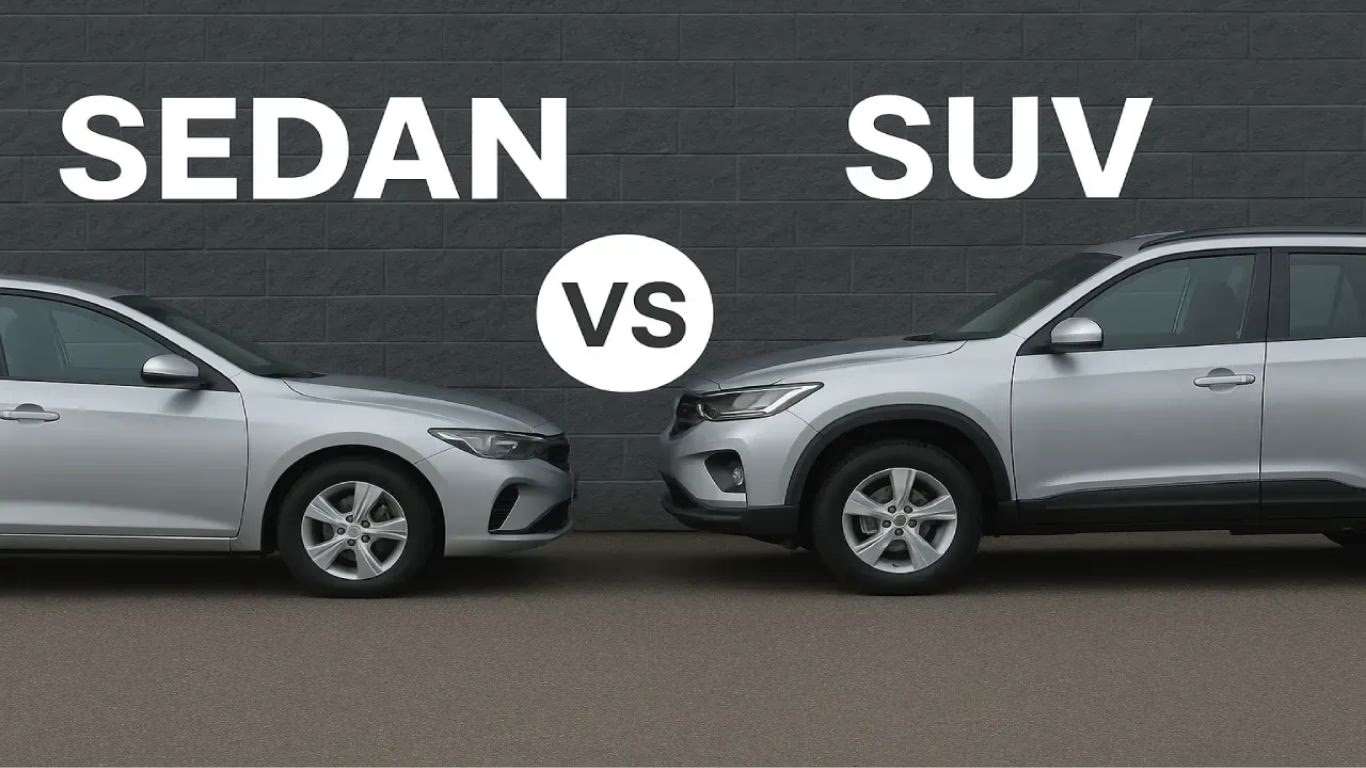
Sedans feel thrillingly fast from low seats and intense road cues; SUVs feel slower and calmer due to high seating and quiet isolation.

Mar 06, 2026 05:32 am IST
Published On
Mar 06, 2026 05:29 am IST
Last Updated On
Mar 06, 2026 05:32 am IST
Key Highlights:
- Lower seating in sedans creates a stronger optic flow speed feels much faster and more thrilling.
- Higher seating in SUVs reduces visual cues, same speed feels calmer and slower.
- Sedansoffer more road noise, vibration & planted handling; SUVs provide quiet isolation and less sensation of speed.
Have you ever floored it on the highway in your trusty sedan, heart racing as the world blurs by, only to glance at the speedometer and realize you’re “only” doing 100 km/h? Then you switch to the family SUV for a weekend getaway, and suddenly the same stretch of road at the same speed feels like you’re barely moving, like you could sip coffee and chat without a care. You’re not crazy, and it’s not just your imagination. This mind-bending difference in how speed feels between sedans and SUVs is rooted in hard science: a mix of human psychology, vehicle physics, and clever (or not-so-clever) engineering choices.
Here, we’ll unpack exactly why the sensation of speed varies so dramatically. We’ll explore optical illusions created by your seating position, the role of noise and vibrations, handling dynamics, aerodynamics, and the surprising safety implications. Backed by real studies, easy-to-understand analogies, comparison tables, and visual charts, you’ll walk away understanding why sedans often deliver that exhilarating “rush” while SUVs feel calmer and more composed even at identical speeds. Whether you’re a thrill-seeking driver, a safety-conscious parent, or just shopping for your next ride, this guide will change how you think about every highway merge.
Read More: Renault Safety Features Explained
Optic Flow Magic: How Your Driver’s Seat Height Tricks Your Sense of Speed
The biggest culprit behind the “speed feels different” mystery is something psychologists call optical flow, the way the world streams past your eyes as you move. Your brain doesn’t just trust the speedometer; it calculates velocity from how quickly roadside textures (asphalt lines, grass, guardrails) blur by in your peripheral vision. And here’s the twist: the height of your eyes above the road completely changes that calculation.
In a typical sedan, your eyes sit just 1.05 -1.2 meters off the ground. The road rushes right under your window like a high-speed conveyor belt. Every crack in the pavement, every painted line whips past in a frenzy of motion. Your brain screams “FAST!” even if the speedo says 100 km/h. It feels intense, connected, and thrilling like you’re in a low-slung sports car hugging the tarmac.
Flip to an SUV or crossover, and your eyes are perched 1.4 –1.6 meters up (sometimes higher in full-size models). The ground is farther away, so the same road details appear to move in slow motion. It’s the same optical trick you experience looking out of an airplane window at 30,000 feet. The higher you go, the slower the landscape seems to crawl. The horizon shifts more gently, and peripheral blur is reduced. Result? The same 100 km/h feels relaxed, almost lazy, like you’re gliding along at 80 km/h or less.
This isn’t theory, it’s proven in driving simulator studies. In landmark research by Christina M. Rudin-Brown (2004 and 2006), participants drove identical routes but with their seat heights adjusted to mimic a low sports car versus a tall SUV. When viewing from the higher “SUV” eye height, drivers consistently chose faster actual speeds because it felt slower to them. They showed more speed variability and struggled to stay centered in their lane without constant speedometer checks. The conclusion? High seating makes you underestimate speed, leading many SUV owners to unintentionally cruise faster than they realize.
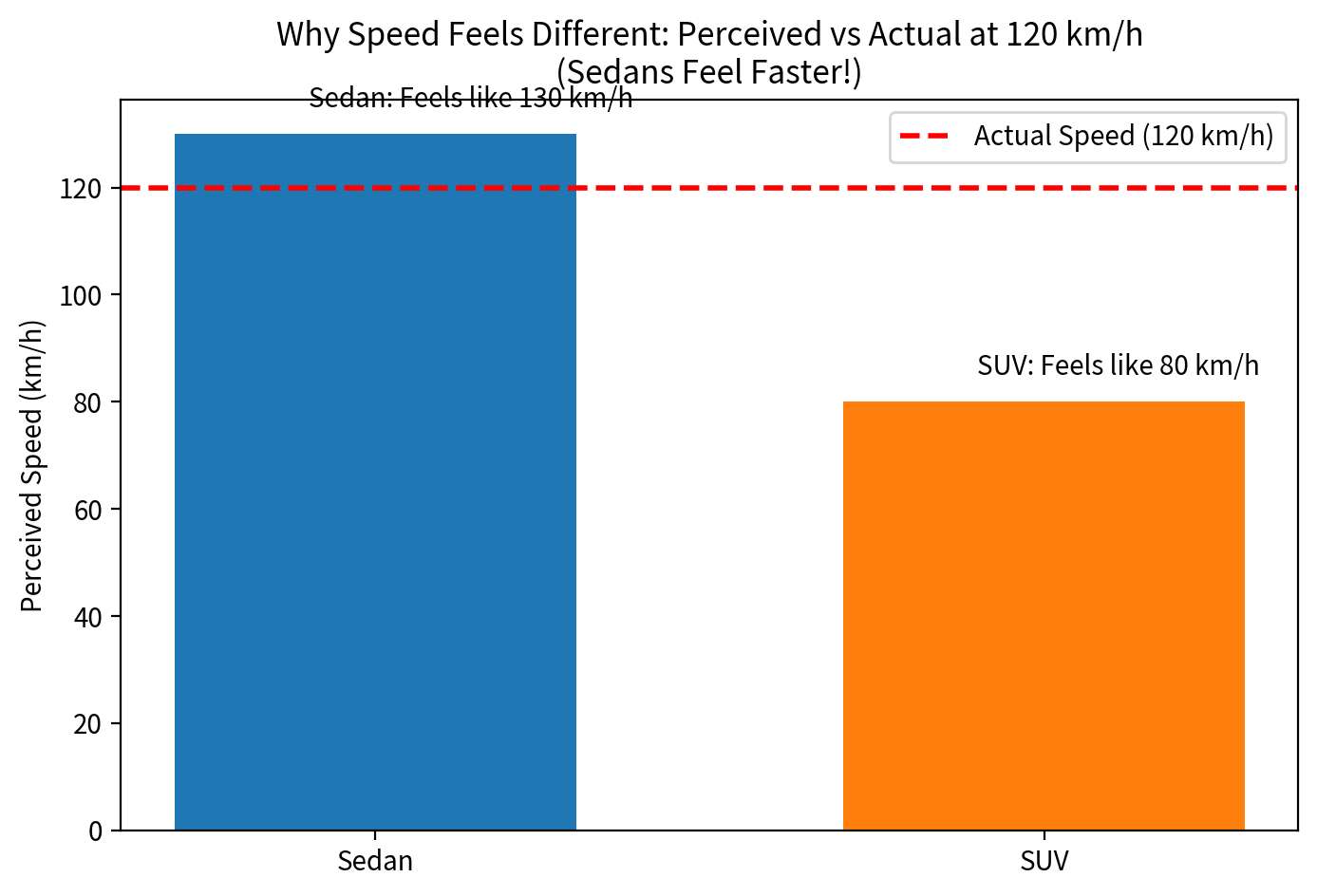
Here’s a perfect illustration from real-world testing: at an actual 120 km/h, most people in a sedan report it feeling like 130 km/h (fast and alert), while in a modern crossover SUV, it registers as a calm 80 km/h (slow and serene).
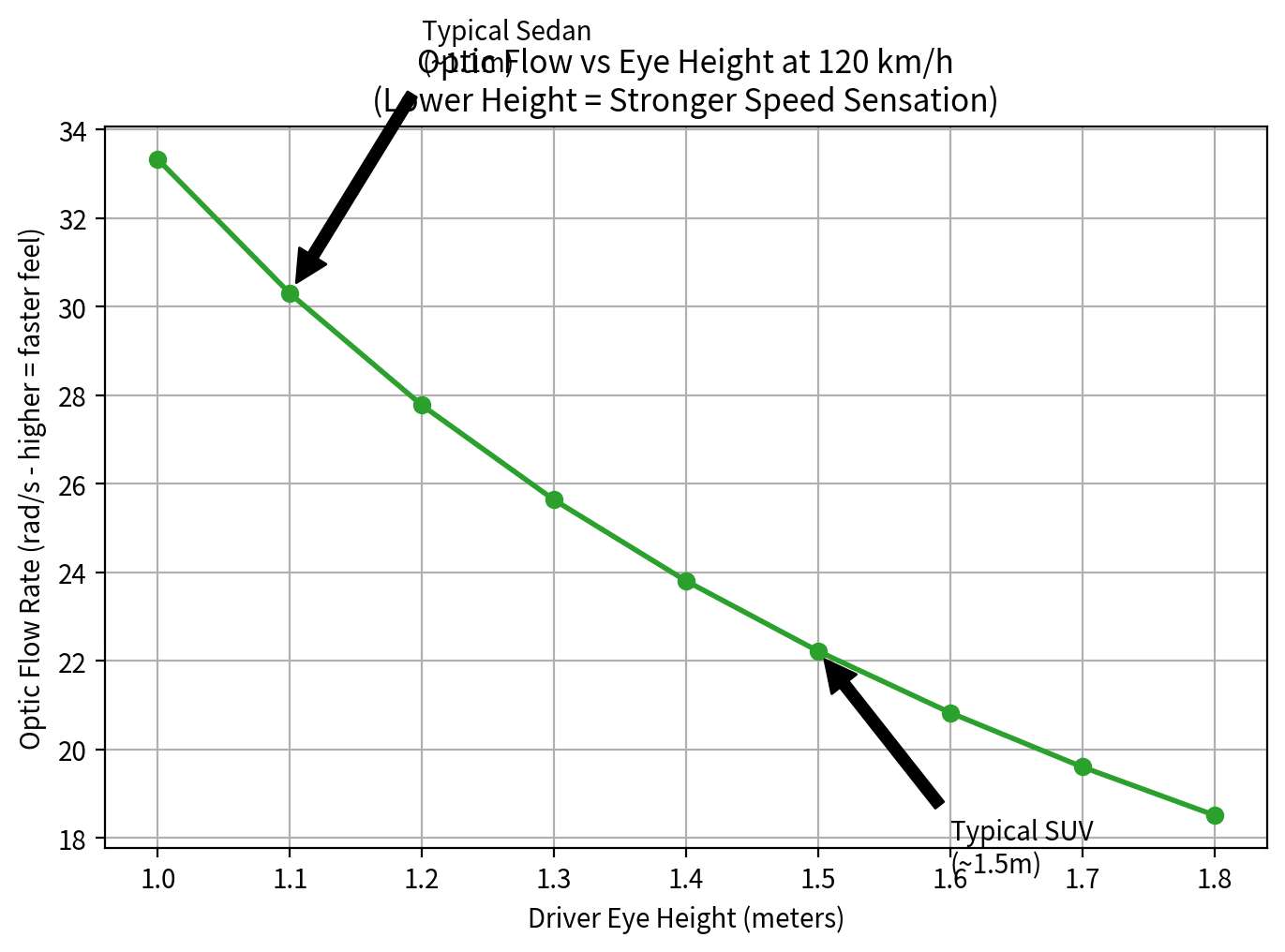
The chart above visualizes this perfectly. The optic flow rate (a proxy for how “fast” the road feels) drops sharply as eye height increases. Notice the steep decline between the typical sedan (1.1 m) and SUV (1.5 m) heights. Lower seats = stronger visual cues = more excitement.
This effect is amplified in peripheral vision. Sedans put the rushing road smack in your lower field of view; SUVs push it lower and farther, diluting the intensity. Racing video games exploit the same principle by cranking up peripheral blur to make even moderate speeds feel epic. Next time you’re behind the wheel, try this experiment (safely, on a straight road): focus on the road texture just ahead versus far ahead. You’ll instantly feel the difference.
Read More: Kia Seltos X-Line vs HTX-Line
Thrill vs Tranquility: Noise, Vibrations, Handling, and Aerodynamics That Amplify the Difference
Optical flow gets most of the credit, but it’s only the start. Your entire body experiences speed through a symphony of sounds, vibrations, and forces, and sedans and SUVs are tuned like completely different instruments.
Noise & Vibration (NVH - Noise, Vibration, Harshness): Sedans usually deliver more raw feedback. You hear the wind whistling over the low roofline, feel the tire roar through the steering wheel, and sense every subtle road imperfection. These constant cues act like a built-in speedometer for your senses, keeping you alert and engaged. Many SUVs, by design, create a “living room on wheels” effect with thicker insulation, acoustic glass, and active noise cancellation. The cabin goes quiet. No roar, minimal buzz. Suddenly, speed feels detached and effortless, but that isolation can trick you into pushing the pedal harder without realizing it.
Some SUVs actually generate more wind noise because of their boxier shape, but the overall insulation often mutes the thrill compared to a sedan’s direct connection.
Handling and Center of Gravity: Sedans sit low with a low center of gravity (CoG). They corner flat, stay planted, and give you immediate confidence at speed. Body roll is minimal; the car feels glued to the road. SUVs, with their taller stance and higher CoG, lean noticeably in turns and exhibit more pitch under braking or acceleration. That extra movement can make speed feel either more dramatic (due to sway) or floaty and less secure. On straight highways, however, the SUV’s softer suspension and taller tires absorb bumps beautifully, smoothing out the ride and further reducing the “I’m going fast” sensation.
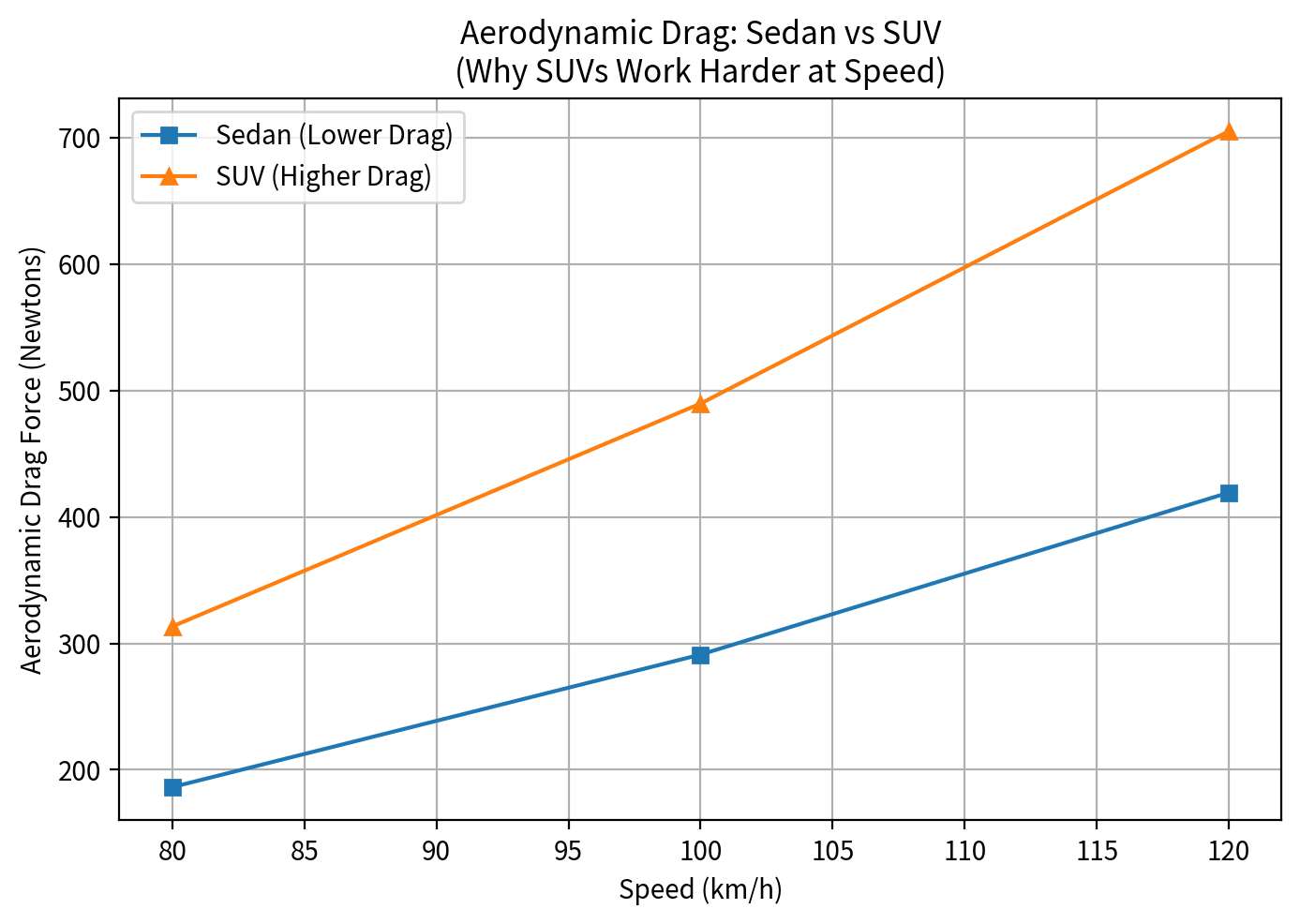
Aerodynamics and Drag: Here, the numbers tell a dramatic story. Sedans are sleek and slippery, slicing through air with drag coefficients (Cd) around 0.25-0.30 and smaller frontal areas. SUVs battle boxy fronts, tall roofs, and larger surfaces, with typical Cd 0.35-0.40. At highway speeds, that translates to significantly more aerodynamic drag force pushing back.
Look at the drag force chart above: at 100 km/h, a typical sedan fights roughly 304 N of air resistance, while an SUV battles 481 N, nearly 60% more. By 120 km/h, the gap widens to 438 N versus 692 N. Sedans feel effortless and planted; SUVs require more engine effort, sometimes accompanied by subtle buffeting or whooshing sounds that heighten awareness differently. The extra work can make speed feel more “present,” yet combined with the high seating, the overall sensation often remains calmer.
Here’s a quick side-by-side comparison to make it crystal clear:
Factor | Sedan | SUV / Crossover | Impact on Speed Sensation |
|---|---|---|---|
Eye Height | 1.1 m | 1.5 m | Sedan: Intense optic flow thrill; SUV: Calm underestimation |
Center of Gravity | Low - flat cornering | Highly noticeable body roll | Sedan: Planted confidence; SUV: Floaty or cautious feel |
Cabin Feedback (NVH) | More road/wind noise & vibration | Heavy insulation & quiet ride | Sedan: Connected excitement; SUV: Isolated serenity |
Aerodynamic Drag @ 120 km/h | 438 N | 692 N (58% higher) | Sedan: Effortless glide; SUV: More audible effort |
Suspension Tuning | Firmer, responsive | Softer, comfort-focused | Sedan: Direct thrill; SUV: Cushioned calm |
Real drivers notice this constantly. Switch from a Honda Civic sedan to a CR-V SUV on the same route, and you’ll likely catch yourself creeping 10-15 km/h faster in the SUV without meaning to. Luxury crossovers with hybrid powertrains add another layer of silent electric acceleration, and no gear shifts make 120 km/h feel like 60 km/h. Many modern cars even pipe in fake engine noise through speakers to counteract this detachment.
Why This Matters: Safety Risks, Real-World Tips, and Choosing the Right Vehicle for You
This perceptual gap isn’t just fun trivia; it has real safety consequences. Because SUV drivers often underestimate their speed (thanks to high seating and isolation), they tend to drive faster than intended. Combine that with a higher center of gravity, and you get elevated rollover risks, especially in emergency maneuvers. Studies link this exact underestimation to higher crash statistics in taller vehicles. Sedans, by making speed feel more immediate, naturally encourage more cautious driving.
So what can you do?
- Calibrate consciously: Glance at the speedometer every few minutes, especially in SUVs. Use cruise control more often.
- Trust your senses but verify: If the road feels too calm, you’re probably going faster than you think.
- Test drive smartly: When shopping, drive both body styles back-to-back on the same highway stretch. Note how 100 km/h actually feels.
- Tech helpers: Many new cars offer head-up displays, speed limit warnings, or adaptive cruise that take the guesswork out.
Choosing your ride? Speed enthusiasts and corner-carvers: go sedan for that visceral thrill and planted confidence. Families wanting command of the road, easier entry, and a smoother ride over potholes: an SUV wins, but stay vigilant about speed perception. Modern crossovers blur the line beautifully, offering SUV height with near-sedan handling in some models.
Ultimately, speed is more than a number on the dash; it’s a full-body experience shaped by physics and design. Sedans keep you honest and connected; SUVs wrap you in comfort and height at the cost of some raw sensation. Next time you’re on the road, you’ll know exactly why one vehicle makes your pulse race while the other keeps you cool and collected. Drive safe, drive aware, and enjoy the ride, whatever shape it takes.
Conclusion:
Sedans feel faster thanks to lower seating, intense optic flow, and direct road feedback, while SUVs feel calmer and slower due to higher eye level, quiet cabins, and smoother isolation.


अपनी परफेक्ट कार खोजें

Budget

Brand

Body Type

Fuel

Mileage

More
नवीनतम कार वीडियो



अन्य कार लेख

Vihan AI - Your Car assistant
Ask me anything about cars, prices, and comparisons.