ELECTRIC
Why the Mini Countryman C Costs Less in India 2026?
 Add CarBike360 on Google
The Mini Countryman C costs ₹47.50 lakh — ₹17 lakh less than the JCW All4. Here's exactly how CKD assembly makes that possible.

Jun 17, 2026 12:41 pm IST
Published On
Jun 17, 2026 12:25 pm IST
Last Updated On
Jun 17, 2026 12:41 pm IST
Key Highlights
The Mini Countryman C is priced at ₹47.50 lakh (ex-showroom) — ₹17.40 lakh cheaper than the Countryman JCW All4 at ₹64.90 lakh
The price difference is largely driven by import duty savings from the CKD (Completely Knocked Down) assembly route
CBU cars in India attract import duty of 100–110%; CKD kits attract just 15–30% — a massive difference that directly impacts the sticker price
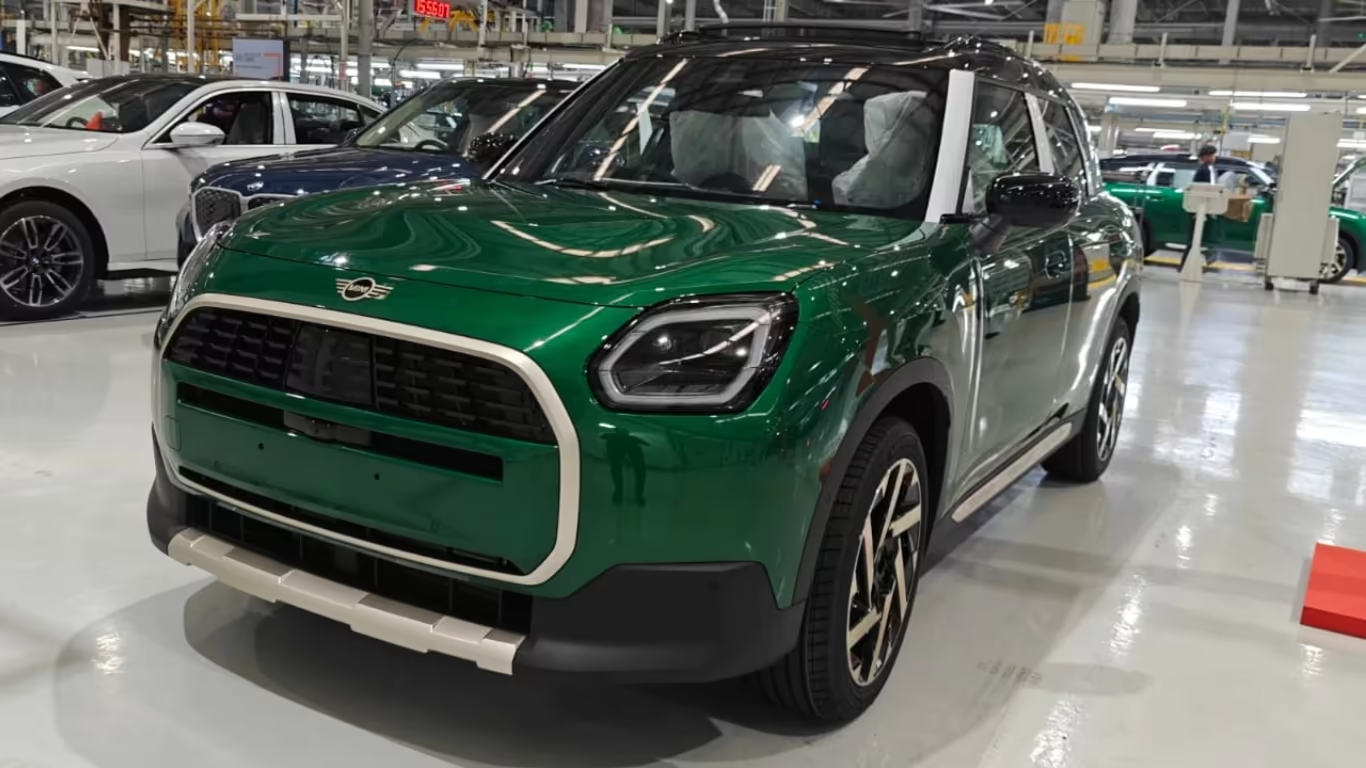
The Countryman C is assembled at BMW Group's Chennai plant — the same facility that builds the BMW X1, X3, X5, and 7 Series for India
This is not Mini's first time assembling the Countryman in India — previous generations were locally assembled in 2013 and 2018
CKD assembly does not compromise quality — all components are built to Mini's global specifications; only final assembly happens in India
The Countryman C is offered in a single, fully-loaded variant — no feature compromises despite the lower price
The Countryman Electric (₹54.90 lakh) and JCW All4 (₹64.90 lakh) continue as CBU imports, which explains their higher price tags
At first glance, the new Mini Countryman C's ₹47.50 lakh (ex-showroom) price tag looks surprisingly reasonable for a premium European SUV. But look a little closer, and an interesting question emerges.
The high-performance Countryman JCW All4 costs ₹64.90 lakh, while the Countryman Electric is priced at ₹54.90 lakh. That's a difference of up to ₹17.40 lakh between models that share the same Countryman nameplate and, broadly speaking, the same underlying vehicle.
So what's driving such a massive price gap?
The answer isn't a bigger engine, fewer features, or cheaper materials. Instead, it comes down to three letters that have transformed the way luxury cars are priced in India: CKD.
Short for Completely Knocked Down, CKD allows manufacturers to assemble vehicles locally rather than importing them fully built. The result? Lower taxes, lower costs, and significantly more competitive pricing for buyers.
In the case of the Mini Countryman C, this strategy has played a major role in making the SUV far more accessible than many expected. And once you understand how the CKD route works, you'll understand why it could save Indian luxury car buyers lakhs of rupees and not just on a Mini, but on many premium vehicles sold in India today.
What Exactly Is a CKD Car And How Is It Different From a Regular Import?
Let's start from the beginning, because this confuses a lot of people.
When a car brand wants to sell a foreign-made model in India, it has two broad options for how to bring that car into the country.
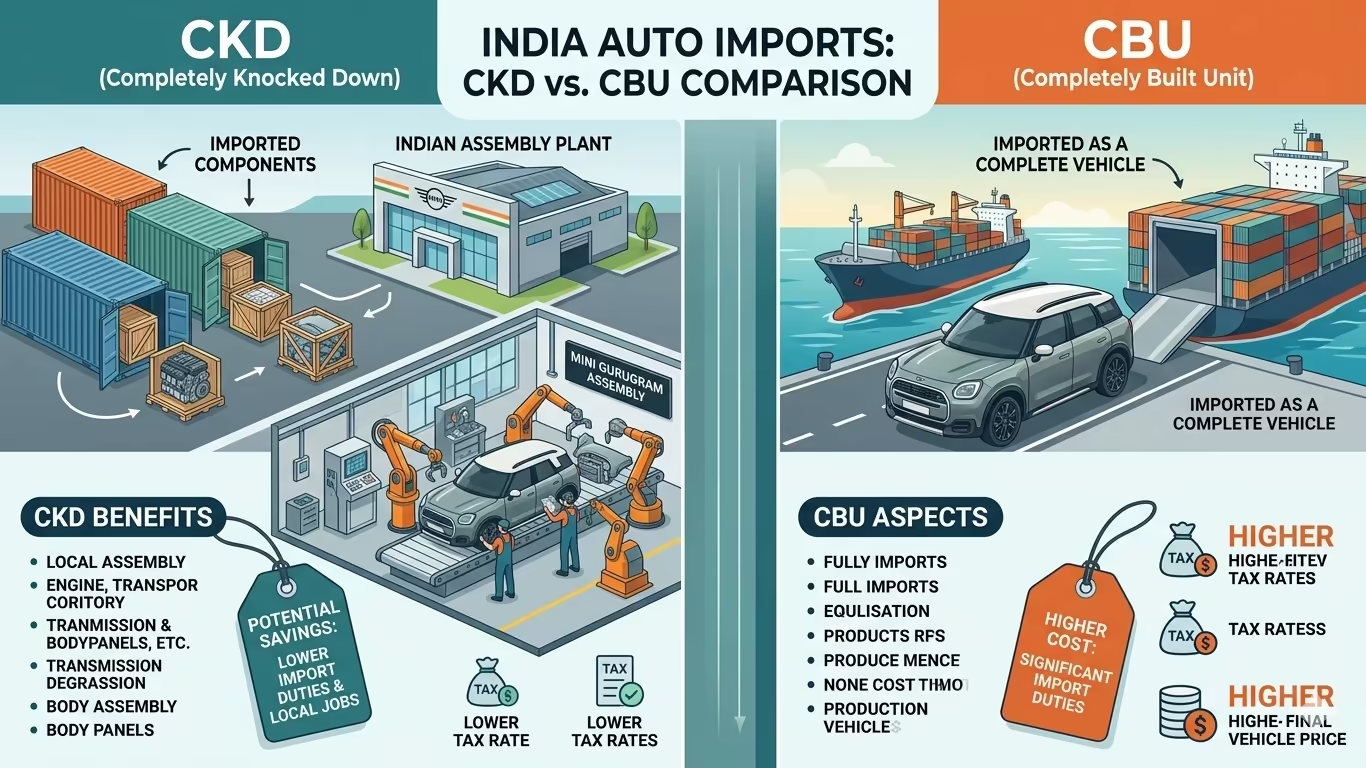
Option 1: CBU (Completely Built Unit): The car is fully assembled at a factory abroad (say Germany or the UK) and shipped to India as a complete, ready-to-drive vehicle. Think of it like ordering a fully cooked meal at a restaurant. It arrives complete. The Countryman JCW All4 and the Countryman Electric are both sold this way in India.
Option 2: CKD (Completely Knocked Down): The car's components such as the body panels, engine, gearbox, interior parts, electronics, are manufactured abroad, but shipped to India as a kit of parts. They are then assembled at a local facility. Think of it like receiving a ready-to-assemble furniture flat pack, except far more sophisticated. The Countryman C is assembled this way, at the BMW Group's plant in Chennai.
The difference in what you pay at the showroom comes down to one brutal reality: import duty.
How Much Does Import Duty Actually Add to a Car's Price in India?
This is where it gets real. India's import duty structure on cars is one of the highest in the world, and it's designed quite deliberately to incentivise local assembly over full imports.
A CBU car imported into India, a completely built, fully assembled vehicle that attracts import duty in the range of 100% to 110% of the car's assessed value, depending on engine displacement and vehicle price. Layer on top of that the Integrated GST (IGST) at 18% and additional cess, and you're looking at a total tax burden that can effectively double the car's ex-factory price before it even reaches a showroom.
CKD kits, on the other hand, attract a significantly lower import duty — roughly 15% to 30% depending on the content and localisation level. The government structures it this way intentionally: if you're going to bring a foreign car to India, at least create local jobs, support a local assembly facility, and contribute to the domestic manufacturing ecosystem.
The result? The same car, assembled locally from CKD kits, can land at a price that's dramatically lower than its fully-imported equivalent.
For the Countryman specifically, the JCW All4 and the Electric both arrive as CBUs and carry that full import duty burden in their ₹64.90 lakh and ₹54.90 lakh price tags respectively. The Countryman C, assembled in Chennai, sidesteps most of that duty hit, and passes the savings directly to you.
Where Is the Mini Countryman C Actually Being Assembled in India?
At the BMW Group's manufacturing plant in Chennai, Tamil Nadu, and this is not a new or experimental setup. BMW India has been operating this facility since 2007, and it has progressively expanded to become one of the most significant premium automotive assembly operations in the country.
The Chennai plant currently assembles 13 BMW and Mini models locally, including the BMW X1, X3, X5, 3 Series, 5 Series, and 7 Series. The Mini Countryman has actually been assembled here before — the first-generation Countryman started local assembly at Chennai in May 2013, and the second generation followed in 2018. This is not an experiment. It's a return to a proven playbook.
Importantly, the Countryman C shares its platform — the UKL2 front-wheel-drive architecture with the BMW X1, which is already assembled at Chennai. That means the plant already has the tooling, the trained workforce, and the supplier network in place for this exact platform. Assembling the Countryman C here is a natural, low-friction extension of existing operations.
Does Local Assembly Mean Lower Quality? Here's the Honest Answer
This is the question every savvy buyer will ask, and it deserves a straight answer.
No. And here's why you can say that with confidence.
CKD assembly does not mean the car is manufactured in India. The components: every panel, every mechanical part, every electronic module, are still made at Mini's European facilities to the exact same specifications as the cars sold anywhere else in the world. What happens in Chennai is the assembly of those parts, performed by BMW-trained technicians, on the same assembly processes that BMW uses globally.
BMW Group Plant Chennai's own management has stated publicly that every locally produced BMW or Mini car is built to the same international quality standards as any other BMW plant in the world. The facility has a localisation level of up to 50%- meaning components like certain interior parts, glass, and tyres are sourced locally but all core mechanical and structural components come from the same supply chain as every other Countryman built globally.
The short answer: the car you're buying is a genuine Mini Countryman, built to global standards. The only thing that changed is where the final assembly happened.
So What Does ₹47.50 Lakh Actually Get You?
Quite a lot, as it turns out. Mini is offering the Countryman C in a single, fully-loaded variant, and no entry-level trim, no stripping out of features to hit the price. For ₹47.50 lakh, you get a 1.5-litre three-cylinder turbocharged petrol engine making 134 bhp and 230 Nm, mated to a 7-speed dual-clutch gearbox. The cabin features a high-definition circular OLED infotainment display running Mini OS 9, a head-up display, panoramic sunroof, dual-zone climate control, premium audio, and a fabric-finished dashboard with champagne trim accents.
It is, by any measure, a well-equipped car at a competitive price for the premium compact SUVsegment, and it goes up against the BMW X1, Audi Q3, and Mercedes-Benz GLA with a genuinely distinctive personality that none of those cars can match.
Also read: Mini Countryman C launched at Rs 47.50 lakh in India
What Does This Mean for You as a Buyer?
Three things worth remembering when you walk into a Mini showroom.
First, the savings are real and significant. The ₹17.40 lakh gap between the Countryman C and the JCW All4 is not about one car being stripped-down and the other being premium. A significant portion of that gap is pure import duty money that, in the CBU model, goes to the government rather than to the car itself.
Second, you're not compromising on the product. CKD assembly at a BMW-certified plant is not a second-class manufacturing process. It's the same approach BMW uses to make its entire India lineup affordable and accessible- the X1 you've seen everywhere is also a CKD-assembled product.
Third, this is how the Indian premium car market works, and savvy buyers benefit from understanding it. When a brand commits to local CKD assembly, it signals long-term confidence in the Indian market. It means better parts availability, more responsive service, and typically more competitive pricing over the product's lifetime.
The Mini Countryman C at ₹47.50 lakh is not a discount product. It's what a Countryman should have cost in India all along, now that the brand has committed to doing it right.
Frequently Asked Questions
1.What does CKD mean in cars?
CKD stands for Completely Knocked Down. It refers to cars that are imported into India as a kit of parts and assembled locally, as opposed to CBU (Completely Built Unit) cars that arrive fully assembled from abroad.
2. Why are CKD cars cheaper than CBU cars in India?
CKD kits attract significantly lower import duty that is roughly 15–30%, compared to CBU cars, which can attract duties of 100–110% of the car's assessed value. This duty saving is passed on to buyers in the form of a lower sticker price.
3. Is the Mini Countryman C assembled in India?
Yes. The Mini Countryman C is assembled at the BMW Group's manufacturing plant in Chennai, Tamil Nadu, using CKD kits imported from Mini's European production facilities.
4. Does CKD assembly affect the quality of the car?
No. All components are manufactured to Mini's global specifications. Only the final assembly happens in India, performed by BMW-trained technicians at a plant that builds to international quality standards.
5. Why is the Mini Countryman C so much cheaper than the Countryman Electric and JCW All4?
The Countryman Electric (₹54.90 lakh) and JCW All4 (₹64.90 lakh) are both imported as fully built CBU units and carry the full import duty burden. The Countryman C's CKD assembly route significantly reduces the duty component, bringing the price down to ₹47.50 lakh.






अपनी परफेक्ट कार खोजें

Budget

Brand

Body Type

Fuel

Mileage

More