ELECTRIC
India’s soaring $160 billion energy import bill raises alarms over supply chain stability
 Add CarBike360 on Google
India imports 85% of its crude oil and over half its gas, resulting in a $160–165 billion annual bill. With low EV adoption and rising transport demand, experts urge a diversified energy strategy and improved efficiency.

By Utsav Chaudhary
Mar 24, 2026 11:57 am IST

India’s heavy reliance on imported energy has created significant vulnerabilities, as highlighted by Vikram Gulati, Country Head and Executive Vice President of Toyota Kirloskar Motor. He warns that ongoing geopolitical tensions, especially in West Asia, have exposed India to recurring global shocks. Gulati calls the current crisis a “wake-up call” for India to urgently rethink its approach to energy security, decarbonization, and industrial resilience.
Key Highlights
- India imports 85 percent of crude oil and over half of its gas needs
- The annual energy import bill stands at $160–165 billion, with crude oil at $137 billion
- The transport sector faces $30–35 billion annual import exposure, expected to rise
- EV penetration remains low at 4–5 percent across all segments
- Ethanol blending saves over ₹1.4 lakh crore but significant capacity remains untapped
India’s Energy Import Dependence
India imports nearly 85% of its crude oil and over half of its gas needs. This results in an annual energy import bill of $160–165 billion. Crude oil alone accounts for about $137 billion, while gas and coal add another $30–35 billion. The transport sector uses nearly one-fifth of India’s total energy and faces an annual import exposure of $30–35 billion. With rising vehicle ownership and freight movement, this figure is expected to increase further.
Global forecasts indicate that India’s passenger vehicle energy demand could grow three to four times by 2040. This growth will intensify the country’s dependence on external energy sources. Gulati stresses that India’s risks are now structural, not just cyclical, and that the country must pursue energy independence as quickly as possible.
Challenges in Decarbonisation and Policy
Despite policy efforts, electric vehicle (EV) adoption in India remains low, with overall penetration at about 4–5%. Gulati argues that relying on a single technology is insufficient. He advocates for a diversified approach, combining electrification, ethanol blending, flex-fuel vehicles, compressed biogas, hydrogen, and cleaner internal combustion engines. He states, “The real enemy is carbon and fossil fuel. It is not about one technology versus another.”
Affordability and a large legacy fleet shape India’s automotive market. Gulati highlights energy efficiency as an immediate opportunity. Unlike Europe, India lacks strong fiscal measures to promote efficient technologies. Even a 10–15% improvement in fleet efficiency could save billions in fuel imports. However, India’s simplified GST structure limits targeted incentives for cleaner technologies like hybrids and flex-fuel vehicles.
Opportunities in Ethanol and Biogas
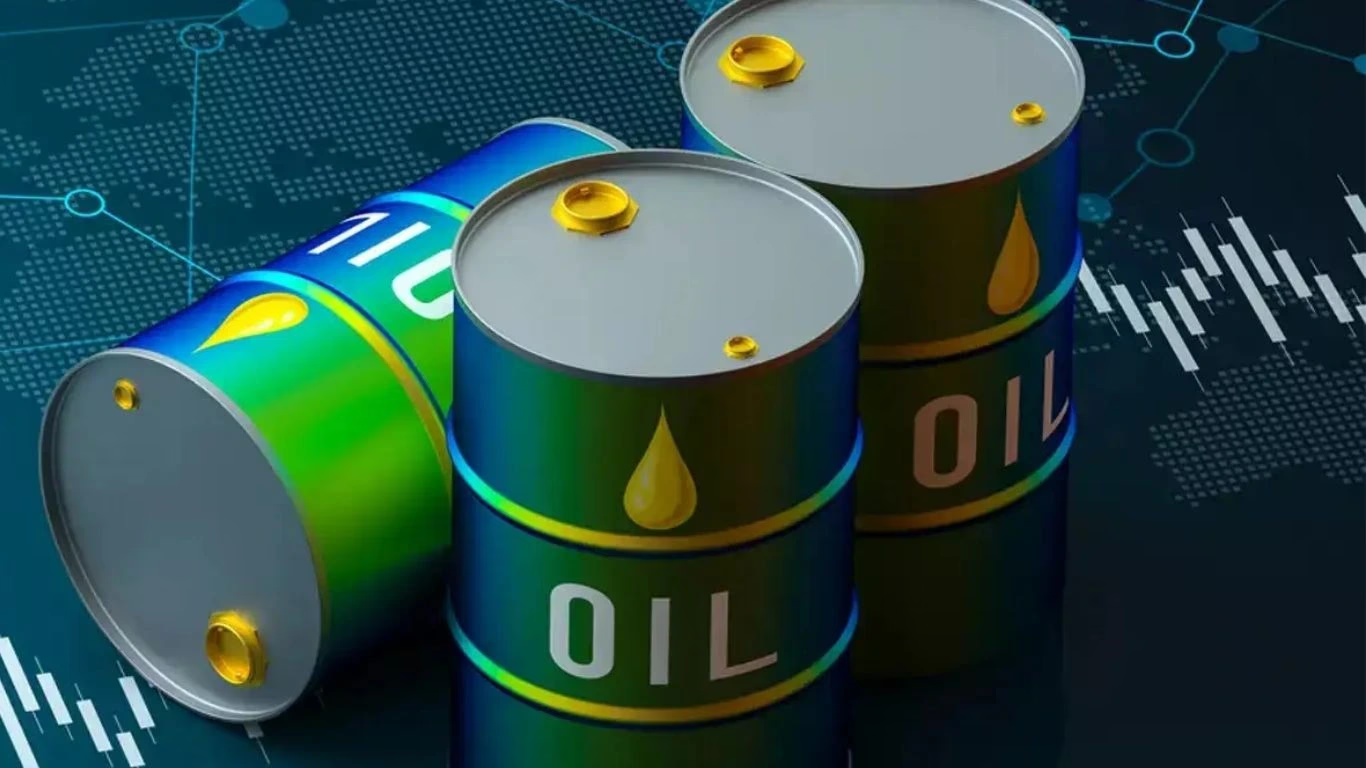
India’s ethanol blending program has reached E20 levels, saving over Rs 1.4 lakh crore in foreign exchange and supporting farmers. Yet, 500–600 crore litres of ethanol capacity remain untapped. Gulati suggests that flex-fuel vehicles could help unlock this potential more effectively than fixed blending mandates. Compressed biogas also offers opportunities, especially by using agricultural waste.
Supply Chain and Industrial Risks
The crisis in West Asia has highlighted the fragility of global supply chains. Disruptions now affect not only crude oil but also critical inputs like sulfur, carbon black, and fertilizers. These materials are vital for sectors such as automotive and agriculture. India’s manufacturing sector, deeply linked to global trade, faces cascading risks from such disruptions.
Gulati urges India to avoid copying global models without local adaptation. He recommends building on India’s strengths, such as its agricultural resources, cost advantages, and emerging technologies. He concludes that India must focus on its unique vulnerabilities and strengths to build resilience against future shocks.
Conclusion
India’s record $160 billion energy import bill serves as a serious reminder of its dependence on global supply networks. To secure long-term energy stability, the country must accelerate its renewable transition, diversify sourcing strategies, and enhance domestic production. Strengthening these foundations will be vital for India’s economic resilience and sustainable growth in the coming decade.


You May Like






Find your perfect car

Budget

Brand

Body Type

Fuel

Mileage

More
Latest Car Videos


Top Auto News of the Week: Tata Sierra EV, BMW X6, E85 Fuel & More - Weekly Wrap

Top Auto News of the Week | Hyundai i20 Leak, Honda ZR-V, Tata Sierra EV, Skoda EV & More!

Talking about new Honda City and upcoming ZR-V SUV with Honda India’s Kunal Bahl!

2026 Honda City Launched in India - Better than VW Virtus, Hyundai Verna & Skoda Slavia?
Other Car News
Listen to Car Audios