ELECTRIC
2026 Nissan Tekton vs 2026 Renault Duster: Differences Explained
 Add CarBike360 on Google
A concise comparison of the 2026 Nissan Tekton and Renault Duster covering styling, cabins, powertrains and pricing to help buyers choose.

Jul 13, 2026 04:53 am IST
Nissan has recently launched the all-new 2026 Nissan Tekton in India. With this, the brand has made its official debut in the midsize SUV segment for the Indian automotive market. However, this mid-size SUV is not the only major player in the market. A close rival has been interpreting before its official debut. The Nissan Tekton is close to the Renault Duster. Even though the Renault Duster is the biggest rival to the Tekton in the market. Still, they are close apart.
The 2026 Nissan Tekton and the 2026 Renault Duster share the same family DNA, but they are tuned for very different buyers. Both SUVs offer their own distinctive styling with similar features. The Renault Duster leans into rugged utility and strong safety credentials, while Nissan has given the Tekton a more premium, urban-friendly identity with a distinct design and richer cabin experience.
Let's take a closer look at these two competitors to see which one should be preferred: the 2026 Nissan Tekton or the Renault Duster.
2026 Nissan Tekton Vs Renault Duster: Exterior Design and Dimensions
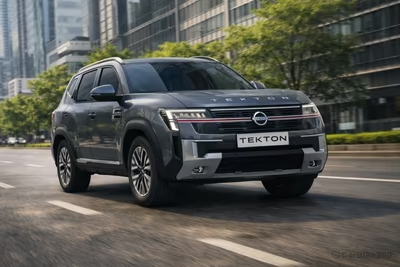
The recently launched Nissan Tekton takes its design proportions from the Nissan Patrol. The car offers a more muscular, boxy stance than the Renault Duster. By looking at the car from the front, we see an upright grille that features twin chrome slats induced by the slim LED headlights. A full-width C-shaped LED DRL connects the two headlights with a red strip underneath.
At the rear, Tekton offers a full-width LED light integrated into C-shaped taillamps. To make it more premium, a roof-mounted spoiler sits above the upright tailgate. While looking at the car from the side, it gets flared wheel arches designed for the all-new 18-inch alloy wheels. There's also a Tekton signature lettering on the tailgate.
The 2026 Renault Duster looks like an SUV that wants to be taken off the beaten path. Its design language is muscular and practical, with visible body cladding, strong shoulder lines, and an emphasis on robustness over ornamentation. However, the boot space is same in both the SUVs.
Cabin and comfort
Inside, the Renault Duster focuses on functionality. The official safety equipment page shows Renault pairing the SUV with a wide set of comfort and assistance features, including cruise control, hill start assist, 360-degree visibility support, and parking aids that fit its practical personality.
The Tekton is positioned as the richer-feeling cabin of the two. Launch coverage points to Google built-in, Google Maps, dual-zone climate control, ventilated seats, a panoramic sunroof, powered front seats, a powered tailgate, and a more premium upholstery and trim strategy. In short, the Duster is likely to feel more straightforward, while the Tekton aims to impress with convenience and polish.
That difference matters in daily use. Buyers who value durability and easy usability may gravitate toward the Duster, but those who want a more feature-loaded and visually upscale interior will likely find the Tekton more appealing.
Technology and features
Renault’s official safety page highlights a strong ADAS and driver-assistance package for the Duster, including adaptive cruise control, automatic emergency braking, lane departure warning, lane keeping support, blind spot detection, traffic sign recognition, and a 360-degree camera setup. It also lists 35 standard safety features, which makes the Duster one of the more thoroughly equipped SUVs in its class.
The Tekton is expected to match that ambition with a more premium feature mix. Reports around the launch mention adaptive cruise control, ADAS, a 360-degree camera, paddle shifters, wireless smartphone connectivity, electronic parking brake, and a smart powered tailgate. Nissan appears to be targeting a more tech-forward buyer who wants the equipment story to feel as modern as the styling.
One key distinction is the tone of the technology. Renault emphasizes broad safety coverage and practical driver aids, while Nissan is packaging its features in a more lifestyle-driven way, with extra attention to convenience and cabin theatre.
Safety equipment
Safety is one of the strongest talking points for the Renault Duster. It has secured a 5-star Bharat NCAP rating, with 30.49 out of 32 for adult occupant protection and 45 out of 49 for child occupant protection. Renault also states that its safety suite includes essentials such as six airbags, ABS, electronic stability control, hill start assist, TPMS, rear parking assistance, and multiple camera-based aids.
For the Tekton, the safety story is equally important, though the final official rating is not yet established in the sources reviewed. Early launch reporting indicates the SUV should offer Level 2 ADAS, six airbags, ESC, TPMS, 360-degree camera support, and a broad list of electronic safety systems. That should make it competitive on paper, even if the Duster currently holds the clearer safety advantage thanks to its confirmed crash-test result.
This is where the two SUVs diverge most clearly. The Duster already has proven credentials, while the Tekton is leaning on specification strength and Nissan’s premium positioning to win trust.
Engines and performance
Mechanically, the pair is closely matched. The Renault Duster is offered with a 1.0-litre turbo-petrol engine producing 100 PS and 160 Nm, and a more powerful 1.3-litre turbo-petrol engine delivering 163 PS and 280 Nm. The stronger unit can be paired with either a 6-speed manual or a 6-speed DCT, while the smaller engine is mated to a 6-speed manual.
The Nissan Tekton is expected to use the same engine family, which means a 1.0-litre turbo-petrol with 100 hp and 166 Nm, plus a 1.3-litre turbo-petrol with 163 hp and 280 Nm. The transmission spread also looks familiar, with a 6-speed manual and a DCT option on the stronger engine.


You May Like



Find your perfect car

Budget

Brand

Body Type

Fuel

Mileage

More
Other Car Articles
Listen to Car Audios