ELECTRIC
Does Your Car Need an AC Recharge? (Signs & Actual Costs)
 Add CarBike360 on Google
Learn the warning signs of a failing car AC, understand recharge and repair costs in India, and discover when a simple gas refill can restore cooling performance.

By Swati Tomar
Jun 19, 2026 12:28 pm IST
Published On
Jun 19, 2026 12:08 pm IST
Last Updated On
Jun 19, 2026 12:28 pm IST

On turning on your car’s AC, all you get is lukewarm air while expecting an icy blast of air, and this is no less than a nightmare.
While car nerds obsess over speed, power, torque, platform detail, zero to one hundred, and all the other major facets of a vehicle's performance, but when its 42°C outside, all this important stuff takes the backseat. And the thing that matters is how quickly the AC can stop you from sweating!
If you sweat more than you drive, then you may suspect your AC of a mechanical failure, or it may need a quick refill.
Without getting into fancy car talk, let’s dive into the things you need to know about the car AC recharge cost in India, the sure-shot warning signs for AC recharges, and what it might actually cost.
Your Car's AC is a Sealed Circle
Before inspecting the cost of AC recharge, let’s first understand the core concept of your car’s AC. Your car does not consume AC gas, which means that the refrigerant operates in a completely sealed, pressurized loop. If the car’s AC system operates perfectly and there are no defects or leakages, then the AC system would never need to be topped up because the gas has nowhere to escape.
Driving on uneven terrains and in unfavorable conditions, cars undergo a lot as they hit potholes, endure the temperature extremes, and get older with time and usage. As a result, there is degradation of the seals, rubber hoses, and other parts of the AC system. Due to such degradation issues, slow leaks are bound to happen, and this makes car AC gas refill cost in India, a crucial part of the long-term maintenance budget.
How to Tell if Your Car Needs an AC Recharge: 5 Warning Signs
There is a threshold for the coolant levels, and if your refrigerant goes below that, then your car’s AC system will reflect this in various predictable and unpredictable ways. It is important to spot these signs before they put a complete halt to the functions of your vehicle’s air conditioning system.
Here are some common signs indicating the need for an AC recharge.
Air flow does not feel cool enough- While the air coming out of the AC may not necessarily be hot, it does not feel cold enough to cool you down. It could be due to the low pressure of the system, which is not able to properly chill the incoming air.
AC compressor won't engage – there is a built-in low-pressure switch in the vehicle to protect the compressor; if you turn on the AC and do not hear a click or there is a sudden drop in engine RPM's, this means that your refrigerant level is critically low.
Oil build-up on fittings- When there is a refrigerant leak, the refrigerant will evaporate instantaneously when exposed to common air. These refrigerants also have a lubricant mixed with them. If you see greasy substances caked on the area of the car's AC hoses or fittings, this indicates that there is a leak.
Ice on metal lines- When refrigerant pressure drops significantly, the remaining refrigerant expands at a rapid pace. This happens due to loss of stored energy in the refrigerant as well as the metal it has evaporated through, causing surfaces to drop substantially in temperature below zero, resulting in blockage of airflow.
Also read: Tropicalized AC: How Citroen Engineered Its Cooling Systems for 45°C+ Indian Summers
Car AC Broken? Why a Gas Refill Might Not Fix It
If your car AC not cooling, then this could mean more than just a simple gas depletion. Before you take your car for an AC gas fill up, it is crucial to know if it needs only that service or if there I a major issue in the vehicle, such as a failed hardware component. Simply adding more gas is a temporary "band-aid" because the new gas will just leak out again. It is important to find and fix the broken part causing the leak.
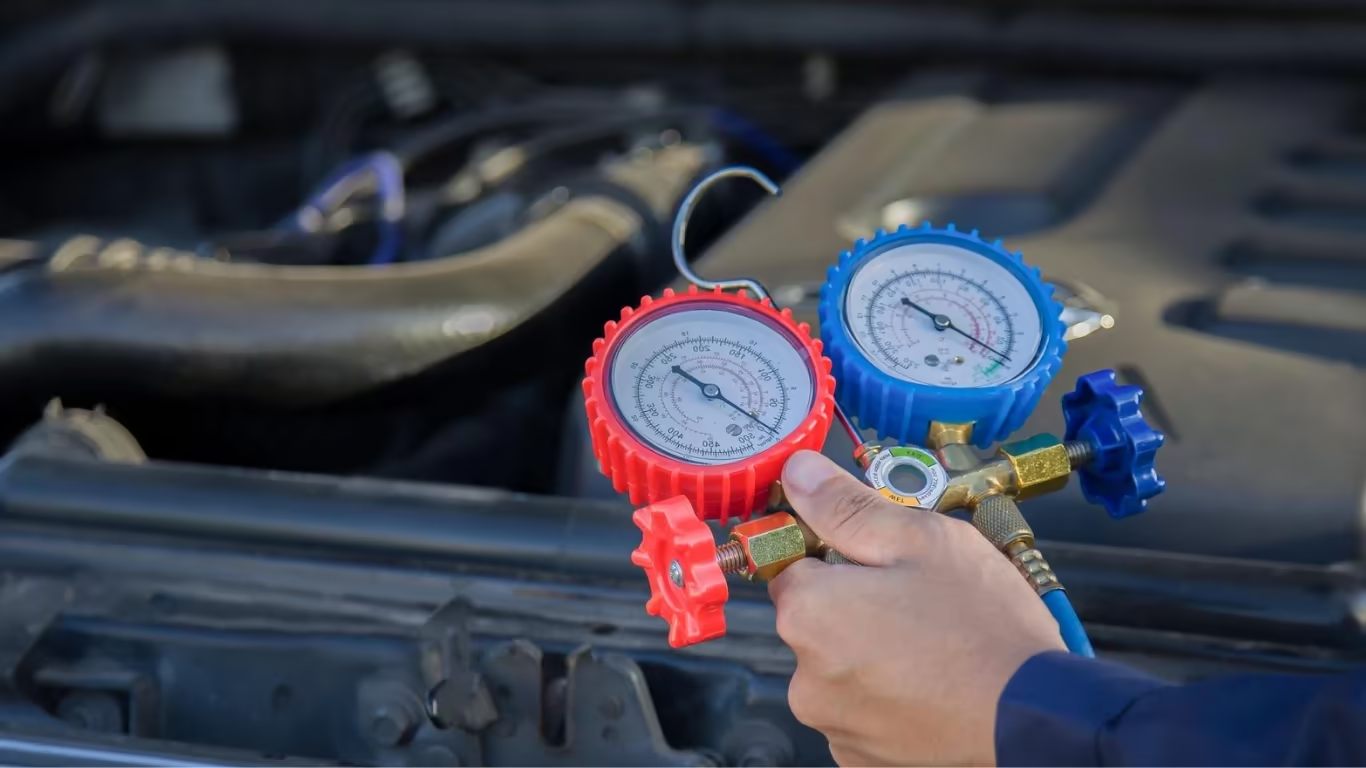
Three common (and costly) reasons your AC might be failing:
The Bad Scenario (Punctured Condenser): A rock from the road might have hit the AC condenser (which sits right behind your car's front grille) and poked a hole in it. Fixing this usually costs between ₹4,500 and ₹11,000.
The Nightmare Scenario (Leaking Cooling Coil/Evaporator): The cooling coil is located deep inside your dashboard. Because mechanics have to spend 4 to 6 hours carefully taking your entire dashboard apart just to reach it, the labor makes this expensive. It costs ₹5,500 to ₹11,000 for regular cars, but can go over ₹25,000 for luxury European cars.
Compressor Failure: The compressor is the "heart" of the AC system. If it breaks internally, it is the most expensive single part to swap out, costing anywhere from ₹12,000 to over ₹35,000.
Remain attentive to these signs, and demand a vacuum test before any gas goes into the car, and protect your wallet from unnecessary part replacements. Stay cool out there.
How Much Does It Cost to Fix a Car's AC? Real Repair Costs Explained
The cost of a car AC recharge varies depending on the age of your car, its segment, and the type of refrigerant in it. While R-134a remains common in older vehicles, many new cars are transitioning to R-1234yf refrigerant, a cleaner alternative that helps manufacturers meet stricter environmental regulations.
To give you an accurate market picture, here are the standard car AC service charges 2026 updates for a system evacuation, leak test, and full recharge across India:
Car AC Gas Refill Cost in India (2026)
Refrigerant Type | Commonly Found In | Average Refill Cost |
R-134a | Most older cars and many mainstream hatchbacks, sedans, and SUVs | ₹1,800 – ₹4,000 |
R-1234yf | Many newer premium vehicles and select modern models | ₹6,500 – ₹15,000+ |
Car AC Gas Refill Cost by Vehicle Category
Vehicle Category | Typical Refill Cost |
Small Hatchbacks (Alto, WagonR, Grand i10, Tiago) | ₹800 – ₹2,500 |
Sedans & Compact SUVs (Dzire, Amaze, Nexon, Venue) | ₹3,800 – ₹5,500 |
₹1,500 – ₹6,500 | |
₹7,500 – ₹12,000+ | |
Vehicles Using R-1234yf Refrigerant | ₹6,500 – ₹13,000+ |
Note: Actual costs can vary depending on the refrigerant type, gas quantity required, labour charges, city, service centre, and whether additional work such as leak detection, vacuuming, or component replacement is needed.
The type of refrigerant used in your car is a more important factor for calculating the costs, and not just the type of vehicle. While R-134 remains common in many Indian vehicles, R-1234f is increasingly being incorporated into the newer models due to its lower environmental impact, which significantly adds to the service cost.
A proper car AC gas refill cost India breakdown should always include pulling a deep vacuum on the system for about 30 minutes before pumping in new gas. This helps in eliminating internal moisture. If a mechanic tries to simply "top it up" straight from a bottle without pulling a vacuum first, then correct him. Ambient moisture that remains if it's not vacuumed out will form an acid that eats your compressor from the inside out.
CarBike360 Verdict: Timely AC Service Saves Money
A car AC not cooling is not just a minor inconvenience, but it’s a genuine functional, safety, and comfort problem. If your car is takes hours before you can finally feel the chiils, then the mechanic might convince you of the expensive component repairs.
Before falling for that, get your vehicle evaluated through a professional diagnostic check in order to know the actual car AC recharge cost in India for your specific vehicle segment. Make sure that the garage treats the process as a complete system evacuation rather than a low-cost top-up service. After the car undergoes the vacuum test, you can pay the car AC gas refill cost India. On the other hand, if the pressure drops instantly during testing, be prepared to bear the strain of noisy hardware repairs, whether that means budgeting for a minor leak fix or mapping out an AC cooling coil replacement cost India estimate.
Stay vigilant of the above-given car refrigerant leak signs, and enjoy a chilled cabinet even when it's blistering outside.
Frequently Asked Questions (FAQs)
1. How often does a car AC need a gas refill?
A properly functioning car AC system is sealed and should not require regular gas refills. If refrigerant levels are low, it usually indicates a leak that needs to be diagnosed and repaired.
2. What are the signs that my car needs an AC recharge?
Common warning signs include weak cooling, warm air from the vents, the AC compressor not engaging, ice formation on AC lines, and oily residue around AC hoses or fittings.
3. How much does a car AC gas refill cost in India?
For most vehicles using R-134a refrigerant, a refill typically costs between ₹1,800 and ₹4,000. Vehicles using R-1234yf refrigerant can cost anywhere from ₹6,500 to ₹15,000 or more.
4. Can I drive my car if the AC gas is low?
Yes, the vehicle will still run, but the AC system may cool poorly or stop working altogether. Running the system with very low refrigerant for extended periods can also put additional stress on AC components.
5. Why is R-1234yf refrigerant more expensive than R-134a?
R-1234yf is a newer refrigerant with a much lower environmental impact. Its production cost, handling requirements, and lower availability make it significantly more expensive than traditional R-134a gas.
6. Will adding more AC gas fix my car's cooling problem?
Not always. Low refrigerant is only one possible cause. Issues such as a leaking condenser, faulty compressor, blocked expansion valve, or damaged evaporator can also reduce cooling performance.
7. How long does a car AC recharge take?
A proper AC service, including leak testing, vacuuming, and refrigerant refilling, typically takes between 45 minutes and 2 hours, depending on the vehicle and the condition of the system.
8. Is it normal for car AC performance to drop in extreme summer temperatures?
Yes. Even a healthy AC system will take longer to cool the cabin when outside temperatures exceed 40°C. However, if the airflow remains only mildly cool or never reaches a comfortable temperature, the system should be inspected.
9. Can a car AC recharge improve fuel efficiency?
Indirectly, yes. An AC system operating at the correct refrigerant pressure puts less strain on the compressor, helping it work more efficiently and potentially reducing engine load.
10. Should I choose a top-up or a complete AC service?
A complete AC service is usually the better option. It includes leak detection, vacuum testing, moisture removal, and refilling the correct amount of refrigerant, ensuring longer-lasting cooling performance and preventing costly repairs later.


You May Like






Find your perfect car

Budget

Brand

Body Type

Fuel

Mileage

More
Latest Videos





Other Articles




Listen to Audios