ELECTRIC
How to Check Battery Health Before Buying a Used Electric Vehicle?
 Add CarBike360 on Google
Thinking of buying a used EV? Learn how to check battery health, understand SoH reports, verify real-world range, and avoid costly mistakes before purchasing a second-hand electric car or scooter.

By Swati Tomar
Jun 16, 2026 10:52 am IST
Published On
Jun 16, 2026 09:56 am IST
Last Updated On
Jun 16, 2026 10:52 am IST
Key Highlights
Battery health is the single most important factor to check when buying a used electric vehicle.
A battery health report or State of Health (SoH) score provides the clearest picture of a battery's condition.
An EV with higher mileage and a healthy battery can be a better purchase than a low-mileage EV with battery degradation.
Always compare the seller's claimed range with real-world range figures reported by owners.
Frequent fast charging and commercial usage can impact long-term battery performance.
Check whether the battery warranty is still valid and transferable to the next owner.
Review service records, repair history, and any battery replacement documentation carefully.
A professional diagnostic inspection can reveal hidden battery, charging, and software-related issues.
Sudden battery percentage drops during a test drive may indicate underlying battery problems.
Understanding battery health can help buyers avoid expensive repairs and make a smarter used EV purchase.
A Practical Guide to Evaluating Battery Health Before Buying a Used EV
Used electric vehicles are building their place in India’s automotive marketplace. Platforms like Spinny, Cars24, and OLX now feature a growing inventory of used electric vehicles, giving buyers more choices than ever before.
Prices of some popular EVs have fallen enough to make them attractive options, especially for city users with a fixed daily commute. But unlike a used petrol car, where engine condition is usually the biggest concern, a used EV presents a different challenge: battery health.
After speaking with EV owners, service technicians, fleet operators, and used vehicle dealers over the past few years, I've noticed one common mistake buyers make. They focus heavily on kilometres driven and cosmetic condition while ignoring the component that accounts for nearly 30–50% of the vehicle's value — the battery pack.
This is not an exaggeration. On many popular EVs sold in India today, the battery pack alone costs more than the combined cost of the entire body shell, infotainment system, and drivetrain. You would never buy a petrol car without checking the engine. The battery deserves at least the same scrutiny.
The truth is simple: a used EV with 50,000 km and a healthy battery can be a better buy than one with 20,000 km and a degraded battery.
So how do you check battery health before handing over your money? Let's break it down.
Also read: How Long Do Electric Car Batteries Last in India? Insights on EV Battery Life, Warranty & More
Why Does Battery Health Matter More Than Odometer Reading?
In traditional vehicles, higher mileage often means more wear and tear. A 70,000 km petrol car usually has a more tired engine, gearbox, and suspension than a 25,000 km one. That logic makes sense and most buyers have internalized it over decades.
In EVs, things are slightly different, and unreasonable if you are coming from a petrol-car background.
A battery gradually loses its ability to store energy over time and across charge cycles. This process is called battery degradation. As degradation increases, the vehicle delivers less range per charge, takes longer to top up in some cases, and may eventually require expensive repairs or outright battery replacement. The odometer alone is not the indicator of the level of battery degradation, as there are different factors leading to deterioration of the battery such as heat exposure, charging habits, the number of deep discharge cycles, and how frequently fast charging was used. Two EVs with the same mileage on the clock can be in dramatically different battery condition depending on how they were driven and charged.
For example: a new Tata Nexon EVLong Range may deliver around 400 km of claimed range under MIDC test conditions. Real-world range for most Indian drivers is typically 280–320 km depending on driving style, load, and AC usage. If the battery health drops to 80%, that real-world range can shrink further to 220–250 km. That means the vehicle you thought was perfect for weekly Bengaluru-to-Mysore highway runs may suddenly become suitable only for city commutes with anxious range calculations.
This is why battery health is the number, and not the kilometre reading.
How to Get a Battery Health Report and What It Actually Reveals?
Before discussing about price, for about the spare key, and even before you sit inside the car — first, ask for a battery health report.
Many modern EVs can generate battery diagnostics reports through authorised service centres. Manufacturers such as Tata Motors, MG Motor, Ather Energy, and others can provide detailed battery-related health information during a pre-purchase inspection. This typically costs between ₹500 and ₹2,000 depending on the brand and is money you should spend without hesitation on any purchase above ₹5 lakh.
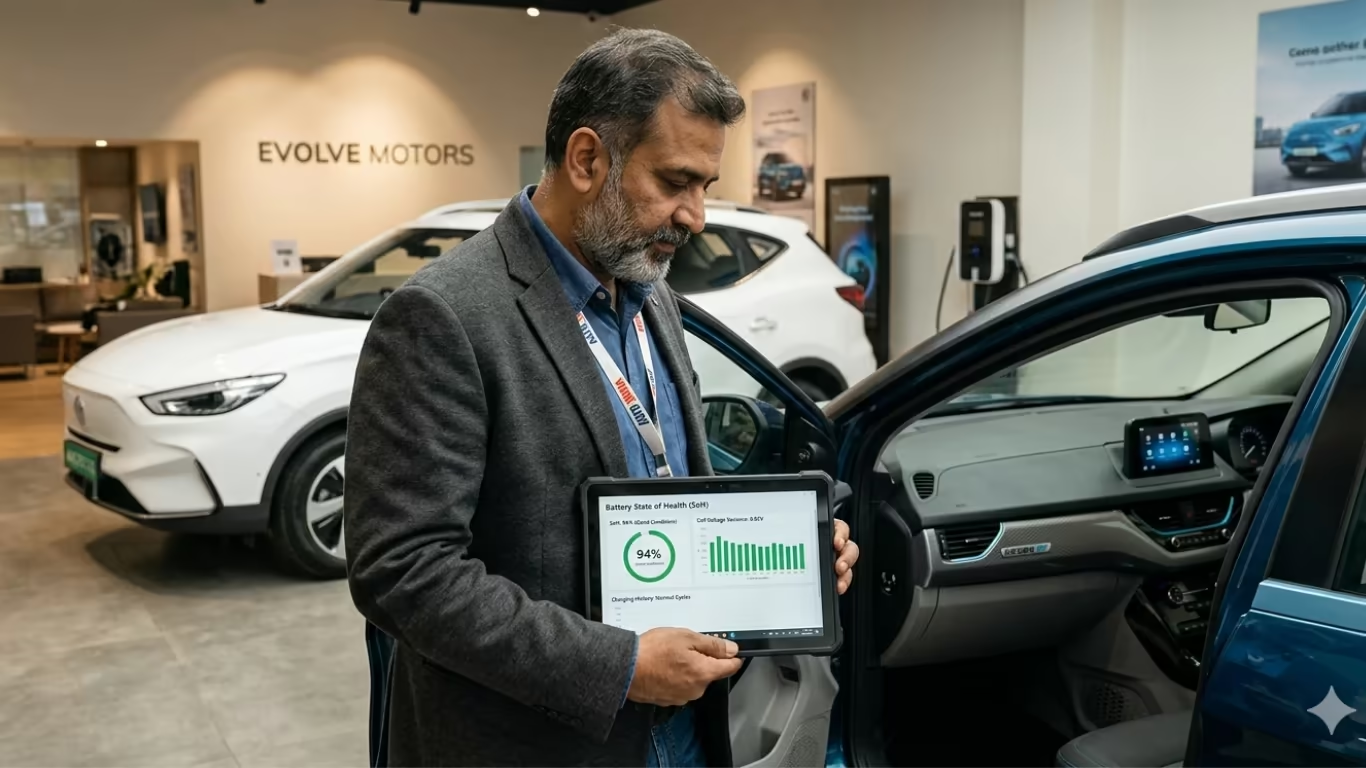
The key number to look for in any such report is the State of Health (SoH).
State of Health indicates how much usable battery capacity remains compared to when the battery was new. A battery brand-new from the factory is at 100% SoH. After a few years of use, this naturally declines. As a practical guideline for Indian buyers:
Above 90% SoH: Excellent condition. Buy with confidence if everything else checks out.
85–90% SoH: Very good condition. Range loss is minimal and unlikely to affect your daily life.
80–85% SoH: Acceptable for most buyers, especially if the price reflects the slight degradation.
Below 80% SoH: Requires careful evaluation. At this level, range loss becomes noticeable in real-world conditions. Factor in the possibility of battery replacement within the next few years and negotiate the price accordingly.
While there is no universal rule, I generally advise buyers to be cautious when battery health falls below 80%, especially if the vehicle is only two or three years old. A three-year-old EV at 78% SoH has degraded faster than average, which raises questions about how it was used and charged, and signals that degradation may continue at a similar pace.
Always ask the seller if they have had a diagnostic done before listing the vehicle. If they haven't, suggest doing one together at an authorised service centre as a condition of purchase. A seller with a genuinely healthy battery will rarely object.
How Do You Compare Real-World Range Against What the Seller Claims?
One of the easiest, and most telling ways to spot battery degradation is through real-world range observation. No diagnostic app needed. Just a bit of attention and a direct question.
Ask the seller: "How much range are you getting on a full charge today, in your actual daily use?"
Then compare that figure with what verified owners report online for the same model. Owner communities on platforms like Team-BHP, EV India Facebook groups, and YouTube ownership reviews are excellent sources of real-world range data for almost every popular EV sold in India. If the seller claims 280 km per charge but owners of the same model with similar usage patterns report 300–320 km, the gap is telling.
A real-life example:
A used electric scooter was listed in Hyderabad last year for a seemingly attractive price. The seller confidently stated the scooter delivered 110 km on a full charge. During a test ride, the range display was dropping faster than expected. After cross-referencing with the OBD diagnostics tool and speaking to the Ather service centre, it became clear that actual usable range was closer to 75–80 km under normal riding conditions. The battery had degraded considerably, and the seller to his credit, was not being deliberately dishonest. He simply didn't track his own range carefully and had gotten used to the reduced performance over time.
This is extremely common with EV owners. The degradation happens gradually, like a slow leak. They adapt to it without noticing. You, as a buyer coming in fresh, will notice it immediately once you know what to look for.
Always verify stated range claims through a physical test, not just the seller's word.
Does Fast Charging History Affect the Battery and How Do You Find Out?
Yes, significantly, and this is one factor that even experienced car buyers almost never consider when looking at used EVs.
Lithium-ion batteries, which power virtually every EV currently sold in India, are sensitive to heat. DC fast charging is the kind you use at public chargers in malls, highways, and office complexes; this pushes large amounts of current into the battery very quickly. This generates heat inside the cells. Done occasionally, the battery's thermal management system handles it well. Done daily, over hundreds of cycles, it accelerates degradation measurably.
AC home charging, by contrast, is slow and gentle. It generates far less heat and is significantly easier on long-term battery health. A vehicle that spent most of its life plugged into a home AC charger overnight has, in all likelihood, a healthier battery than one that fast-charged every evening at a public station, even if both have covered the same distance.
When evaluating a used EV, ask the seller directly:
Was the vehicle primarily charged at home or at public fast chargers?
Was it used for commercial purposes such as cab aggregators, delivery operations, or office fleet use?
How many times per week was DC fast charging used?
A private owner in a gated community with a wall box charger who commuted 30 km a day is your ideal battery-health scenario. A vehicle that served as a fleet car on app-based taxi services, fast-charging twice a day to keep up with trips, is a very different battery story and even if the exterior looks spotless and the mileage seems reasonable.
Some EV models, particularly connected ones from Tata and Ather, log charging session data that a service centre can access. Request this data during the pre-purchase inspection.
Why Does the Vehicle's Usage Pattern Tell You More Than the Odometer?
Not all kilometres are equal. This is one of those truths that becomes obvious once you spend time in the EV world, but is completely non-intuitive coming from the petrol-car mindset.
A 60,000 km EV used for predictable daily highway commutes that includes steady speed, moderate temperature, mostly AC home charging, may have a healthier battery than a 25,000 km vehicle subjected to extreme heat, stop-start city traffic, aggressive acceleration, and frequent fast charging. The kilometres on the clock are merely a proxy. Usage pattern is the real variable.
Consider the specific conditions of Indian urban driving: temperatures touching 42–45°C in cities like Delhi, Nagpur, and Ahmedabad between April and June; bumper-to-bumper traffic that demands constant acceleration and braking; and a charging infrastructure that still pushes many owners toward fast charging out of necessity. These conditions collectively put more stress on a battery than cool-weather highway cruising.
Questions worth asking when evaluating any used EV include:
Was the vehicle used for ride-sharing platforms like Ola or Uber?
Was it part of a corporate fleet or delivery operation?
Was it parked outdoors in direct sunlight regularly, or in a covered parking space?
Was it driven predominantly in city conditions with heavy traffic?
Was it ever used for outstation trips with multiple fast charges in a single day?
Usage history often tells a bigger story than the odometer. A vehicle with clean, documented answers to the above questions is worth paying a modest premium for compared to one with vague or contradictory answers.
What Should You Look for During a Test Drive to Assess Battery Condition?
Instead of the battery condition and performance, buyers focus more on the paint quality, tyre tread depth, or upholstery condition. That is a costly mistake when it comes to EVs, because the test drive is one of the few moments where the battery reveals itself directly to you.
Before the test drive, make sure the vehicle is charged to at least 80–90%. Note the exact percentage and indicated range shown on the instrument cluster. Take a photograph of the screen. Then drive for 15–20 km under realistic conditions such as some city traffic, a few hard accelerations, AC running on a normal setting.
During the drive, pay attention to:
Range estimate behaviour: Does the indicated range drop faster than the kilometres you are actually covering? A car showing 220 km of range at the start and dropping to 180 km after you've driven just 25 km is a sign of degraded battery estimation or actual capacity issues.
Power delivery: Does the car feel responsive and consistent, or does it feel sluggish, particularly when the battery is below 50%? Some degraded batteries show significantly reduced power in the lower state-of-charge range.
Regenerative braking consistency: Is regen braking smooth and predictable, or does it feel inconsistent? Inconsistent regen can sometimes point to cell imbalance within the battery pack.
Sudden percentage drops: A drop of more than 2–3% in battery percentage over a short distance without corresponding real-world range is a yellow flag.
Warning lights or error messages: Any battery-related warning during a test drive is a hard stop. Do not proceed until it is explained and resolved.
Healthy batteries generally discharge predictably and proportionally. The relationship between the percentage on the screen and the actual distance you can cover should feel consistent. If it does not, trust your observation.
How Do You Check Whether the Battery Warranty Is Still Valid and Does It Transfer?
This single question can dramatically change the financial risk profile of a used EV purchase, and yet a surprisingly large number of buyers forget to ask it.
Most EV manufacturers in India offer substantial battery warranties precisely because the battery is the most expensive component and the one buyers are most anxious about. Common warranty terms in the Indian market include 8-year or 1.6-lakh km coverage on battery packs for several popular electric cars, and multi-year coverage on premium electric scooters from brands like Ather and Ola.
The critical question is not just whether the warranty exists, and it is whether it transfers to the second owner.
Most manufacturer warranties in India are transferable, but the process and conditions vary. Some manufacturers require the transfer to be formally registered with them within a certain period of the ownership change. Others require an inspection at an authorised centre before confirming transfer. Some have clauses around what voids the warranty including unauthorised modifications, non-authorised charging equipment, or accidents involving the battery compartment.
When evaluating a used EV, verify:
The exact remaining warranty period on the battery
Whether the warranty is fully transferable and what the process involves
Whether any warranty claims have already been filed against the battery (this narrows the remaining coverage)
Whether the vehicle's service record is intact, because many manufacturers require proof of regular authorised servicing to honour warranty claims
Never rely solely on the seller's verbal assurance on warranty status. Request the original warranty document and verify directly with the manufacturer's customer care or an authorised service centre. A five-minute phone call can save you lakhs.
What a Battery Replacement Record Reveals About a Used EV
Battery replacement is not automatically a bad thing. In fact, approached correctly, a recently replaced battery can be one of the strongest selling points of a used EV.
Think about it: if a three-year-old EV has had its battery pack replaced under warranty at a Tata or MG authorised service centre, and that replacement was six months ago, you are essentially getting a vehicle with a near-new battery at a used-car price. That is a genuinely attractive proposition, provided you can verify it properly.
What you are looking for is documentation. Specifically:
An authorised service centre invoice or job card clearly stating battery replacement
The date and odometer reading at the time of replacement
Confirmation of whether the replacement was covered under warranty or paid out of pocket
The warranty status of the replacement battery itself (in many cases, a warranty-replaced battery carries its own coverage period)
If the seller mentions a battery replacement but cannot produce paperwork or produces documentation that does not match the service history, proceed with considerable caution. Unauthorised battery replacements, or replacements using non-OEM cells, can void existing warranties, affect vehicle software calibration, and in some cases create safety risks.
Documented, authorised battery replacement? Green flag. Undocumented claims? Ask until you are satisfied, and if satisfaction does not come, walk away.
Can a Professional Diagnostic Scan Tell You Things a Visual Inspection Cannot?
Absolutely! And for any used EV purchase involving significant money, a professional diagnostic scan is not optional. It is the price of due diligence.
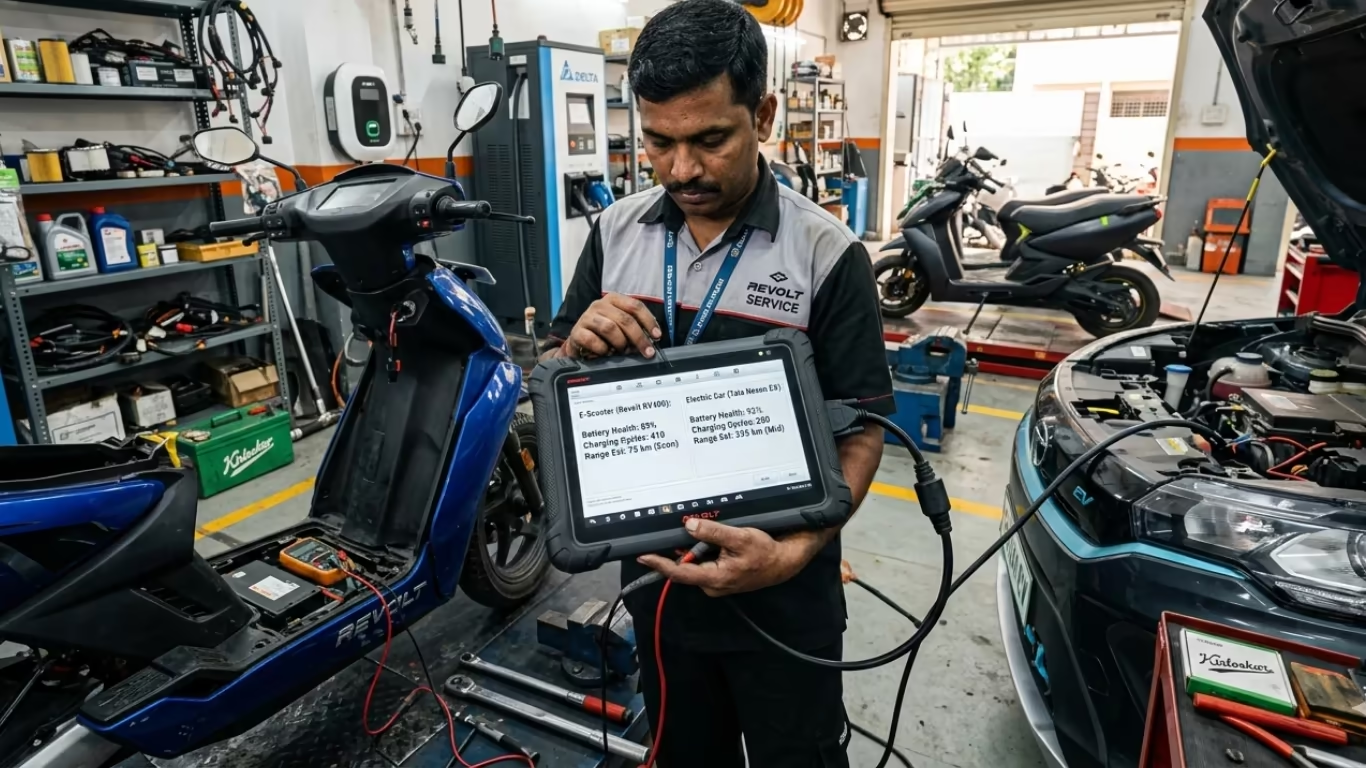
Modern EVs are software-driven machines in a way that no petrol car ever was. The battery management system (BMS) continuously monitors and records hundreds of data points: individual cell voltages, temperature history, charge cycles, fast charge count, error codes, and system faults. Much of this data is invisible during a casual inspection or even a test drive. A proper diagnostic scan surfaces all of it.
At an authorised service centre, a diagnostic report can reveal:
State of Health (SoH): The definitive battery capacity figure
Cell voltage spread: Whether individual cells within the pack are balanced. A high spread, where some cells are significantly weaker than others — is a sign of uneven degradation and can cause premature capacity loss
Thermal history: Peak temperatures the battery has experienced. A battery that has regularly hit high temperatures is a higher degradation risk going forward
Charging history and fast charge count: How many total charge cycles, and how many were DC fast charges
Error codes: Any past or present faults logged in the BMS, including ones that have been cleared but leave a trace in the system
Regeneration and discharge patterns: Whether the battery is behaving consistently across its charge range
Think of a diagnostic scan the same way you would think of a blood test before a major surgery. You would not skip it simply because the patient looks healthy on the outside. The same logic applies here.
The cost of a professional pre-purchase inspection, typically ₹500–₹2,000 at an authorised service centre is trivial compared to the risk of discovering a ₹3–5 lakh battery problem after the paperwork is signed.
What Is My Personal Rule When Buying a Used EV?
After reviewing numerous electric vehicles and advising many readers through their used EV purchases, I follow a principle that sounds simple but carries a lot of weight:
I would rather buy a three-year-old EV with documented service history, 88% battery health, and a consistent home charging pattern than a newer-looking vehicle with unknown battery condition, a single careful-looking owner, and a compelling asking price.
The battery tells the real story of how a vehicle was lived in. Everything else is surface.
Paint can be polished. Dents can be straightened. Tyres can be replaced in an afternoon. Even the infotainment screen and seat upholstery can be refreshed at modest cost.
A degraded battery, however, is not a minor inconvenience. It is a structural limitation of the vehicle that affects every single drive, and correcting it is an expensive, sometimes complicated process that can equal a significant fraction of the car's current market value.
The used EV market in India is genuinely exciting, and there are real deals to be had on very good vehicles. But those deals require homework.
Final Verdict: What Should You Do Before Buying a Used EV in India?
Buying a used electric vehicle in India can be a smart financial decision, but only if you treat the battery with the same seriousness that previous generations of buyers treated the engine.
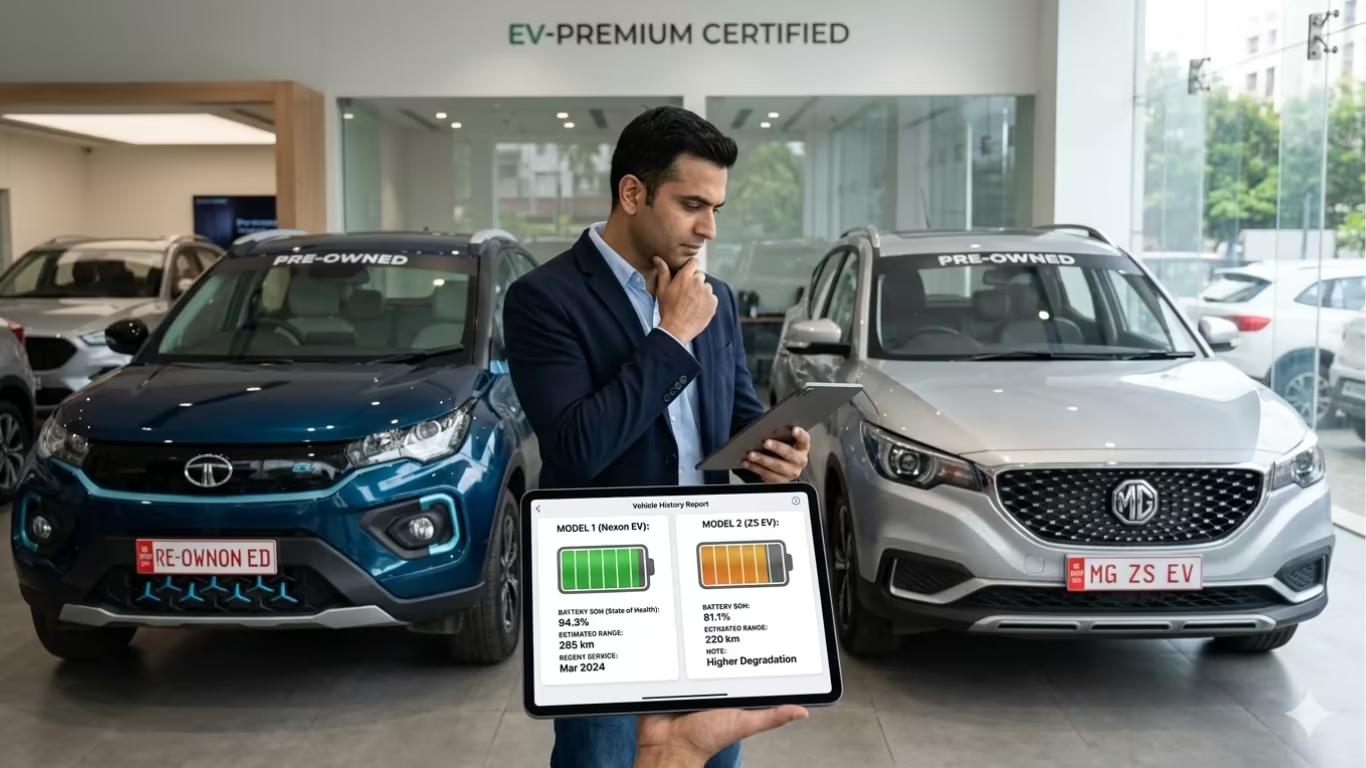
The framework is straightforward:
Ask for a battery health report first. Make it a non-negotiable condition of proceeding with any serious discussion. If the seller resists, that itself is information.
Verify real-world range through a proper test drive, not just the number the seller quotes. Drive it yourself, note the drop, do the maths.
Understand the charging history. A vehicle that lived on home charging is a different battery proposition from one that fast-charged daily for two years.
Check warranty status and transferability. A remaining manufacturer battery warranty dramatically reduces your financial exposure and should be verified directly with the brand, not just through the seller.
Invest in a professional diagnostic scan. Pay for it. Do it at an authorised service centre. Read the report carefully, or have someone explain it to you.
Scrutinise usage history. Fleet vehicles, commercial use, and outdoor parking in peak summer heat all have implications for battery longevity that the odometer will never tell you.
Do these things, and a used EV can offer tremendous value, lower running costs, a more enjoyable driving experience, and the satisfaction of a well-researched decision. Ignore them, and even the most attractive asking price can quietly become one of your most expensive purchases.
As India's used EV market matures, battery transparency will become the single biggest factor separating buyers who made a great decision from those who are still figuring out how it went wrong.
Frequently Asked Questions (FAQs)
1. How can I check the battery health of a used electric vehicle?
The best way is to request a battery health report from an authorised service centre. This report typically includes the battery's State of Health (SoH), charging history, and any diagnostic issues.
2. What is a good battery health percentage for a used EV?
A battery with more than 90% SoH is considered excellent. Between 85% and 90% is very good, while anything below 80% should be evaluated carefully before purchase.
3. Does higher mileage mean a used EV has a bad battery?
Not necessarily. A well-maintained EV with 50,000 km and healthy battery condition can be a better buy than a low-mileage vehicle with significant battery degradation.
4.Why is battery health more important than the odometer reading?
Battery replacement is one of the most expensive repairs on an EV. A healthy battery directly affects range, charging performance, and long-term ownership costs.
5. Can frequent fast charging damage an EV battery?
Modern batteries are designed for fast charging, but excessive reliance on DC fast charging over several years may accelerate battery degradation compared to regular home charging.
6. How do I verify the real-world range of a used EV?
Ask the seller about the current range they achieve on a full charge and compare it with owner reviews, online forums, and independent road tests for the same model.
7. Should I buy a used EV with a replaced battery?
Yes, provided the battery replacement was carried out by an authorised service centre and is backed by proper documentation and warranty records.
8. Is battery warranty transferable to the second owner?
Many manufacturers allow battery warranties to be transferred, but policies vary. Always confirm the warranty status and transfer eligibility before completing the purchase.
9. What documents should I ask for when buying a used EV?
Request the service history, battery health report, warranty documents, charging records (if available), repair invoices, and any battery replacement paperwork.
10. Are used electric vehicles worth buying in India?
Yes, a used EV can offer excellent value if the battery is in good condition, the service history is documented, and the vehicle still has adequate warranty coverage.
11. How much battery degradation is normal in an EV?
Most modern EV batteries lose a small percentage of capacity each year. A battery retaining 85–90% of its original capacity after a few years is generally considered healthy.
12. Is a professional battery diagnostic inspection worth the cost?
Absolutely. Spending a few thousand rupees on a professional inspection can help identify battery issues, hidden faults, and expensive future repairs before you buy.









अपनी परफेक्ट कार खोजें

Budget

Brand

Body Type

Fuel

Mileage

More