ELECTRIC
India begins nationwide Isobutanol diesel blending trials for transport fleets
 Add CarBike360 on Google
India has initiated large-scale trials of isobutanol-diesel blends in transport fleets to explore cleaner fuel alternatives. The move supports emission reduction goals while testing performance and efficiency in real-world commercial operations.

Jun 25, 2026 11:58 am IST
Published On
Jun 25, 2026 11:00 am IST
Last Updated On
Jun 25, 2026 11:58 am IST
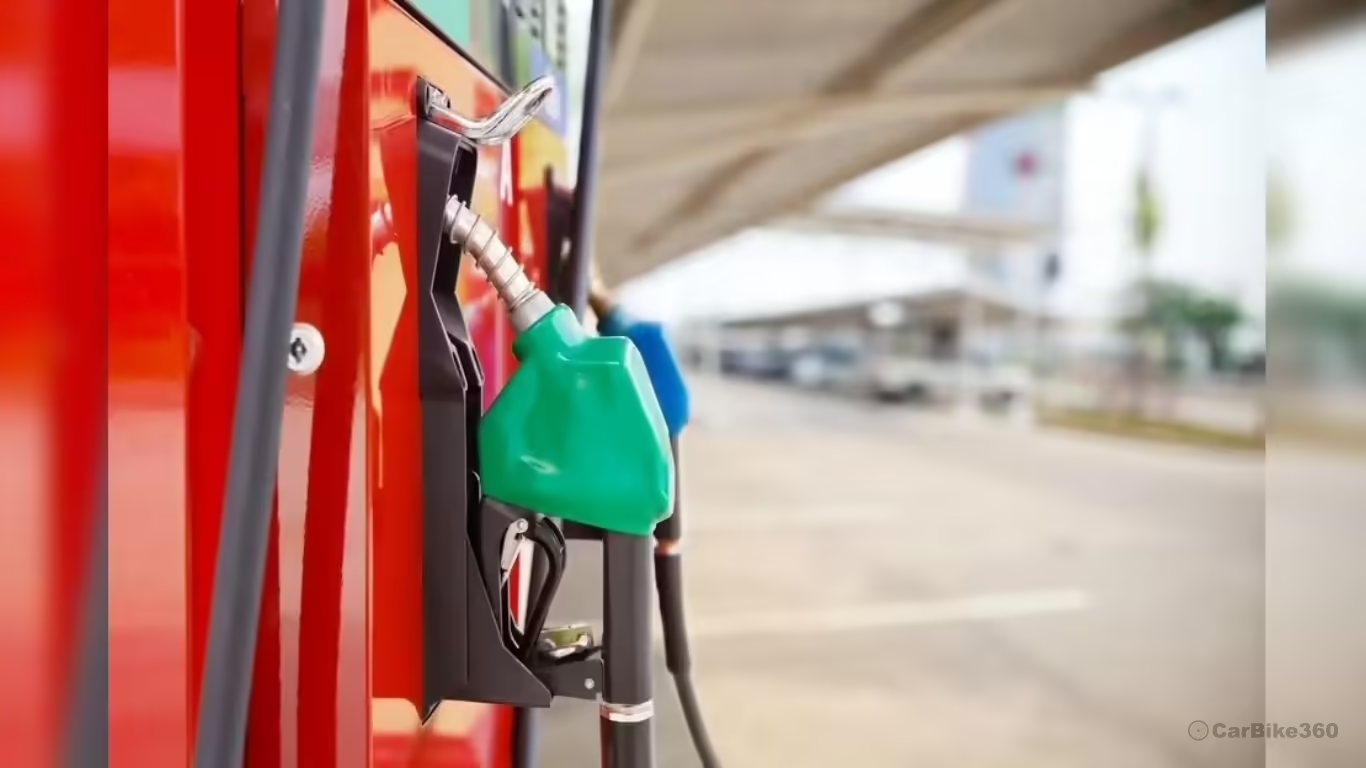
India is set to begin nationwide trials of isobutanol-diesel blends in transport fleets, aiming to advance energy independence. Tata Motors Managing Director and CEO Girish Wagh announced that a pilot trial with a 2% isobutanol blend will start in the second quarter of FY27. The program involves oil marketing companies, original equipment manufacturers (OEMs), testing agencies, and government task forces.
Key Highlights
- India is to start nationwide isobutanol-diesel blending trials with a 2 percent blend in FY '27.
- Tata Motors and HPCL to coordinate pilot tests with support from ARAI and Praj Industries.
- Isobutanol offers better stability and safety than ethanol for diesel blending in transport fleets.
- BPCL has conducted two years of isobutanol testing and will validate data across 33 vehicle types.
Isobutanol Blending Initiative
The initiative seeks to validate the use of low-ratio biofuel blends in standard transport fleets. Tata Motors is working with Hindustan Petroleum Corporation Limited (HPCL) to secure the specialized blended fuel for these tests. The Automotive Research Association of India (ARAI) will lead a 10-month technical assessment, partnering with Praj Industries, a major bioenergy technology supplier.
The validation program follows the model of ethanol blending with petrol, where the base blending level has reached 20% (E20). The government has recently notified standards for higher ethanol blends, including E22, E25, E27, and E30. Plans are underway to introduce E85 and E100 blends as well.
Industry Collaboration and Technical Details
Major OEMs, oil marketing companies, and research agencies such as ARAI and the Council of Scientific and Industrial Research (CSIR) are participating in the trials. The goal is to address long-standing challenges in diesel decarbonization by testing isobutanol as a potential drop-in replacement for diesel.
BPCL has already conducted two years of isobutanol testing, including a recent three-month trial in stationary Cummins engines. The company is now investing in data validation across 33 different vehicle types in India.
Isobutanol offers advantages over ethanol for diesel blending. Ethanol, a two-carbon alcohol, does not mix well with diesel due to its polar structure and low flashpoint of 12 to 13 degrees Celsius. Diesel, regulated at a minimum flashpoint of 35 degrees, belongs to a different safety class. These differences have limited ethanol-diesel blends to 5% or less, often causing combustion issues and storage challenges.
Isobutanol, a four-carbon alcohol, has a flashpoint between 27 and 30 degrees Celsius. This allows it to remain in the same petroleum safety class as diesel, making it compatible with existing storage and transport infrastructure. Initial tests showed isobutanol blends remained stable at 10% for over 40 days without separation. Early trials on Indian driving cycles indicated that a 5% blend reduced emissions with only a 1 to 2% impact on fuel mileage.
Impact and Next Steps
Wagh stated that isobutanol could play a key role in reducing India's reliance on imported fuels. Although isobutanol has a lower calorific value than diesel, the planned 2% blend is expected to have minimal impact on vehicle performance. Wagh emphasized the importance of energy independence and expressed confidence in industry support for the initiative.
Tata Motors is also reviewing its supply chains and managing commodity cost inflation through selective price adjustments. The company is evaluating new vehicle models for the Indian market and monitoring developments in global manufacturing investments.
Also Read: Tata Motors targets FY28 growth with IVECO deal and digital expansion
CarBike 360 Says
India’s nationwide isobutanol-diesel blending trials mark a significant step toward cleaner and more sustainable transportation. By testing this alternative fuel across diverse fleet operations, the initiative could unlock practical solutions for reducing emissions without compromising performance. If successful, it may accelerate the adoption of advanced biofuels and strengthen India’s long-term energy transition strategy.


You May Like




Find your perfect car

Budget

Brand

Body Type

Fuel

Mileage

More
Latest Videos


Top Auto News of the Week | Hyundai i20 Leak, Honda ZR-V, Tata Sierra EV, Skoda EV & More!

Talking about new Honda City and upcoming ZR-V SUV with Honda India’s Kunal Bahl!
2026 Honda City Launched in India - Better than VW Virtus, Hyundai Verna & Skoda Slavia?

Weekly Auto & EV Wrap-Up: Luxury Launches, AI Tech & Big Industry Updates!
Other News
Listen to Audios