ELECTRIC
India ICE passenger vehicle sales report FY 2025–26
 Add CarBike360 on Google
Petrol and Diesel still drive the world’s most dynamic car market with CNG also fast picking up pace as a preferred fuel.

By Ashish Masih
Apr 01, 2026 08:00 am IST
Key Highlights – FY 2025–26
- Internal combustion engine (ICE) vehicles still account for over 94 percent of passenger vehicle sales in India.
- The Indian passenger vehicle market recorded around 4.5 million units in FY 2025–26, maintaining its position as one of the fastest-growing automotive markets globally.
- SUVs now dominate the market, contributing nearly two-thirds of all passenger vehicle sales.
- Maruti Suzuki remains the undisputed market leader, with close to 40 percent market share.
- Mahindra has firmly established itself as India’s second-largest SUV powerhouse, driven by strong demand for its lifestyle and off-road vehicles.
- Hyundai and Tata Motors continue their intense rivalry, competing strongly across multiple segments.
- Electric vehicles are gaining attention, but petrol and diesel cars remain the overwhelming choice for Indian buyers.
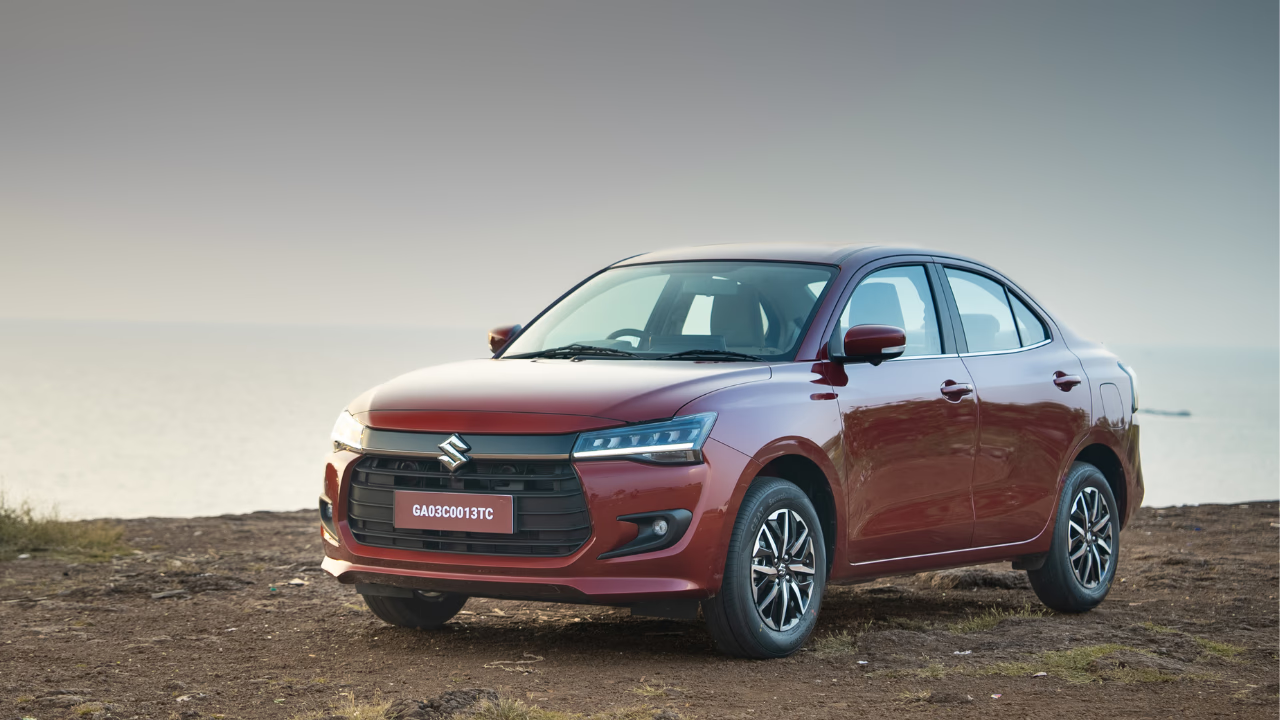
Top 10 best-selling cars in India (Jan–Dec 2025)
Rank | Model | Manufacturer | Segment | 2025 Sales (Units) |
|---|---|---|---|---|
1 | Maruti Suzuki Dzire | Maruti Suzuki | Compact Sedan | 1,98,000 |
2 | Tata Punch | Tata Motors | Micro SUV | 1,96,000 |
3 | Hyundai Creta | Hyundai | Mid-Size SUV | 1,94,000 |
4 | Maruti Suzuki Wagon R | Maruti Suzuki | Hatchback | 1,93,000 |
5 | Tata Nexon | Tata Motors | Compact SUV | 1,82,000 |
6 | Maruti Suzuki Swift | Maruti Suzuki | Hatchback | 1,79,000 |
7 | Maruti Suzuki Brezza | Maruti Suzuki | Compact SUV | 1,70,000 |
8 | Maruti Suzuki Baleno | Maruti Suzuki | Premium Hatchback | 1,66,000 |
9 | Maruti Suzuki Fronx | Maruti Suzuki | Compact SUV | 1,60,000 |
10 | Mahindra Scorpio (N + Classic) | Mahindra | Full-Size SUV | 1,55,000 |
A market moving from growth to maturity
For several years after the pandemic, India’s automotive industry experienced an extraordinary surge in demand. Buyers who had postponed purchases returned to the market, financing options improved, and the aspirational value of owning a car reached new heights.
By FY 2025–26, however, the industry entered a slightly more mature phase.
Growth remained positive but moderated, reflecting a natural stabilisation after multiple years of record-breaking sales. Dealership inventories were more carefully managed, and manufacturers focused increasingly on profitability and product positioning rather than pure volume expansion.
What makes the Indian market fascinating is its resilience. Even during periods of economic uncertainty, car ownership continues to represent a powerful symbol of upward mobility for millions of households.
In smaller cities and semi-urban regions especially, owning a car is still seen as a milestone achievement.

GST 2.0 Reforms: The quiet catalyst behind India’s FY26 car sales boom
While strong SUV demand, rising disposable incomes and improved financing options played their role in driving India’s passenger vehicle market in FY2025–26, one policy reform quietly strengthened the industry’s momentum — the implementation of GST 2.0. Introduced in late 2025 as part of a broader effort to rationalise India’s indirect taxation structure, the revised framework simplified the earlier multi-layered tax regime and made several vehicle categories more affordable.
For years, the Indian auto industry had been operating under a taxation structure that combined the standard GST rate with an additional compensation cess. Depending on the vehicle category, this often pushed effective tax levels close to or above 45 percent, particularly for larger vehicles and SUVs. GST 2.0 sought to streamline this system by removing the compensation cess and replacing it with a simpler slab-based structure that brought greater clarity to pricing.
The immediate outcome was a noticeable improvement in affordability across several segments of the passenger vehicle market. Manufacturers were able to revise prices downward on certain models, and in a market as price-sensitive as India, even modest price reductions can significantly influence buying behaviour.
Key GST 2.0 Changes That Helped the Auto Industry
• Lower taxes on small cars
Entry-level petrol cars measuring under four metres in length and powered by engines up to 1.2 litres moved into a lower tax bracket. The reduction helped improve the price positioning of hatchbacks and compact sedans, segments that had been struggling with slowing demand in recent years.
• Simplified taxation for larger vehicles
Mid-size sedans, SUVs and premium cars now fall under a clearer tax structure with a flat rate replacing the earlier system of GST plus compensation cess. While these vehicles still attract relatively high taxation, the removal of the layered structure has simplified pricing and improved transparency.
• Commercial vehicle tax rationalisation
The commercial vehicle segment also benefited from the revised structure, with lower tax rates improving the economics for fleet operators. While this does not directly affect passenger car sales, stronger commercial vehicle demand often signals improved economic activity, which indirectly supports the broader auto market.
• Standardised GST for auto components
Automotive components have largely been brought under the 18 percent tax bracket. This change simplifies the supply chain and reduces compliance complexity for suppliers and manufacturers, improving cost efficiency across the industry.
• Continued incentives for electric vehicles
Electric vehicles continue to attract significantly lower GST rates compared with conventional internal combustion models, ensuring that the government’s push toward electrification remains intact.
Impact on the Market
The timing of GST 2.0 proved significant. The reforms arrived just ahead of the festive buying season, traditionally the most important sales period for the Indian auto industry. Several manufacturers recalibrated their pricing strategies to reflect the revised tax structure, and the improved affordability quickly translated into stronger showroom enquiries.
The entry-level segment, which had been under pressure for several years due to rising vehicle costs and stricter regulatory requirements, saw renewed interest from first-time buyers. Hatchbacks and compact sedans in particular benefited from the price corrections, helping manufacturers regain traction in a category that once formed the backbone of India’s car market.
SUVs, meanwhile, continued their relentless rise in popularity. Although taxation on larger vehicles remains relatively high, the simplified structure brought greater clarity to pricing, allowing manufacturers to plan product strategies with more confidence.
Why GST 2.0 Matters for FY26
India’s passenger vehicle market remains extremely sensitive to price movements. Even relatively small reductions in ex-showroom prices can have a meaningful impact on buying decisions, particularly for first-time buyers and budget-conscious households.
By simplifying the tax structure and reducing the burden on certain vehicle categories, GST 2.0 helped restore some of the affordability that had gradually eroded over the past decade. The reform also sent a positive signal to the automotive industry, indicating a willingness from policymakers to address long-standing concerns around taxation complexity.
In the context of FY2025–26, GST 2.0 acted less like a dramatic policy intervention and more like a quiet enabler. It did not fundamentally transform the market overnight, but it helped remove friction from the system at a time when the industry was already experiencing strong consumer demand.
Combined with new product launches, improved financing availability and the continued popularity of SUVs, the reform contributed to a market environment that allowed India’s passenger vehicle industry to maintain its growth trajectory. As the country moves further into an era of electrification, connected mobility and evolving consumer preferences, policy stability and tax clarity will remain crucial factors shaping the future of the automotive market.

The strong challenges ahead
Despite the strong sales momentum seen in FY2025–26, the Indian passenger vehicle industry could soon face a few external pressures. One of the most significant uncertainties stems from the ongoing geopolitical tensions in the Middle East. Any escalation of conflict in this region has the potential to disrupt global oil supply routes, which in turn could trigger a sharp increase in crude oil prices. For an oil-import dependent country like India, higher crude prices almost inevitably translate into more expensive petrol and diesel. Rising fuel costs tend to influence consumer behaviour quite quickly in the Indian market, where running expenses remain a crucial factor in vehicle ownership. If fuel prices rise significantly, many potential buyers — particularly those in the entry-level segments — may delay their purchase decisions or reconsider upgrading to a new car. Such conditions can gradually weaken showroom footfall and soften overall buyer sentiment. While the industry currently enjoys healthy demand and a steady pipeline of new models, prolonged geopolitical instability and volatile fuel prices could emerge as a meaningful headwind for the market in the months ahead.


You May Like



Find your perfect car

Budget

Brand

Body Type

Fuel

Mileage

More
Latest Car Videos


Top Auto News of the Week: Tata Sierra EV, BMW X6, E85 Fuel & More - Weekly Wrap

Top Auto News of the Week | Hyundai i20 Leak, Honda ZR-V, Tata Sierra EV, Skoda EV & More!

Talking about new Honda City and upcoming ZR-V SUV with Honda India’s Kunal Bahl!
2026 Honda City Launched in India - Better than VW Virtus, Hyundai Verna & Skoda Slavia?
Other Car News
Four-Wheeler Sales Report June 2026: Maruti Suzuki leads the market with 41.7% Y-o-Y, followed by Tata Motors
Tata plans special editions and exports for Sierra and Sierra EV
Maruti Suzuki XL7 Facelift India launch expected by year end with new design and features

Yezdi Scrambler Launches on Amazon.in During Prime Day 2026
Listen to Car Audios