ELECTRIC
India Auto Sector Faces Growth and Cost Pressures Amid Fuel Price Hikes and Policy Shifts
 Add CarBike360 on Google
India’s auto sector expects 10% PV growth in FY27, but faces rising fuel costs and supply risks. Policy support for EVs, new supplier investments, and a growing used-car market are shaping industry trends.

May 18, 2026 04:34 am IST
India’s automobile sector entered the week of May 11-17 with strong demand but rising cost and supply-chain risks. Tata Motors projected 10% growth in the passenger vehicle (PV) industry for FY27, supported by GST 2.0, new launches, and increased production capacity. However, fuel prices rose by ₹3 per litre and CNG prices by ₹2, driven by the West Asia crisis, adding pressure to costs and margins.
Key Highlights
- Tata Motors projects 10 percent passenger vehicle growth in FY27
- Fuel prices increased by ₹3 per litre and CNG by ₹2
- Government approved ₹503 crore for 4874 new EV chargers
- Used car market expected to reach $68-78 billion by FY31
- Suppliers investing in electrified powertrain and digital engineering
Passenger Vehicle Growth and EV Momentum
Passenger vehicle makers remained optimistic about FY27, expecting the domestic PV industry to grow around 10%. Tata Motors aimed to outpace the market, citing new launches, higher EV demand, and CNG momentum. EV bookings rose 25-30% in April and May, partly due to fuel price concerns linked to the Middle East crisis. Crisil Ratings projected India’s passenger vehicle sales could grow 5-7% in FY27, reaching a record high. The GST rate cut from September 2025 continued to support demand, especially for sub-4 metre vehicles. However, higher input costs, emission regulations, and the West Asia conflict remained risks to margins.
Tata Motors reported a 31.7% decline in consolidated net profit to ₹5,783 crore in Q4 FY26, while revenue rose 7.2% to ₹1,05,447 crore. Higher raw material costs and challenges at Jaguar Land Rover affected earnings, though domestic PV volumes stayed strong. Tata Motors crossed cumulative EV sales of 2.5 lakh units in FY26 and reported 43% annual EV volume growth to over 92,000 units. The company stated that EVs are becoming as profitable as ICE vehicles and does not see an immediate need to introduce hybrids. Tata Motors also plans to have its first flex-fuel passenger vehicle ready by late 2026 or early 2027. Its vehicles have been E20-compliant since 2023, and discussions on higher ethanol blends are ongoing.
Fuel Prices, Policy, and Supplier Investments
Petrol and diesel prices in Delhi rose to ₹97.77 and ₹90.67 per litre, respectively, while CNG increased to ₹2 per kg. This has increased interest in EVs, CNG, and alternative fuels. The government approved the installation of 4,874 EV chargers worth ₹503 crore and allocated ₹10,900 crore for EV adoption and charging infrastructure. Another ₹780 crore was set aside for modernising vehicle testing agencies. The government also suspended the purchase of new ICE vehicles for six months under the “My India, My Contribution” Delhi Action Plan, reinforcing the policy shift toward cleaner mobility.
Suppliers increased investments in electrified powertrain technologies. A ₹550 crore greenfield facility was approved in Chhatrapati Sambhajinagar, Maharashtra, to manufacture Electric Drive Units and Dedicated Hybrid Transmission systems for four-wheelers, with commissioning set for Q2 FY28. Partnerships expanded for domestic EV development, with collaborations involving seven colleges on 39 joint projects. A ₹2,000 crore capital infusion was approved for EV and battery subsidiaries. APSRTC retrofitted a diesel bus into an electric AC coach with a range of over 230 km for trials. Component suppliers secured contracts for electric axles, ADAS systems, and sheet-metal parts for major OEMs.
Used Cars, Aftermarket, and Logistics Trends
Sales Performance
| Model / Brand | Units Sold | YoY | MoM | Market Share |
|---|---|---|---|---|
| Motors crossed cumulative EV | 92,000 units | 31.7% | — | — |
India’s used-car market is projected to nearly double to $68-78 billion by FY31, with volumes rising to 9-10 million units. This would make India the third-largest used-car market globally. Lubricant makers reported India as their largest market by volume, with expectations of 10-15% annual growth. An automaker crossed 3 million cumulative vehicle dispatches by rail, increasing rail-based dispatches from 5% to 26.5% over the past decade, aiming for 35% by FY31.
Software, Safety, and Engineering Advances
Vehicle engineering is shifting toward software, safety, and digital systems. Companies noted that AI, electrification, and digital twins are transforming engineering and manufacturing. India is seen as a key growth market for automotive software and digital engineering. ARAI completed its first far-side sled test under Euro NCAP 2026 protocol, expanding its occupant protection evaluation capabilities. The week’s developments highlighted a sector balancing growth with rising costs, policy changes, and technological advances as it prepares for FY27.


You May Like






Find your perfect car

Budget

Brand

Body Type

Fuel

Mileage

More
Latest Car Videos


Top Auto News of the Week: Tata Sierra EV, BMW X6, E85 Fuel & More - Weekly Wrap

Top Auto News of the Week | Hyundai i20 Leak, Honda ZR-V, Tata Sierra EV, Skoda EV & More!

Talking about new Honda City and upcoming ZR-V SUV with Honda India’s Kunal Bahl!

2026 Honda City Launched in India - Better than VW Virtus, Hyundai Verna & Skoda Slavia?
Other Car News
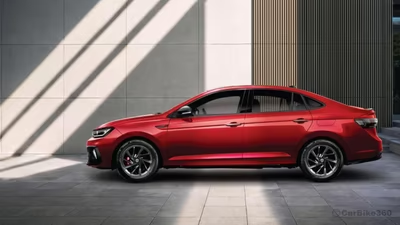
Volkswagen India introduces Virtus sedan anniversary offers with new finance schemes

2026 Renault Kwid Facelift launched in India at Rs 4.53 lakh
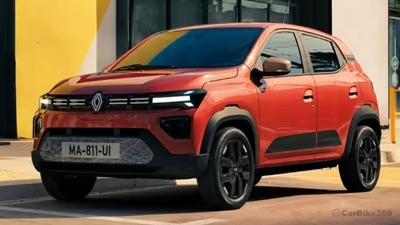
2026 Renault Kwid Facelift launching today: Here’s everything you need to know

Maruti Suzuki XL7 Facelift India launch expected by year end with new design and features
Listen to Car Audios