ELECTRIC
India Passenger Vehicle Sales Set for Record High in Fiscal 2027 Amid Rising Costs
 Add CarBike360 on Google
India's passenger vehicle sector is set for record sales in fiscal 2027, driven by GST cuts and strong domestic demand. Utility vehicles lead growth, while export gains slow amid West Asia conflict and new regulations increase industry costs.

May 13, 2026 07:04 am IST
India's passenger vehicle industry is on track to achieve record annual sales in fiscal 2027, with projected volumes rising 5–7% to about 5.9 million units. This outlook comes from a Crisil Ratings analysis released on May 13, 2026. The forecast covers manufacturers responsible for around 94% of wholesale volumes and reflects strong recovery momentum from the previous fiscal year.
Key Highlights
- Passenger vehicle sales in India projected to reach 5.9 million units in fiscal 2027
- GST rate cut in September 2025 boosted demand and lowered sub-4 metre vehicle prices by 11–13 percent
- Utility vehicles expected to comprise 69 percent of volumes in fiscal 2027
- Export growth to slow due to West Asia conflict and higher transportation costs
- Operating margins forecast to compress to 9.7–10 percent amid rising input and shipping costs
Sales Growth and Market Drivers
The main driver of this growth is the goods and services tax (GST) reduction implemented in September 2025. The GST cut lowered prices by 11–13% on sub-4 metre vehicles, which make up just over half of total industry volumes. As a result, domestic sales surged by 16.7% in the second half of fiscal 2026, reversing a 1.4% decline in the first half. Full-year domestic volume growth for fiscal 2026 reached 7.9%.
Domestic sales account for about 86% of total output, with exports making up the rest. Crisil expects the positive impact of the GST cut to continue into fiscal 2027, though the effect will gradually moderate. Utility vehicles remain the main growth segment, with their share rising to 67% in fiscal 2026 and projected to reach 69% in fiscal 2027. This segment is expected to grow at 7–9%, driven by consumer preference for larger, feature-rich vehicles and a wider range of models.
The small car segment, representing roughly 30% of domestic volume, is forecast to grow at a slower 2–4%. Improved affordability from the GST cut and stable interest rates are supporting this segment, but the shift toward utility vehicles continues to limit its growth.
Export Trends and Regulatory Challenges
Exports grew 17.5% in fiscal 2026, reaching 0.9 million units. West Asia accounts for about 25% of export volume. Ongoing conflict in the region is expected to slow export growth to 6–8% in fiscal 2027 and increase transportation costs.
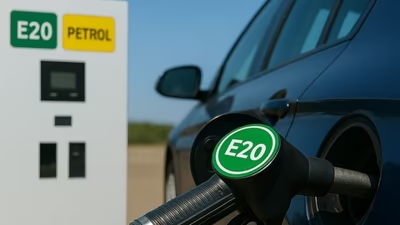
The industry faces new regulatory challenges. The Corporate Average Fuel Efficiency (CAFE-III) norms will take effect from April 1, 2027, and last through fiscal 2032. These standards require tighter fuel efficiency across manufacturers' portfolios, leading to investments in powertrain technology and lightweighting. Bharat Stage VII emission standards and higher ethanol blending targets are also under consideration, adding to costs and capital expenditure.
Electric Vehicles and Financial Outlook
Electric vehicles (EVs) make up about 5% of passenger vehicle volumes. Crisil notes that regulatory changes could accelerate EV adoption, especially as CAFE compliance encourages electrification. However, the pace of EV growth depends on the expansion of public charging infrastructure and the industry's ability to manage higher production costs.
Industry revenue is projected to grow 9–10% in fiscal 2027, mainly from higher volumes and some price increases. Operating margins are expected to narrow by 50–80 basis points to 9.7–10%, down from about 10.5% in fiscal 2026. This decline reflects higher input and shipping costs, which manufacturers have only partly offset through pricing. Despite these pressures, the sector's strong liquidity and near debt-free balance sheets are expected to maintain stable credit profiles.
The outlook for India's passenger vehicle industry depends on commodity and fuel prices, regulatory changes, consumer response to price increases, and broader economic conditions. While record sales are likely, maintaining profitability will require careful management as the industry adapts to new challenges.


You May Like





Find your perfect car

Budget

Brand

Body Type

Fuel

Mileage

More
Latest Car Videos


Top Auto News of the Week: Tata Sierra EV, BMW X6, E85 Fuel & More - Weekly Wrap

Top Auto News of the Week | Hyundai i20 Leak, Honda ZR-V, Tata Sierra EV, Skoda EV & More!

Talking about new Honda City and upcoming ZR-V SUV with Honda India’s Kunal Bahl!

2026 Honda City Launched in India - Better than VW Virtus, Hyundai Verna & Skoda Slavia?
Other Car News


Listen to Car Audios