ELECTRIC
India's used car market to double by FY31 on digital boom and easy financing
 Add CarBike360 on Google
The Indian used-car market is entering a high-growth phase, powered by online platforms, better financing options, and rising demand across urban and rural regions.

By Priya Thakur
May 16, 2026 05:12 am IST

India’s used-car market is projected to nearly double in value to $68-78 billion by FY31, up from around $35 billion in FY26. The market could reach 9-10 million units by FY31, expanding at an 8-11% compound annual growth rate (CAGR) by volume. This growth would make India the world’s third-largest used-car market, after the US and China, according to a report by Redseer Strategy Consultants.
Key Highlights
- India’s used-car market may reach $68-78 billion and 9-10 million units by FY31
- Full-stack platforms could grow to 5-6 percent market share by FY31
- Used-car financing penetration expected to rise to 30-40 percent by FY27
- Average holding period for cars projected to drop to 4-5 years by FY31
- Top eight cities to contribute up to 25 percent of used-car volumes by FY31
Key Growth Drivers and Market Trends
The expansion of India’s used-car market is being driven by rising household incomes, shorter vehicle replacement cycles, improved access to financing, and increasing digital adoption. Redseer expects the country’s car parc to exceed 50 million units by FY31, supported by steady new car sales and low current motorization levels.
Used cars are no longer seen as a compromise purchase. Buyers now use the used-car route to access higher segments, better variants, and lower total ownership costs. The report identifies four buyer types: aspirational buyers, convenience seekers, assurance seekers, and bare-minimum buyers. Nearly 65% of used-car buyers are first-time car owners, making trust, certification, warranty, financing, and documentation essential factors in purchase decisions.
Demand remains concentrated in large cities. The top eight cities are expected to contribute 20-25% of used-car volumes by FY31. Delhi accounts for 25-35% of demand within these metros, while Mumbai, Bengaluru, and Hyderabad together make up another 30-40%. Used cars sold per 1,000 people in top cities are three to four times higher than in non-metro markets. However, as incomes rise and financing improves, Tier 1 and Tier 2 markets are expected to generate more demand.
Organised Players and Platform Evolution
Currently, about 80% of used-car transactions remain unorganized, with an estimated 47,000-52,000 unorganized dealers compared to 2,500-3,000 branded outlets. Organized players, especially full-stack platforms, are expected to increase their market share from 2% to 5-6% by FY31, unlocking a $4-billion opportunity and growing at a 36-44% CAGR. In the top eight cities, their share could reach 15% by FY31.
Full-stack platforms manage the entire transaction process, from sourcing and inspection to sales, financing, and post-sale support. These platforms have an average Net Promoter Score (NPS) of 80%, compared to less than 30% for unorganized channels. However, building such models requires significant capital, inventory management, refurbishment centers, logistics, technology, and trained teams.
Financing and Market Resilience
Used-car financing penetration is expected to rise from 20-30% in FY22 to 30-40% by FY27, supported by increased participation from non-banking financial companies (NBFCs), better valuation tools, and digital processes. The addressable used-car buyer base could expand to 280 million households by FY31 as incomes rise and financing becomes more accessible.
The used-car market has shown resilience during economic shocks. During the Covid-19 pandemic and semiconductor shortages, used-car demand remained steadier than new-car sales. Lower acquisition costs and wider price points make used cars more attractive during downturns. The electric vehicle (EV) transition is not expected to disrupt the core used-car market soon, with over 90% of India’s car parc projected to remain non-EV in the next decade.
Changing Supply and Premiumization
Shorter ownership cycles are expected to bring younger, better-quality used cars to market. The average car holding period in India is projected to drop from 7-8 years in FY21 to 4-5 years by FY31. In metros, the replacement cycle could shorten to 3-4 years. The average selling price of used cars is expected to rise from Rs 5 lakh in FY26 to Rs 6.5-6.9 lakh by FY31, reflecting premiumization and a richer inventory mix. The share of utility vehicles in used-car sales is projected to increase, while hatchbacks are expected to lose share.
For organized players, the challenge is to build trust, control quality, and manage inventory risk while remaining profitable in a market dominated by unorganized dealers. Full-stack platforms could set new benchmarks for trust and process quality, helping India’s used-car market become a key growth engine for the auto retail sector.
Also Read: Delhi halts new petrol and diesel vehicle purchases for 6 months to save fuel
CarBike 360 Says
India’s used-car market is clearly on a fast growth trajectory, supported by digital transformation and expanding financing accessibility. As organized players bring transparency and trust, more buyers are entering the segment. With rising demand across Tier 2 and Tier 3 cities, the sector is well-positioned to become a key pillar of India’s automotive ecosystem by FY31.


You May Like


Find your perfect car

Budget

Brand

Body Type

Fuel

Mileage

More
Latest Car Videos


Top Auto News of the Week: Tata Sierra EV, BMW X6, E85 Fuel & More - Weekly Wrap

Top Auto News of the Week | Hyundai i20 Leak, Honda ZR-V, Tata Sierra EV, Skoda EV & More!

Talking about new Honda City and upcoming ZR-V SUV with Honda India’s Kunal Bahl!

2026 Honda City Launched in India - Better than VW Virtus, Hyundai Verna & Skoda Slavia?
Other Car News
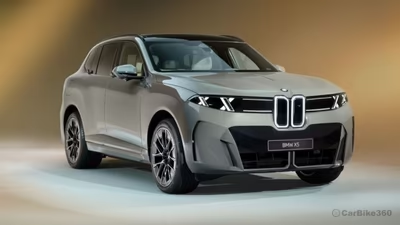
BMW unveils fifth-generation X5 with five powertrain options and 845 km range
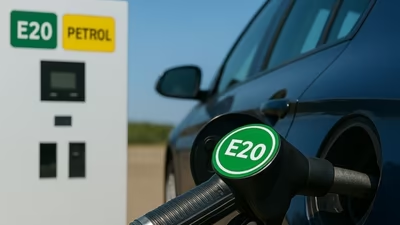
Government clarifies E20 fuel policy, not an experiment amid media reports
Maruti Suzuki reecords 19.3% sales growth in June 2026, surpassing 2 lakh units
Kia strengthens Seltos lineup with new GTX(O) and X-Line(O) top trims in India
Listen to Car Audios