ELECTRIC
ISMA urges government to advance to E22 ethanol blend, seeks lower GST on flex-fuel vehicles
 Add CarBike360 on Google
The Indian Sugar Mills Association (ISMA) is pushing policymakers to adopt the E22 ethanol blend and lower GST rates on flex-fuel vehicles, aiming to strengthen India’s ethanol economy.

Apr 06, 2026 08:56 am IST

India's ethanol blending program faces a critical juncture as production capacity far exceeds current consumption. The Indian Sugar & Bio-Energy Manufacturers Association (ISMA) advocates for an immediate move to E22 blending and a reduction in GST on E100 to make flex-fuel vehicles more viable. With global crude oil prices above $110 a barrel, ISMA argues that these steps are essential for energy security and industry sustainability.
Key Highlights
- ISMA calls for immediate shift from E20 to E22 ethanol blending
- India's ethanol production capacity is double current consumption levels
- Flex-fuel vehicles need lower GST on E100 to become commercially viable
- Automakers and ISMA discuss technical and cost challenges of higher ethanol blends
Ethanol Production and Consumption Gap
India's ethanol production capacity stands at nearly 2,000 crore litres annually, with an additional 400 crore litres expected next year. However, E20 blending currently requires only about 1,100 crore litres, resulting in just 50 percent capacity utilization. ISMA Director General Deepak Balani notes that this underutilization is not economically sustainable for distilleries. Government incentives have expanded production, but policy support for increased consumption has lagged.
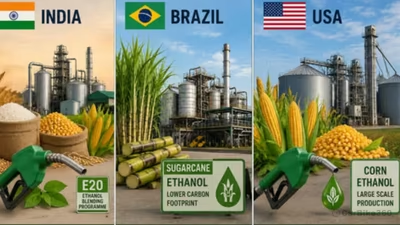
Export is not a short-term solution. Indian ethanol, produced from sugarcane, is less competitive globally due to high feedstock costs. The Fair and Remunerative Price (FRP) paid to farmers makes up around 75 percent of production costs, making Indian ethanol more expensive than US corn-based ethanol.
Policy Recommendations and Industry Response
ISMA proposes a step up from E20 to E22 lubricant as an immediate measure. Balani states that vehicles compliant with E20, mandatory for new vehicles from 2023, can handle E22 without recalibration. He cites scientific evidence and Brazil's experience, where E20-compliant vehicles have managed blends up to 25 percent.
Increasing the blend from E20 to E22 would absorb an additional 150 crore litres of ethanol. On fuel efficiency, Balani acknowledges a 2–3 percent overall drop, based on ARAI and OEM data. However, Autocar India tests show drops of up to 12 percent in older vehicles, highlighting the need for proper engine calibration.
Flex-Fuel Vehicles and Future Pathways
ISMA's long-term vision involves mainstreaming flex-fuel vehicles, similar to Brazil, where 74.4 percent of new light vehicle registrations in 2025 were flex-fuel. Balani stresses the need for competitive E100 pricing and eliminating the cost premium for flex-fuel vehicles. With ethanol at Rs 67 per litre and 5 percent GST, E100 could retail at Rs 80–82 per litre, undercutting petrol if GST is reduced.
Draft CAFE-3 norms may offer super-credits for biofuel vehicles, and NITI Aayog's Net Zero report supports flex-fuel adoption. However, automakers remain cautious, citing costs and technical challenges. ISMA is in discussions with industry bodies to find common ground. Retrofit kits for older vehicles are being tested but remain in pilot stages.
Challenges and Outlook
2026 may be a turning point, with the government considering steps to boost ethanol consumption and reduce crude imports. ISMA advocates a two-track approach: a near-term move to E22 and policy changes to support flex-fuel vehicles.
Higher blends will reduce fuel efficiency and may increase wear in older vehicles, but most new cars are future-proofed for E30. The final blending baseline remains under debate, as policymakers and automakers weigh technical and consumer impacts.
Also Read: Oil India and CSIR-IMMT signed strategic MoU for joint critical minerals research
CarBike 360 Says
The ISMA’s proposal reflects India’s growing commitment to sustainable fuel solutions and carbon reduction. Moving to E22 and easing taxes on flex-fuel vehicles could accelerate adoption, strengthen domestic ethanol production, and reduce reliance on fossil fuels. With proactive policy support, India can pave the way for a cleaner, more self-reliant automotive future powered by indigenous biofuels.


You May Like





Latest Lubricant Videos


Other Lubricant News
BSSPL deploys AI-Driver monitoring across aviation fuelling fleet at major airports
LIQUI MOLY introduces hybrid and OAT ready mix motorcycle coolants globally

Tata Motors and HPCL Pilot used lubricant recycling initiative in India

Petrol prices rise again in Delhi and Mumbai amid global supply disruptions
Listen to Lubricant Audios