ELECTRIC
Jaguar Land Rover aims £1.7 billion cost savings to cut Breakeven volumes
 Add CarBike360 on Google
JLR is focusing on major cost optimizations to strengthen financial resilience and improve margins in a competitive global market.

May 19, 2026 05:42 am IST
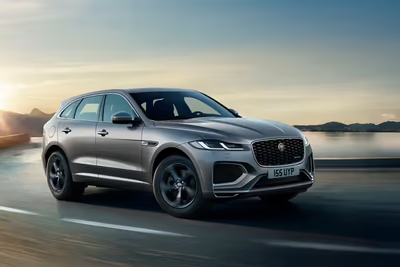
Jaguar Land Rover (JLR) plans to reduce its breakeven volume to 300,000 units over two years. The company aims to achieve this through £1.7 billion in savings, focusing on cost, warranty, procurement, and digital productivity. This initiative follows a challenging FY26, which saw tariffs, cyber disruptions, weaker demand in China, and increasing supply-side pressures.
Key Highlights
- Jaguar Land Rover targets £1.7 billion in savings over two years
- Company aims to reduce breakeven volume to 300,000 units annually
- Cost, warranty, procurement, and digital productivity are main focus areas
- FY26 saw 308,000 wholesale units and £6.87 billion in Q4 revenue
- Middle East conflict and supply-side inflation pose ongoing challenges
Cost-Reset Programme Details
JLR’s cost-reset program will use "Enterprise Missions" to drive savings. These missions will target cost reduction, productivity improvement, and disciplined product launches. The company has made flawless execution of upcoming launches a priority for the next 18 months.
Dheeman Gupta, CFO of Tata Motors Passenger Vehicles Ltd., said that reducing breakeven volumes is a top priority. He emphasized the importance of the £1.7 billion savings to bring cash breakeven volumes back to 300,000 units. Gupta made these remarks during the Q4FY26 earnings call.
In Q4 FY26, JLR reported 95,000 wholesale units, £6.87 billion in revenue, and a 9.2% EBIT margin. The company generated £829 million in positive cash flow during the quarter. Richard Molyneux, CFO of JLR, stated that the company met its Q4 and full-year guidance. JLR ended FY26 with a 0.7% EBIT margin, within its 0-2% guidance range, and a full-year cash loss of just over £2.2 billion, which was better than the guided range of -£2.2 billion to -£2.5 billion.
Focus Areas for Savings
For FY26, JLR reported 308,000 wholesale units, with the Defender, Range Rover, and Range Rover Sport as top performers. The Defender model showed strong growth both quarter-on-quarter and year-on-year in Q4.
P B Balaji, CEO of JLR, explained that previous efforts had reduced breakeven volumes to 300,000-320,000 units. However, new challenges have increased costs, including tariffs, changes in product mix due to EVs, currency shifts, and commodity inflation.
JLR will focus on three main areas to achieve the £1.7 billion savings. The first area is end-to-end delivered cost, including raw material sourcing and procurement. A new procurement vertical now reports directly to the board, highlighting the importance of strategic sourcing.
The second area is warranty costs. While product quality indicators have improved, repair costs have risen, especially in the US market.
The third area is IT and digital productivity. JLR expects its investments in IT and digital systems to deliver productivity gains. The recent cyber incident showed the need to simplify the technology landscape. Balaji said benefits from these efforts should start appearing in the second half of the year.
Market and Structural Challenges
JLR said demand remains stable, but supply-side pressures have grown more complex. The Middle East conflict is expected to affect sales in the region in Q1, which accounts for about 6% of JLR’s total sales. The company expects the impact to be temporary, with underlying demand for its brands remaining steady.
On the cost side, the conflict may increase utility costs, freight rates, and component costs linked to petrochemicals. JLR has not yet experienced component shortages but remains concerned about supply-side inflation. The company also faces broader challenges, including geopolitical volatility, protectionism, uneven EV adoption, rules-of-origin requirements, and regulatory uncertainty.
CarBike 360 Says
Jaguar Land Rover’s aggressive £1.7 billion savings plan highlights its commitment to long-term financial stability and operational efficiency. By lowering breakeven volumes, the company is better positioned to navigate market uncertainties and invest in future mobility solutions. This strategic shift could play a crucial role in strengthening JLR’s competitiveness in the evolving global automotive landscape.


You May Like


Find your perfect car

Budget

Brand

Body Type

Fuel

Mileage

More
Latest Car Videos

Top Auto News of the Week: Tata Sierra EV, BMW X6, E85 Fuel & More - Weekly Wrap

Top Auto News of the Week | Hyundai i20 Leak, Honda ZR-V, Tata Sierra EV, Skoda EV & More!
Talking about new Honda City and upcoming ZR-V SUV with Honda India’s Kunal Bahl!
2026 Honda City Launched in India - Better than VW Virtus, Hyundai Verna & Skoda Slavia?
Other Car News

Listen to Car Audios