ELECTRIC
Driverless Cars in India promise Peril and the need for stronger guardrails
 Add CarBike360 on Google
Autonomous vehicles could reshape India’s mobility landscape, but safety concerns, infrastructure gaps, and regulatory readiness remain critical hurdles.

Jul 14, 2026 06:12 am IST

Driverless cars may sound like the next great leap in mobility, but the real story is more complicated. In India, the most useful near-term gains are coming not from fully autonomous vehicles, but from ADAS features such as lane assist and adaptive cruise control, which are already finding their way into mainstream models.
That progress brings convenience and safety, but it also introduces new risks that the industry cannot ignore. As vehicles become more software-led, questions around reliability, cybersecurity, accountability, and ethical decision-making are moving from theory to the centre of the road safety conversation.
The Rise of ADAS
The article’s core point is simple: full autonomy may still be a distant goal for India, but the building blocks of that future are already here. Features like lane-keeping assist and cruise control are valuable in the right conditions, yet they depend on sensors, software, and assumptions that do not always match the realities of Indian roads. Narrow lanes, unclear markings, unpredictable traffic, and frequent edge cases can expose the limits of machine learning-based driving systems.
That does not make the technology useless. It means the industry must present it honestly, as driver assistance rather than driver replacement, and ensure that buyers understand the gap between convenience and full autonomy. One cited example from CarDekho shows how overconfidence in ADAS can quickly become dangerous when a driver treats assistance features as a substitute for attention.
Safety Limits On Indian Roads
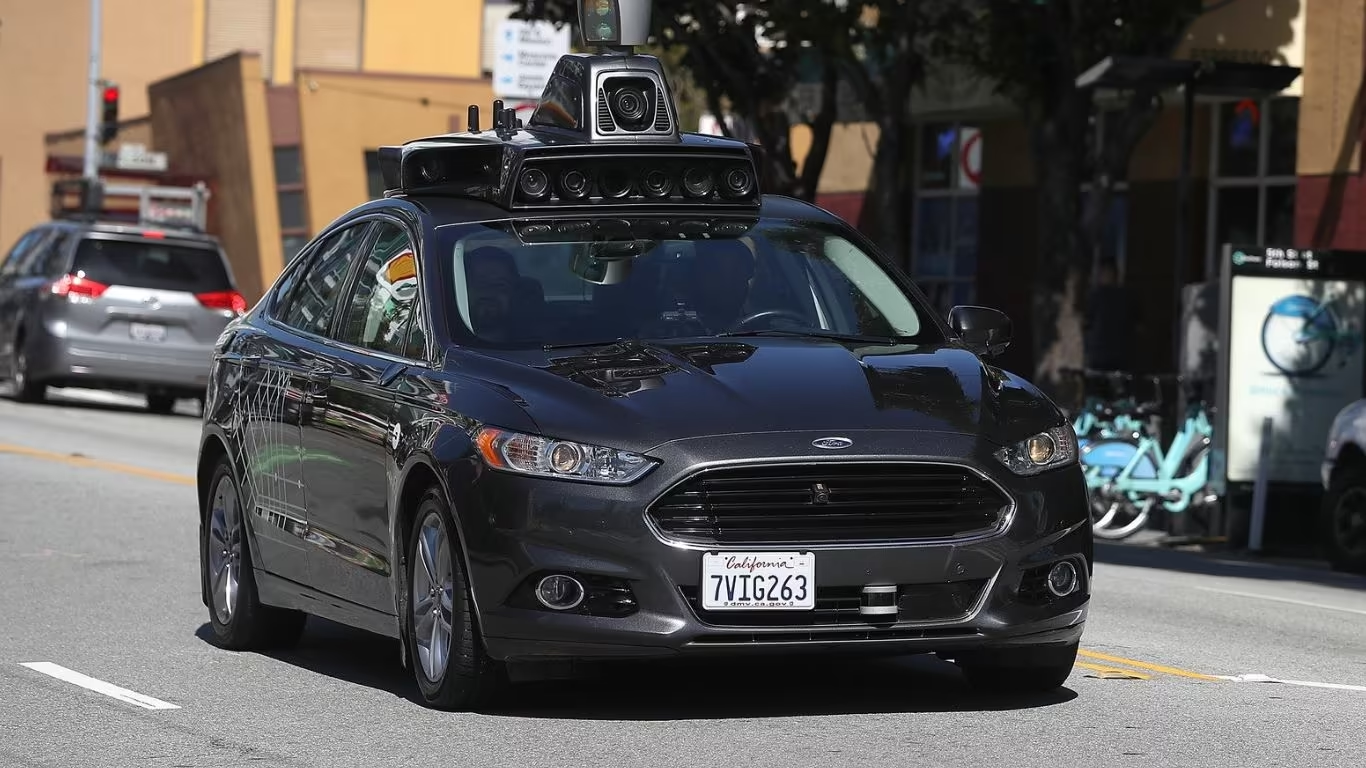
The report also highlights a practical issue: systems trained on limited datasets can struggle with rare but critical situations. Human drivers still have an advantage in contextual judgement, especially when road conditions fall outside the scenarios the software has learned. In dense metro traffic or on poorly marked highways, that limitation matters far more than it would in controlled demonstrations.
Real-world incidents underline the concern. A Team-BHP discussion cited in the source material describes a case where an ADAS-equipped vehicle reportedly failed on a sharp turn, reinforcing the idea that automation can still misread road geometry and conditions. The broader lesson is not that ADAS should be avoided, but that it should be designed and marketed with clear boundaries, not hype.
Cybersecurity Risks
As cars become connected machines, they also become digital targets. The article argues that modern autonomous and semi-autonomous vehicles rely on cyber-physical systems with many sensors and that weak protection in one area can create a pathway to deeper vehicle control.
This is a major shift from the older era, when vehicles mostly functioned in isolation.
Cloud communication adds another layer of risk because it opens channels for spoofing and hacking. That makes cybersecurity a safety issue, not just an IT concern. For OEMs, the implication is clear: secure-by-design architecture must become as important as crash testing and powertrain validation.
In July 2026, Maj. Vineet Kumar, Founder and Global President, CyberPeace stated that organisations handling sensitive data must act now to prepare for quantum threats because in today's digital era, encryption may become as transparent as an "open book". He also spoke at the Centre for Land Warfare Studies Seminar on protecting digital ecosystems from evolving threats in the upcoming future.
Liability And Ethics
One of the strongest parts of the report is its focus on accountability. Traditional accident law assumes a clear human driver responsibility, but autonomous systems complicate that framework by spreading risk across manufacturers, software developers, data providers, and regulators. When something goes wrong, that ambiguity can delay compensation and weaken public trust.
The ethical challenge is just as serious. If an AI system must choose between two harmful outcomes, who decides the priority order, and according to what standard? The article argues that without transparent reasoning and a clear regulatory structure, such decisions remain hidden inside proprietary software while the consequences are felt on the road.
India Needs Regulation
The conclusion is direct: India needs a stronger, more regulated semi-automated vehicle regime. The source notes the country’s high road fatality burden and argues that ADAS must be treated as part of a larger system involving artificial intelligence, cybersecurity, law, and public safety. That framing is important because it moves the conversation beyond gadgetry and into governance.
Also Read: Will Motor Insurance Become Cheaper Under IRDAI's 2026 Reforms?
CarBike 360 Says
Driverless cars in India offer transformative potential, from improved safety to smarter mobility solutions. However, without robust regulations, reliable infrastructure, and clear accountability frameworks, risks could outweigh benefits. A balanced approach combining innovation with strict guardrails will be essential to ensure that autonomous technology evolves responsibly and gains public trust in the years ahead.


You May Like






Find your perfect car

Budget

Brand

Body Type

Fuel

Mileage

More
Other Car Articles




Listen to Car Audios