ELECTRIC
India’s GST Reboot Accelerates the Auto Industry: A Game-Changer for Cars, Bikes & EVs
 Add CarBike360 on Google
Discover how India’s groundbreaking 2025 GST reform on automobiles is set to make cars, bikes, and electric vehicles more affordable, as new tax slabs drive major price reductions and shape the automotive industry.

By Utsav Chaudhary
Sep 04, 2025 05:58 am IST

The Government of India is planning to enforce new rules and regulations of the GTS regime on September 22, 2025. As a result, these new rules and regulations will directly affect car and bike prices across the country. The new GTS tax slab regime marks a watershed moment for automobile taxation, following the GST Council’s announcement. This new reform is set to align the automotive market and bring changes for both brands, dealers, and buyers.
As stated earlier, the Indian government has reduced tax rates on certain categories of cars and bikes, depending upon their engine specifications and overall design and dimensions. For instance, petrol, diesel, and hybrid cars were previously taxed at 28%, but now, with the latest amendment, these vehicles will be taxed under the new GST regime slab. Let's take a look at what changes the new GTS tax slab regime has brought to the automotive world, as well as who wins and loses when it comes to product taxation.
From Old to New: GST Slab Changes Diversified
As per the latest reports, released by the parliament of India, the new tax system brought valuable goods to cars and bikes in the second quarter of the 2025 season. Previously, the GST framework would impose 28% taxation on all passenger vehicles (excluding EVs), with additional cess ranging from 1 to 22%. This additional cess was taxed on the basis of engine type, fuel type, and body type (hatchback, sedan, luxury, SUV, MPV).
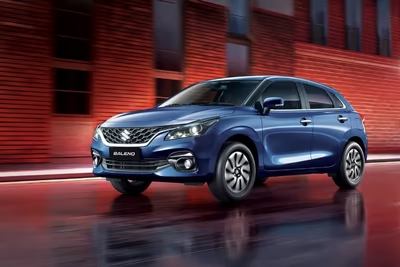
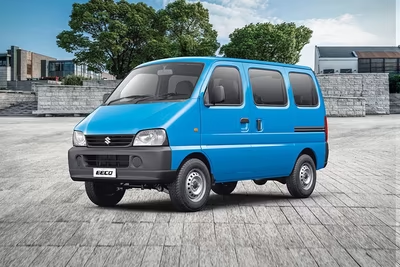
Under the new GST tax system, entry-level models of cars and bikes will become particularly cheaper. Petrol, LPG, and CNG cars with engines below 1200 cc and diesel cars up to 1500 cc will now be placed under the 1*% tax regime category. However, those cars that are not longer than 4,000 mm will be placed under such a slab.
The GST Council has scrapped the 12% and 28% slabs for automobiles, introducing three primary rates effective September 22, 2025, in India. To gain a better understanding of each tax regime slab, let us examine the most recent GST taxation upgrades.

- 18% GST for Small Cars and Bikes: The new GST tax slab now classifies entry-level cars and bikes under the 18% GST slab. But there is a condition for those cars that run on petrol and CNG, equipped with an engine below 1200 cc, and the diesel cars that are equipped with 1500 cc, provided they are not longer than 4000 mm in wheelbase, which are now subject to 18% taxation rates.
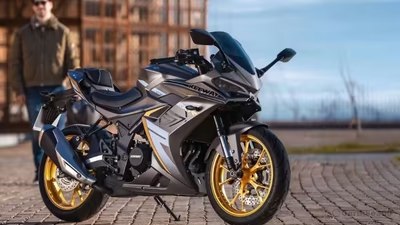
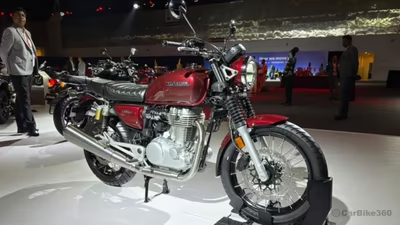
- On the other hand, in the case of two-wheelers, the bikes that offer powertrain units up to 350 cc are ready to enjoy the new pricing with the now 18% tax implementation.
- 40% GST for Larger Cars, SUVs, and Big Bikes: Cars exceeding the small car definition or larger motorcycles face a flat 40% rate. This new tax slab might bring pain for premium car buyers. All mid-size cars that offer an engine above 1200 cc in petrol and 1500 cc in diesel, even measuring longer than 4000 mm in wheelbase, will now attract a 40% GST across the nation.
- This will also apply to two-wheelers with powertrain units of more than 350 cc, regardless of body type (racing, sports, commuter, or naked).
- 18% GST on All Auto Parts: Standardizing this category eliminates confusion and variance irrespective of HS codes.
Passenger Vehicles: Who Wins and Loses?
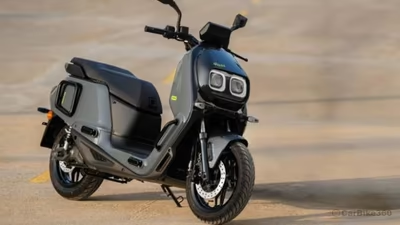
Electric Vehicles: No changes in the taxation
Conclusion


You May Like




Find your perfect bike

Brand

Budget

Body Type

Fuel

Mileage

More
Latest Bike Videos





Other Bike News
Listen to Bike Audios