ELECTRIC
Epsilon launches hard carbon anode to boost sodium-ion battery sustainability
 Add CarBike360 on Google
Epsilon’s new hard carbon anode could accelerate the adoption of sodium-ion batteries by lowering emissions and production costs.

May 18, 2026 09:54 am IST

Epsilon Advanced Materials Private Limited has launched a hard carbon anode material for sodium-ion batteries. The company announced the development on May 18, 2026, aiming to address the growing demand for grid-scale energy storage. This new material eliminates graphite dependency and reduces carbon emissions by 50 percent compared to standard production methods.
Key Highlights
- Epsilon launched a hard carbon anode for sodium-ion batteries on May 18, 2026
- The material eliminates graphite use and cuts carbon emissions by 50 percent
- Production uses coconut shell waste and lower processing temperatures
- Facility in Bellary targets 30,000 tons per year by 2028 and 100,000 tons by 2031
New Anode Targets Energy Storage
The hard carbon anode is designed for sodium-ion batteries, which are gaining popularity for grid-scale storage. Sodium-ion chemistry is attracting interest due to its lower environmental impact and the abundance of sodium compared to lithium. Major battery manufacturers, including CATL and several Indian cell producers, are expanding sodium-ion production to meet rising energy storage needs.
Epsilon’s anode uses coconut shell waste as its raw material. The process involves controlled pyrolysis and high-temperature carbonization. This bio-based approach eliminates the need for graphite and uses lower processing temperatures. As a result, the process emits up to 50 percent less carbon dioxide than conventional anode manufacturing.
Technical Features and Production Plans
The new material features an engineered microarchitecture. This design provides high reversibility and fast charge-discharge capability. It also supports an extended cycle life, allowing for thousands of charge cycles in grid storage applications.
Vikram Handa, Managing Director of Epsilon Group, said sodium-ion batteries offer a viable solution for long-term energy storage. He noted that the technology leverages raw materials widely available in India, supporting domestic supply chains.
Epsilon has already set up a graphite anode customer qualification facility in Bellary, Karnataka. The company plans to produce 30,000 tons of anode material per year by 2028. It aims to scale up production to 100,000 tons per year by 2031.
Industry Context and Outlook
The launch comes as the battery industry seeks sustainable alternatives to lithium-ion technology. Sodium-ion batteries are gaining commercial traction due to their lower cost and environmental benefits. The use of agricultural byproducts in anode production further reduces environmental impact and supports circular economy practices.
Global and domestic battery manufacturers are investing in sodium-ion technology to meet the growing demand for grid-scale storage. Epsilon’s new hard carbon anode is positioned to support this shift by offering a sustainable, high-performance solution for large-scale energy storage systems.
Also Read: Rocklink India inaugurates advanced battery and magnet recycling plant in Uttar Pradesh
CarBike 360 Says
With its latest innovation, Epsilon reinforces the potential of sodium-ion batteries as a viable, eco-friendly alternative to lithium-based systems. The hard carbon anode not only enhances efficiency but also supports a lower-emission future. As industries seek scalable and sustainable solutions, developments like this could accelerate the transition toward greener and more resilient energy storage worldwide.


You May Like


Latest Battery Videos


Other Battery News
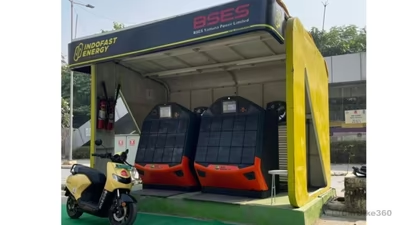
Indofast Energy and Hala Mobility target 40,000 EVs with battery swapping expansion by 2027
Tata Group prioritises cybersecurity and local battery production for EV growth
JSW Green Mobility invests in lithium urban technologies to accelerate electric fleet growth
India stationary energy storage market to grow thirtyfold by 2032
Listen to Battery Audios