ELECTRIC
How software and AI are transforming the automotive industry and shaping India’s future
 Add CarBike360 on Google
Software and artificial intelligence are redefining the global automotive landscape, with India emerging as a key hub for innovation, development, and future mobility solutions.

Jul 05, 2026 12:15 pm IST
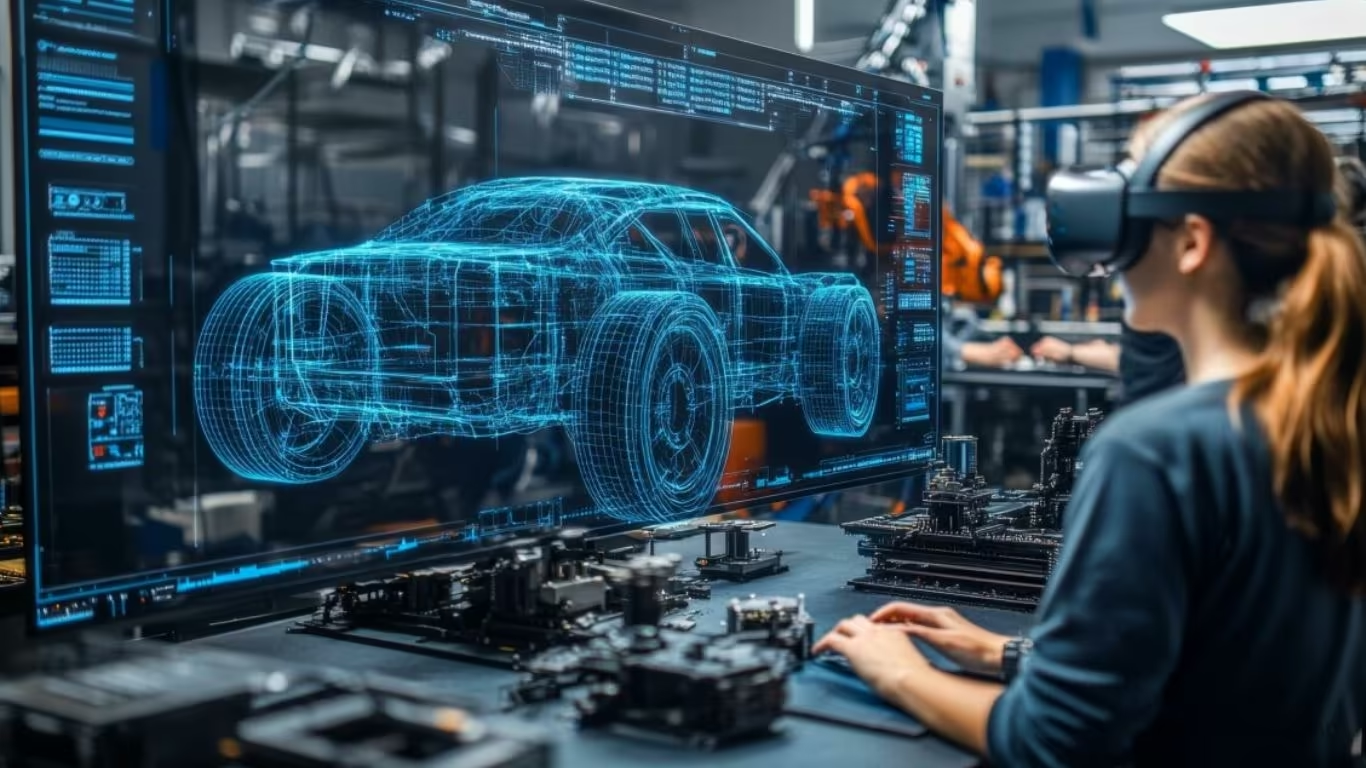
Software-defined vehicles (SDVs) have become a major strategic focus for the automotive industry. As vehicles become more connected and software-driven, the industry is shifting its attention to organisational structures, development methods, partnerships, and engineering talent. Dr Matthias Traub, President & Managing Director of Vector Informatik GmbH, discusses the impact of software and artificial intelligence (AI) on vehicle development and India's potential as a leader in software-defined mobility.
Key Highlights
- Software has become the main value driver in the automotive industry.
- AI is reshaping vehicle development and engineering workflows.
- India is positioned as a key global hub for automotive software.
- Collaboration and organisational change are essential for software-defined mobility.
- ADAS and autonomous systems require robust validation and transparent AI integration.
Software as the Primary Value Driver
Over the past decade, software has moved from a supporting role to become the main value driver in automotive. Customers now expect seamless updates, continuous improvements, and new features, similar to consumer electronics. This shift means automotive companies must manage complex software-driven systems throughout a vehicle's lifecycle. AI is accelerating development and enabling more sophisticated systems.
The challenge for original equipment manufacturers (OEMs) is to manage these systems with suppliers and technology partners. Software now determines adaptability, innovation speed, and long-term competitiveness.
Traditionally, automotive development was tool-driven or platform-driven. In the SDV era, organisations need integrated software ecosystems. Architecture, toolchains, safety, security, and functionality must work together consistently.
Isolated optimisations create inefficiencies as software complexity grows. Scalable development environments are now essential. Vector Informatik positions itself as an SDV solution partner, helping customers build foundations for software-defined mobility.
AI and Organisational Transformation
AI is influencing all aspects of vehicle development, including engineering, validation, and advanced driver-assistance systems (ADAS). However, adopting AI requires changes in development processes.
The traditional V-model is giving way to DevOps approaches, emphasising continuous integration and agility. AI should be integrated into end-to-end workflows, not added as an afterthought. Human expertise remains crucial for defining requirements and reviewing AI outputs, as AI systems can produce errors or hallucinations.
The role of automotive software engineers is changing. Coding is increasingly handled by AI agents, while engineers focus on systems expertise, architecture, validation, and quality assurance. Companies must train teams in systems engineering, AI supervision, and requirement definition. This shift will be significant over the next decade.
India's Position in Software-Defined Mobility
India has become a major engineering and software hub for the global automotive industry. However, the transition to fully software-defined vehicles is ongoing. The industry needs the right technologies, skills, and organisational structures. Collaboration between OEMs, suppliers, and engineering companies must improve. Traditional hierarchical models are less effective in a software-defined environment. Mixed teams must work together to solve problems and drive innovation.
India's opportunity is to combine its engineering talent and growing ecosystem to become a key player in software-defined and AI-defined mobility. Achieving this requires continued investment in skills, collaboration, and development ecosystems. The goal is for India to operate at the same level as leading global mobility ecosystems within five years.
Challenges and Future Directions
ADAS technologies face challenges in India due to road infrastructure, traffic behaviour, and economic factors. Technological solutions, such as better sensors and improved algorithms, can address some issues. However, affordability remains critical. Simulation, virtual validation, and integrated toolchains are essential for validating ADAS and autonomous systems at scale. AI supports scenario generation and validation, but safety-critical systems require transparency, traceability, and trust.
Semiconductor companies are now delivering system-level solutions, changing traditional relationships in the value chain. Partnerships between software providers, semiconductor companies, and OEMs are becoming more important. Stable ecosystems and co-creation models will be vital as software complexity increases.
Also Read: India blocks chinese linked battery apps over EV cybersecurity concerns
CarBike 360 Says
As software and AI continue to redefine mobility, the automotive industry is shifting from hardware-driven engineering to intelligent, data-powered ecosystems. India stands at the forefront of this transformation, fuelled by talent, innovation, and digital adoption. The coming years will not just reshape vehicles but also redefine how people experience mobility, making it smarter, safer, and more connected.


You May Like





Find your perfect car

Budget

Brand

Body Type

Fuel

Mileage

More
Latest Car Videos


Top Auto News of the Week: Tata Sierra EV, BMW X6, E85 Fuel & More - Weekly Wrap

Top Auto News of the Week | Hyundai i20 Leak, Honda ZR-V, Tata Sierra EV, Skoda EV & More!

Talking about new Honda City and upcoming ZR-V SUV with Honda India’s Kunal Bahl!

2026 Honda City Launched in India - Better than VW Virtus, Hyundai Verna & Skoda Slavia?
Other Car News
Listen to Car Audios