ELECTRIC
India-EU FTA Explained: Here's What Buyers Should Know
 Add CarBike360 on Google
The India-EU FTA reshapes long-term strategy for European automakers but offers little immediate pricing relief for Indian buyers.

Jan 29, 2026 08:14 am IST

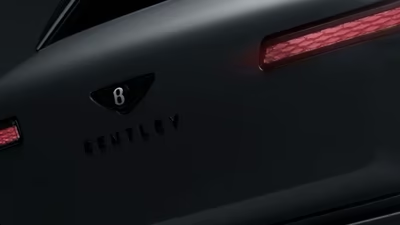
The long-awaited India-European Union Free Trade Agreement (FTA) has finally been concluded after nearly 16 years of negotiations, drawing significant attention across the automotive sector. The highlight of the deal is that it includes a sharp reduction in import duties on European cars. However, the Industry leaders say the agreement will not lead to immediate price cuts for luxury vehicles in India. Instead, the FTA is expected to reshape long-term product strategy, manufacturing competitiveness, and supply-chain integration for European automakers operating in the country. Let's have a close look at the India-European Union FTA Agreement
Read More: Tata XPRES Petrol & Twin-Cylinder CNG Launched
Key Highlights
- India-EU FTA reduces EU car import duties gradually.
- Phased cuts apply to 250,000 annual vehicle quota.
- CKD assembly limits immediate pricing benefits for buyers.
- No tariff relief for European electric vehicles initially.
- FTA strengthens supply chains, planning, and long-term growth.
Limited Short-Term Price Impact
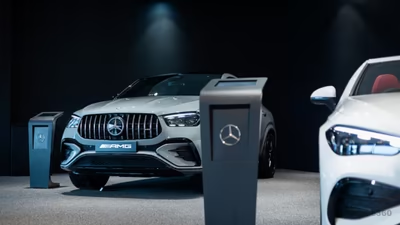
The biggest highlight that drew the attention is the announcements of gradual reduction in import duties on EU-made cars from current levels of up to 110 percent to as low as 10 percent. These cuts will be implemented in phases over five years and apply to a limited annual quota of 250,000 vehicles. According to Santosh Iyer, Managing Director and CEO of Mercedes-Benz India, expectations of near-term price drops are misplaced. He says the agreement should be viewed as a structural, long-term growth enabler rather than a short-term pricing trigger.
How Car Import Duties Will Change
Category | Current Duty | Under India–EU FTA |
CBU cars under USD 40,000 | ~70% | Phased reduction |
High-value CBU imports | Up to 110% | Gradual cut to 10% |
Annual import quota | Not applicable | 250,000 units |
Electric vehicles | Same as ICE | No relief for 5 years |
While these numbers look significant on paper, their real-world impact on pricing remains limited.
CKD (Completely Knocked Down) and Pricing Benefits

A very significant reason why European car prices are unlikely to fall is the dominance of local assembly in India’s luxury car market. More than 90 percent of luxury vehicles sold in India are assembled locally using Completely Knocked Down (CKD) kits, a model already designed to reduce import costs. Brands such as Mercedes-Benz, BMW, Audi and Jaguar Land Rover manufacture or assemble most of their India-spec models at local facilities. Import duty on CKD kits is about 16.5 percent, significantly lower than for complete cars. Since the FTA primarily benefits CBU imports, its pricing impact on locally assembled vehicles is minimal.
Why Tariff Savings Aren’t Passed to Buyers
Luxury vehicle pricing in India has never been a simple addition of European ex-factory prices and duties. Automakers follow a market-calibrated pricing strategy based on demand, positioning, and long-term brand planning. Santosh Iyer explained that even before the FTA, tariffs were not fully passed on to customers. In many cases, equivalent European models would cost significantly more in India if pricing strictly followed duty structures. This means that even when duties fall, manufacturers are more likely to absorb the benefit to manage costs rather than reduce sticker prices.
What Changes for Automakers
While consumers may not see immediate benefits, the FTA significantly improves the operating environment for European carmakers in India.
Key Gains for OEMs Include
- Greater tariff certainty for future product planning
- Easier sourcing of components from Europe
- Improved feasibility of niche CBU model introductions
- Stronger supply-chain integration
- Better long-term cost visibility
Executives from BMW Group India and Skoda Auto Volkswagen India have echoed similar views, stating that the agreement improves strategic flexibility rather than short-term pricing. Moreover, Automakers that rely entirely on CBU imports could see limited early benefits under the quota system. Potential beneficiaries include Porsche, Ferrari, Lamborghini. However, even for these brands, pricing relief will depend heavily on quota availability, currency trends, and global pricing strategies.
Electric Vehicles and Timeline
The FTA does not offer tariff concessions for Battery Electric Vehicles (BEVs) for at least the first five years. This effectively rules out any near-term reduction in prices for imported European EVs. This move aligns with India’s broader goal of pushing forward the domestic EV manufacturing and protecting local investments in the segment. Although discussions are underway to implement the agreement by 2027, the actual economic impact will take time to filter through. Industry estimates suggest an 18–24-month period post-implementation before meaningful changes are visible. Until then, pricing decisions will continue to be driven by exchange rates, input costs, and local demand.
Why the FTA Still Matters for the Auto Industry
Even though the FTA won’t lower car prices immediately, it is still very important for the automotive sector. The agreement helps support long-term growth in demand for premium vehicles, allows manufacturers to allocate more models to India, speeds up the introduction of global models, and makes it easier to source components and access new technologies. Historically, higher per-capita income has driven luxury car sales in India, and with closer economic integration, automakers expect demand to continue growing steadily over the next decade.
Read More: 2026 Renault Duster VS Old Renault Duster: Differences Explained
Verdict
The India-EU FTA is a strategic win for automakers, not consumers. While luxury car prices in India won’t drop immediately due to local assembly dominance, phased tariff cuts, and currency pressures, the deal strengthens long-term planning, supply-chain integration, and premium vehicle allocation. For Europe-based automakers, it provides stability and growth potential, positioning India as a key market for the next decade.


You May Like


Find your perfect car

Budget

Brand

Body Type

Fuel

Mileage

More
Latest Car Videos




Other Car Articles



Listen to Car Audios