

 ELECTRIC
Is Paying ₹50 Extra for Nitrogen Tyres Actually Worth It?
 Add CarBike360 on Google
Many fuel stations now offer nitrogen tyre filling for an extra charge. But does it really improve fuel efficiency, tyre life, and safety? Here's what Indian vehicle owners should know.

By Swati Tomar
Jun 11, 2026 08:49 am IST
Published On
Jun 11, 2026 08:49 am IST
Last Updated On
Jun 11, 2026 08:49 am IST
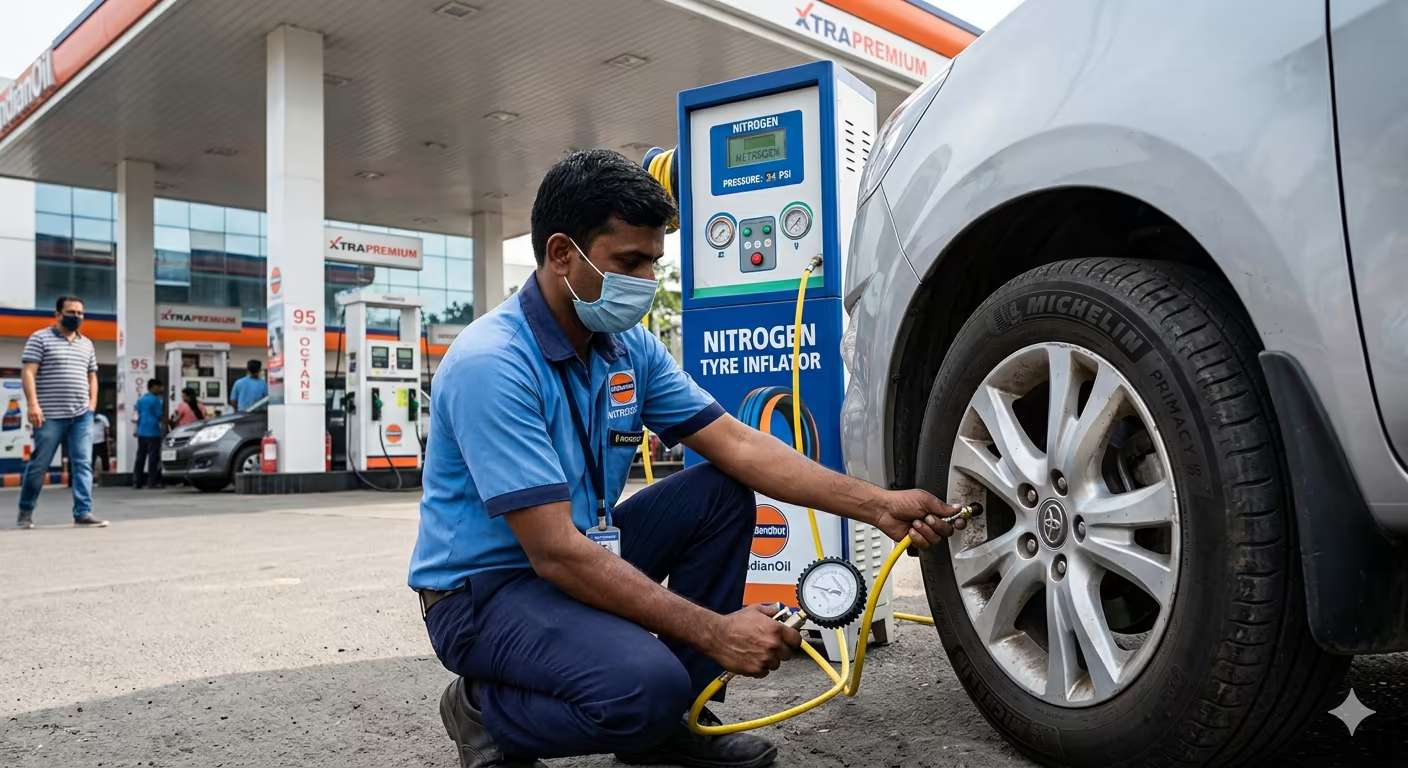
“Would you like nitrogen in your tyres?” – is the question you’ll hear at almost every fuel station today. For an extra ₹20- ₹50 per tyre, vehicle owners are promised better fuel efficiency, improved vehicle safety, and enhanced tyre life. But is nitrogen tyre filling actually worth the extra cost, or is it just an add-on service offering no real benefits?
Based on the views of tyre experts, and on the real-world usage patterns, here’s what Indian vehicle owners need to know.
Let’s separate the facts from the claims here!
Table of Contents
- What Is Nitrogen Tyre Filling Exactly?
- Why Do Petrol Pumps Push Nitrogen Tyres?
- Does Nitrogen Really Aid Better Tyre Pressure Retention?
- Can Nitrogen Tyres Improve Fuel Efficiency?
- Do Nitrogen Tyres Increase Tyre Life?
- Are Nitrogen Tyres Better for Highway Driving?
- What Are the Downsides of Nitrogen Tyre Filling?
- Is Nitrogen Better for Cars or Bikes?
- What Are the Most Common Myths About Nitrogen Tyres?
o Myth 1: Nitrogen Tyres Prevent Punctures
o Myth 2: Nitrogen Instantly Improves Fuel Efficiency
o Myth 3: Nitrogen-Filled Tyres Never Need Pressure Checks
o Myth 4: Mixing Nitrogen with Regular Air Is Unsafe
o Myth 5: Nitrogen Dramatically Extends Tyre Life
- What Practical Tips Should You Follow for Nitrogen-Filled Tyres?
- Should You Pay ₹50 Extra for Nitrogen Tyres?
- Carbike360 Verdict: Is Nitrogen Tyre Filling Actually Worth It?
What is Nitrogen Tyre Filling Exactly?
Nitrogen tyre filling is basically inflating the tyres with pure nitrogen gas. This uses highly purified nitrogen gas, typically above 95% purity, in place of standard compressed air. During the nitrogen filling, oxygen and moisture are removed as the nitrogen molecules are larger and help maintain tyre pressure for longer periods.
Regular compressed air already contains about 78% nitrogen, 21% oxygen, moisture, and small amount of other gases. There are water vapours in regular air, while the nitrogen air is dry, and thus, provide for better pressure retention and improved tyre performance.
The Real Reason Petrol Pumps Push Nitrogen Tyres
Ever wondered why fuel station people always recommending nitrogen tyre filling? The simple answer is that it’s an easy add-on service. While nitrogen offers some genuine benefits, many drivers are led to believe the benefits are much bigger than what they are likely to experience in everyday use.
The key benefits usually associated with nitrogen tyres include:
- Increase tyre pressure retention
- Longer tyre lifespan
- Improved fuel efficiency
- Better high-speed stability
While these benefits are mostly true, but their real-world impact varies significantly depending on how you use your vehicle.
Does Nitrogen Really Aids in Better Tyre Pressure Retention?
Tyres tend lose their air pressure through the small pores of its rubber. Oxygen is the gas that leaves the pores faster than the nitrogen gas. Nitrogen molecules are larger and thus, this gas leaks more slowly. Because of these larger molecules, tyres filled with nitrogen retain more pressure than tyres filled with regular air.
However, the advantage is often smaller than many people expect.
For most Indian car and bike owners who check tyre pressure once every few weeks, the difference is relatively minor. The core issue is not the tyre of gas that the tyres are inflated with, it’s rather how frequently the tyres are checked for pressure.
Can Nitrogen Tyres Improve Fuel Efficiency?
Due to the better tyre pressure retention with nitrogen gas, there are indirect impacts on the fuel efficiency as well. When tyre pressure remains to the recommended levels, it helps in lowering the rolling resistance. Lower rolling resistance, means less force exerted by the tyres to propel, and this, eventually leads to better fuel efficiency. However, this improvement is barely noticeable to the daily city drivers. If the tyres are properly inflated with the regular air, then fuel efficiency may be as good as it is with the nitrogen-filled tyres.
Do Nitrogen Tyres Increase Tyre Life?
There is some truth to this claim.
Nitrogen contains less moisture than regular compressed air. Reduced moisture can help minimise internal oxidation and slow down rubber degradation over time.
That said, Indian tyres more likely to wear out because of:
- Poor road conditions
- Incorrect wheel alignment
- Improper tyre pressure
- Aggressive driving habits
For the average vehicle owner, these factors have a much bigger impact on tyre life than the choice between nitrogen and normal air.
Are Nitrogen Tyres Better for Highway Driving?
This is where nitrogen offers its strongest argument.
Vehicles that frequently travel long distances at high speeds generate more tyre heat. Nitrogen tends to provide slightly more stable pressure under varying temperature conditions.
That's why nitrogen is commonly used in:
- Aircraft tyres
- Racing vehicles
- Commercial fleets
- High-performance cars
If you regularly drive on expressways or cover thousands of kilometres every month, nitrogen can provide a small but measurable benefit.
What Are the Downsides of Nitrogen Tyre Filling?
Before paying extra, consider these limitations:
- Availability can be inconsistent in smaller towns.
- Refilling may require visiting specific fuel stations.
- Benefits are often difficult to notice in daily driving.
- Mixing nitrogen and regular air reduces purity levels.
- Regular pressure checks are still necessary.
In short, nitrogen is not a "fill it and forget it" solution.
Is Nitrogen Better for Cars or Bikes?
Whether nitrogen is worth it depends more on how you use your vehicle than what you drive. For most city commuters, regular air combined with proper tyre pressure maintenance is usually more than adequate.
For riders and drivers who:
- Frequently travel on highways
- Cover high monthly distances
- Own premium or performance vehicles
- Prioritise maximum tyre consistency
Nitrogen may offer a modest advantage.
Also read: Smart Tyres with Pressure Sensors (TPMS): The Future of Safe and Fuel-Efficient Driving
5 Common Myths About Nitrogen Tyres
Nitrogen tyre filling has become increasingly popular at fuel stations, but it's also surrounded by several misconceptions. Here are five common myths that every vehicle owner should know about.
Myth 1: Nitrogen Tyres Prevent Punctures
This is completely false.
Nitrogen cannot protect your tyres from nails, potholes, sharp objects, or road debris. A tyre's resistance to punctures depends on its construction and the road conditions—not the gas inside it.
Myth 2: Nitrogen Instantly Improves Fuel Efficiency
Many motorists believe switching to nitrogen will immediately boost mileage.
In reality, nitrogen itself doesn't increase fuel efficiency. Any potential benefit comes from maintaining proper tyre pressure for longer periods, and even then, the improvement is usually quite small.
Myth 3: Nitrogen-Filled Tyres Never Need Pressure Checks
This is one of the most common misunderstandings.
While nitrogen-filled tyres tend to lose pressure more slowly than air-filled tyres, they still lose pressure over time. Regular tyre pressure checks remain essential for safety, performance, and tyre life.
Myth 4: Mixing Nitrogen with Regular Air Is Unsafe
Many drivers worry that topping up a nitrogen-filled tyre with normal air could damage the tyre.
That's simply not true. Since regular air already contains about 78% nitrogen, mixing the two is perfectly safe. It may slightly reduce nitrogen's benefits, but it won't harm the tyre.
Myth 5: Nitrogen Dramatically Extends Tyre Life
Nitrogen can help reduce moisture and slow internal oxidation, but it isn't a miracle solution for tyre longevity.
Factors such as driving habits, wheel alignment, road conditions, and proper maintenance play a much bigger role in determining how long your tyres last.
The Reality
Nitrogen tyre filling offers some genuine advantages, but it's not the game-changing upgrade it's often made out to be. For most drivers, maintaining the correct tyre pressure regularly matters far more than whether the tyres are filled with nitrogen or normal air.
Practical Tips for Nitrogen-Filled Tires
In order to get the greatest effect, tyres should ideally be drained before being filled with nitrogen for the first time. The efficiency of nitrogen is decreased when too much ordinary air is mixed in.
In an emergency, nitrogen-filled tyres can be safely replenished with regular air. The tyre won't be harmed in any way.
It is still necessary to periodically check the pressure in nitrogen-filled tires. Never assume they require no upkeep.
For a more precise measurement, tyre pressure should be taken in cold weather.
Nitrogen is most effective when used on cars that travel large distances on the highway frequently or are parked for extended periods of time.
Should You Pay ₹50 Extra for Nitrogen Tyres?
For most Indian motorists, the answer is: probably not necessary.
A tyre filled with regular air and maintained at the correct pressure will outperform a nitrogen-filled tyre that is neglected.
However, if the additional ₹50 is a one-time or occasional expense and you regularly undertake long highway journeys, nitrogen can provide slightly better pressure stability and convenience.
The benefits are real—but they are often exaggerated.
At a Glance: Should You Choose Nitrogen?
Driver Type | Recommended Option |
Daily city commuter | Regular Air |
Occasional highway traveller | Either Option |
Frequent long-distance driver | Nitrogen |
Commercial fleet operator | Nitrogen |
Premium or performance vehicle owner | Nitrogen |
Budget-conscious vehicle owner | Regular Air |
Bottom Line: Nitrogen offers genuine benefits but not transformational benefits. For Indian vehicle owners, maintaining the correct tyre pressure should be of more concern than whether the air inside is nitrogen or regular.
Carbike360 Verdict: Is Nitrogen Tyre Filling Worth It?
Nitrogen tyre filling isn't a scam, but it isn't a miracle solution either.
For everyday city users, disciplined tyre pressure maintenance matters far more than the gas inside the tyre. Spending two minutes checking tyre pressure every few weeks will deliver bigger benefits than switching to nitrogen alone.
But for highway travellers, fleet operators, and performance-focused enthusiasts, the small advantages of nitrogen can justify the modest extra cost.
The bottom line? Don't buy nitrogen expecting dramatic gains in mileage or tyre life. Think of it as a minor upgrade—not a game changer.
FAQs
Is nitrogen tyre filling better than normal air?
Nitrogen retains tyre pressure slightly longer and contains less moisture, but for most daily drivers, the benefits are relatively small.
How much does nitrogen tyre filling cost in India?
Most fuel stations charge between ₹20 and ₹50 per tyre, depending on location and vehicle type.
Does nitrogen improve car mileage?
Any mileage improvement is usually indirect and very small, resulting from better tyre pressure retention rather than the nitrogen itself.
Can I mix normal air with nitrogen in tyres?
Yes. It is completely safe, although doing so reduces the nitrogen purity inside the tyre.
Are nitrogen tyres worth it for motorcycles?
For daily commuting, regular air is generally sufficient. Riders covering long highway distances may benefit slightly from nitrogen filling.
How often should tyre pressure be checked?
Experts recommend checking tyre pressure at least once every two weeks, regardless of whether you use nitrogen or regular air.


You May Like


Find your perfect car

Budget

Brand

Body Type

Fuel

Mileage

More
Latest Videos





Other Articles


Listen to Audios


Vihan AI - Your Car assistant
Ask me anything about cars, prices, and comparisons.