

 ELECTRIC
We Calculated the 5-Year Ownership Cost of Petrol, CNG, Hybrid and EV Cars. Here's What Indian Buyers Need to Know
 Add CarBike360 on Google
Petrol, CNG, hybrid or EV? We break down real-world ownership costs, running expenses and savings to help Indian car buyers make a smarter choice in 2026.

By Swati Tomar
Jun 03, 2026 08:49 am IST
Published On
Jun 03, 2026 07:38 am IST
Last Updated On
Jun 03, 2026 08:49 am IST
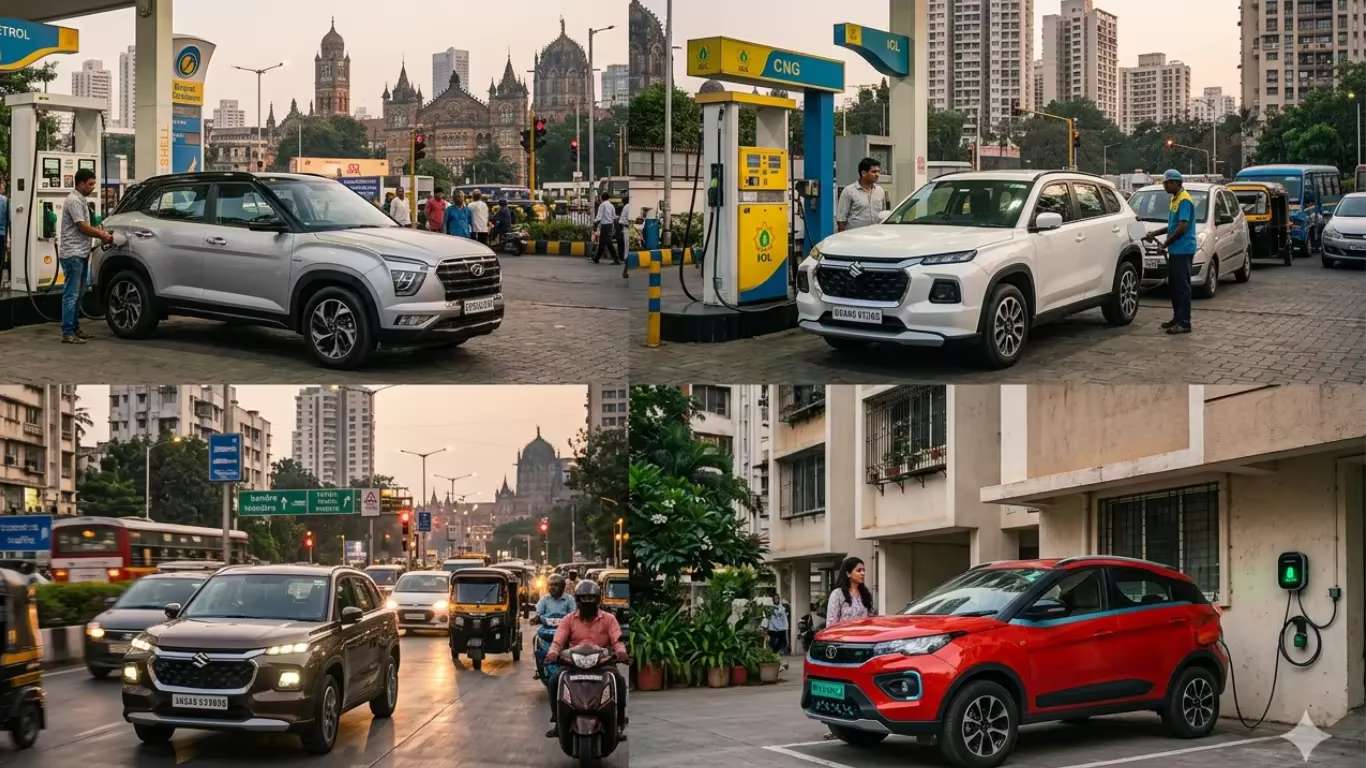
Petrol, CNG, Hybrid, or EV — Which One Is Right for You?
Choosing a new car in India has never been more complicated. A few years ago, the decision was simple: petrol for most buyers, diesel for those who drove more. Today, buyers must choose between petrol, CNG, hybrid and EV options, each claiming to save money.
But with fuel prices rising, EV charging expanding and car prices climbing, the real question isn't which car is cheaper to buy, but which one is cheaper to own.
That's exactly what many buyers are asking in showrooms today. Instead of discussing touchscreen sizes and features, they're comparing running costs, fuel bills, charging expenses and long-term savings. And in 2026, those numbers matter more than ever.
That's why CarBike360 decided to examine the numbers.
We analysed the five-year ownership costs of petrol, CNG, hybrid and electric vehicles using current fuel prices, maintenance expenses, purchase premiums and ownership patterns commonly seen across major Indian cities.
The findings reveal something interesting: the cheapest car to run isn't always the smartest car to buy.
The Indian Auto Market Is Going Through a Major Transition
The importance of this comparison extends beyond individual buyers.
India's passenger vehicle market is currently experiencing one of its biggest powertrain transitions since the diesel boom of the early 2010s.
Electric vehicles continue to gain momentum in urban centres such as Delhi NCR, Bengaluru and Pune. Strong hybrids are attracting buyers who want better efficiency without worrying about charging infrastructure. CNG remains a preferred option among value-conscious consumers, while petrol continues to dominate overall sales volumes.
Every manufacturer appears to be pursuing a different strategy.
Maruti Suzuki and Toyota are betting heavily on hybrids. Tata Motors and MG are pushing EV adoption. Hyundai is investing across multiple technologies. Meanwhile, CNG continues to expand into vehicle segments that were once exclusively petrol-powered.
For buyers, the abundance of choice is positive.
For decision-making, however, it has become significantly more complicated.
How We Calculated Ownership Costs
To ensure a realistic comparison, we focused on the compact SUV segment, India's most competitive and highest-volume passenger vehicle category.
Representative models include:
Assumptions Used
While actual ownership costs vary by city and driving habits, these assumptions reflect a typical urban Indian ownership pattern.
Parameter | Figure |
Monthly driving | 1,200 km |
Annual driving | 14,400 km |
Ownership period | 5 years |
Petrol price | ₹100/litre |
CNG price | ₹90/kg |
Home charging cost | ₹8/kWh |
Driving mix | 80% city, 20% highway |
The Most Important Number Buyers Often Ignore
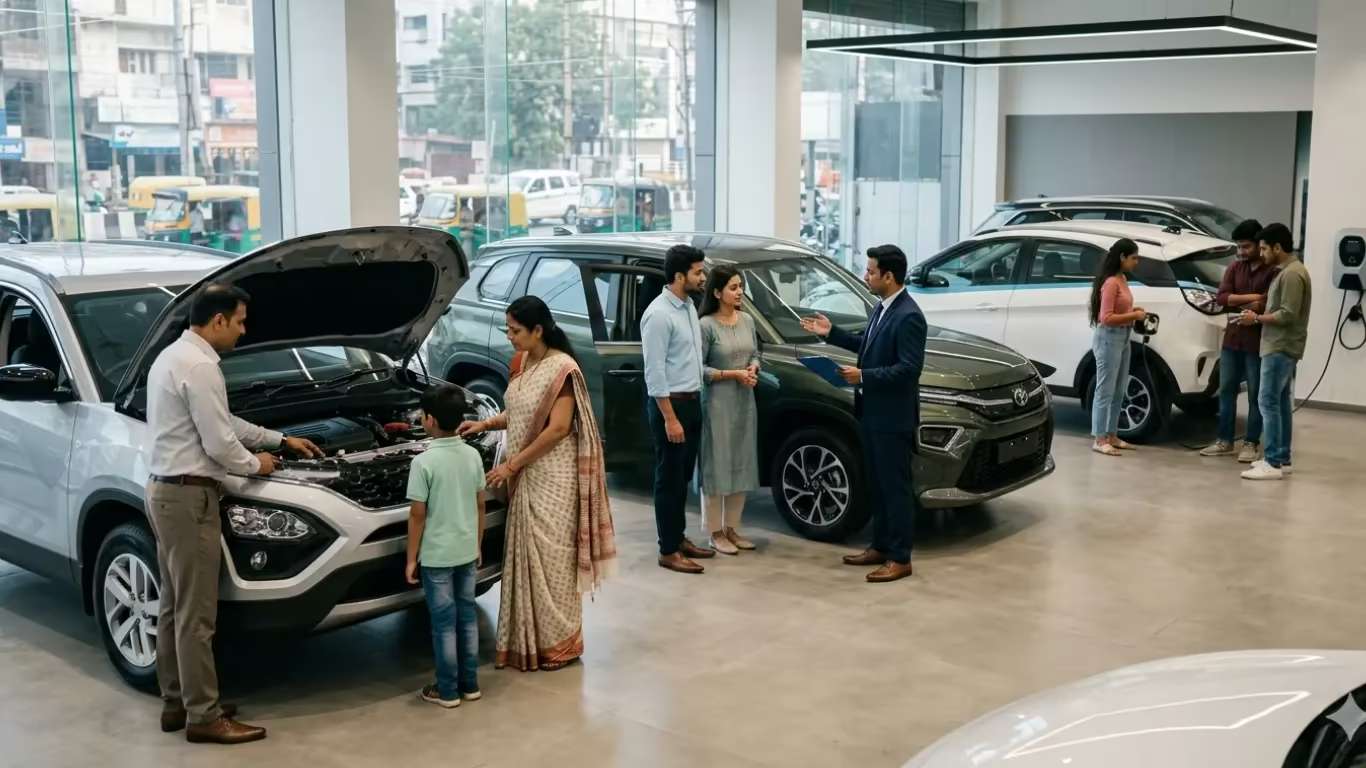
Before discussing fuel savings, we need to address the cost that many comparison articles overlook: the upfront premium.
A vehicle that saves money on fuel must first recover the additional amount paid at purchase.
Here's how the market currently looks:
Fuel Type | Typical Price Range | Additional Cost vs Petrol |
Petrol | ₹10–13 lakh | — |
CNG | ₹12–15 lakh | ₹2–3 lakh |
Strong Hybrid | ₹16–20 lakh | ₹5–7 lakh |
EV | ₹14–20 lakh | ₹3–7 lakh |
This premium fundamentally changes the ownership equation.
A buyer driving 8,000 km per year will experience very different economics from someone covering 25,000 km annually.
That distinction matters more than the fuel type itself.
Petrol: Still the Sensible Choice for Millions of Indians
Despite increasing attention on EVs and hybrids, petrol remains the benchmark against which every other powertrain is measured.
There is a reason for that.
Petrol ownership is simple.
Fuel stations are available virtually everywhere. Refueling takes minutes. Service networks are widespread. Resale demand remains strong. There are no infrastructure concerns and no learning curve.
For many Indian families, those advantages still carry significant value.
A typical compact petrol SUV delivers approximately 14 km/l under real-world driving conditions.
At current fuel prices, that translates to around ₹7 per kilometre.
Five-Year Petrol Ownership Cost
Expense | Cost |
Fuel | ₹5.1 lakh |
Maintenance | ₹65,000 |
Total | ₹5.75 lakh |
The Real-World Perspective
For a family in Jaipur, Lucknow or Indore that drives primarily on weekends and occasional road trips, recovering the premium of a hybrid or EV can be difficult.
This is where many buyers make costly mistakes.
They focus on fuel savings without considering how little they actually drive.
For low-mileage owners, petrol remains surprisingly difficult to beat.
Why CNG Continues to Attract Value-Conscious Buyers
If petrol is the practical choice, CNG is the financial choice.
Factory-fitted CNG vehicles have evolved considerably over the past decade. Performance compromises have reduced, safety standards have improved and infrastructure has expanded across many metropolitan areas.
Models such as the Tata Nexon CNG, Hyundai Exter CNG and Maruti Brezza CNG are attracting buyers primarily for one reason: lower monthly fuel bills.
Real-world efficiency typically ranges between 18 and 20 km/kg.
That translates to approximately ₹4.5–5 per kilometre.
Five-Year CNG Ownership Cost
Expense | Cost |
Fuel | ₹3.4 lakh |
Maintenance | ₹70,000 |
Total | ₹4.1 lakh |
Where CNG Makes the Most Sense
For a Delhi NCR commuter travelling 50–60 km every day, CNG ownership can deliver substantial savings without requiring lifestyle changes.
The challenge appears when buyers regularly travel outside cities where infrastructure remains inconsistent.
CNG is often the smartest option, provided the infrastructure around you supports it.
The Hybrid Story Is Bigger Than Fuel Economy
Among all powertrains, hybrids may be the most misunderstood.
Many buyers still view them as expensive petrol cars with marginal efficiency improvements.
The numbers tell a different story.
Strong hybrids such as the Maruti Grand Vitara Hybrid and Toyota Urban Cruiser Hyryder Hybrid consistently deliver fuel economy figures of 22–25 km/l under real-world conditions.
Operationally, they rival CNG while preserving the convenience of petrol.
Five-Year Hybrid Ownership Cost
Expense | Cost |
Fuel | ₹3 lakh |
Maintenance | ₹50,000 |
Total | ₹3.5 lakh |
Why Hybrids Are Finding Buyers
During conversations with dealers and industry executives over the past year, a recurring theme has emerged.
Many consumers like the concept of EVs but remain uncertain about charging infrastructure, apartment charging permissions and long-distance usability.
Strong hybrids occupy that middle ground.
They provide significant fuel savings without requiring any behavioural change from the owner.
That explains why hybrid demand has continued to grow despite higher purchase prices.
Also read: Are Hybrid Cars better than EVs in the Current Scenario?
EVs Deliver the Biggest Savings—But Only Under the Right Conditions
There is little debate regarding running costs.
EVs are the cheapest vehicles to operate.
A Tata Nexon EV, Punch EV or MG Windsor EV typically costs approximately ₹1.2–1.5 per kilometre when charged at home.
Five-Year EV Ownership Cost
Expense | Cost |
Charging | ₹1 lakh |
Maintenance | ₹25,000 |
Total | ₹1.25 lakh |
The savings are substantial.
However, ownership economics depend heavily on charging access.
This is a point often overlooked in headline comparisons.
An EV owner charging at home enjoys dramatically lower costs than someone relying primarily on public fast chargers.
In other words, two buyers owning the same EV can have very different ownership experiences.
The Reality of EV Ownership in India
For a Bengaluru software professional with dedicated parking and home charging, the financial argument for EV ownership is compelling.
For an apartment resident dependent on public infrastructure, the equation becomes more complicated.
Technology isn't the deciding factor.
The parking situation often is.
Which Fuel Type Makes Sense Based on How Much You Drive?
After analysing ownership costs, one conclusion became clear.
Annual mileage matters more than fuel type.
Annual Driving | Recommended Choice |
Under 10,000 km | Petrol |
10,000–15,000 km | CNG |
15,000–20,000 km | Hybrid |
Above 20,000 km | EV |
Buyers should calculate annual running before comparing technologies.
It is often the single most important variable in the ownership equation.
CarBike's Verdict: The Cheapest Car Isn't Always the Best Car
If operating costs are the only metric, EVs win comfortably.
If flexibility matters, hybrids become extremely attractive.
If affordability is the priority, CNG remains difficult to ignore.
And if annual mileage is low, petrol continues to make more sense than many buyers realise.
The broader lesson is that there is no universal winner.
The best powertrain for a Delhi commuter may be completely wrong for a highway traveller in Rajasthan or a family in a Tier-2 city.
The Indian automotive market now offers more choices than ever before.
That's good news for consumers.
But it also means buyers must stop focusing solely on purchase price and start thinking about ownership costs.
Because in 2026, the smartest car purchase isn't necessarily the cheapest one in the showroom. It's the one that costs the least to live with after the excitement of delivery day fades.


अपनी परफेक्ट कार खोजें

Budget

Brand

Body Type

Fuel

Mileage

More
अन्य लेख


Vihan AI - Your Car assistant
Ask me anything about cars, prices, and comparisons.