

 ELECTRIC
Are Hybrid Cars better than EVs in the Current Scenario?
 Add CarBike360 on Google
We have made a comparison of the features of Hybrid Cars and EVs to help you choose the right car when making your next purchase!

Mar 27, 2023 10:17 pm IST
Published On
Feb 10, 2023 04:30 pm IST
Last Updated On
Mar 27, 2023 10:17 pm IST
What are Hybrid Cars?
A hybrid car is powered by an internal combustion engine and one or more electric motors, which use energy stored in batteries. It combines a petrol or a diesel engine with an electric motor, and the two systems work together to move the vehicle. As it uses more than one source of energy, the car burns less gasoline, achieving better fuel efficiency than a traditional engine that is completely dependent on fuel.
In a hybrid car, electric power helps the car in boosting the performance of the engine. A hybrid electric vehicle cannot be plugged-in to charge the battery, as they do not need recharging. Hybrid cars charge the battery through regenerative braking and by the internal combustion engine. Regenerative braking recovers some of the kinetic energy that would otherwise turn into heat and converts it into electricity to charge its battery.
What are Plug-In Hybrid Cars?
Plug-In Hybrid Cars:
Plug-In Hybrids are halfway housed between conventional cars and completely electric vehicles. A plug-in car has a larger battery that needs to be connected to an external power source to fully recharge.
They have an electric motor and an internal combustion engine and can charge the battery by plugging it into an electrical source from outside.
Pros of Hybrid Cars
Self-Charging Battery:
A hybrid car uses a self-charging battery, which starts working when the vehicle slows down and self-switches the petrol engine off. This brings down the cost of running hybrid cars as compared to petrol cars. There is no waiting around for the car to charge and you can start the ride immediately.
Environment Friendly:
Hybrid cars use electric batteries in low-speed zones to reduce unnecessary petrol consumption. This results in less carbon emission from hybrid cars.
Less Maintenance Cost than a Petrol Car: Due to the shared load of the electric engine, there is less wear and tear on the petrol engine, which brings down the maintenance cost by almost 5%.
Better Fuel Efficiency: They get electric-vehicle efficiency for short distances and traditional car range for longer trips. They provide better fuel efficiency as compared to the electric vehicles.
Reduced Emissions:
Hybrid cars switch to electricity for short distances and produce zero tailpipe emissions during that time. Thus, hybrid cars produce lower tailpipe emissions when compared to conventional vehicles.
Improved Fuel Efficiency:
As they have two sources of fuel they can switch between their petrol and electric motors while being driven. So, hybrid cars are more fuel-efficient than all conventional cars.
Cons of Hybrid Cars
Extra Maintenance Cost:
Hybrid cars have an extra maintenance cost as the car batteries need to be replaced every 150,000 miles or every 15 years, whichever comes first.
Evaporative Emissions:
The Evaporative emissions (EVAP) system is prone to leaks in hybrid vehicles. There can be system failures or leaks. The common symptoms are the active ‘Check Engine Light’ and the smell of gasoline. Regular check-ups with the mechanic and scheduling regular hybrid car maintenance can prevent this issue.
Higher Price:
A hybrid Car is more expensive than its counterpart powered by a conventional gasoline engine or the other conventional cars available in the market.
Risk of Electrocution:
In case of an accident, there is a risk of the passengers being electrocuted as the batteries in hybrid cars contain very high voltage.
Higher Cost of Repairs:
Due to the advanced technology used in Hybrid cars, it might be difficult to find a mechanic with the required expertise. And once you find a mechanic, they can charge you more for maintenance and repairs than the amount they charge for conventional cars.
Less Power:
Hybrid cars have twin-powered engines. Hybrids combine both an electric motor and a gasoline engine and as a result, neither the gasoline engine nor the electric motor works as strongly as they do in conventional gasoline or electric cars.
Slower Acceleration:
As hybrid car generally uses electric motor only at low speeds, they have slower acceleration than conventional cars.
What are Electric Cars (EVs)?
All-Electric Vehicles (commonly referred to as EVs or BEVs) operate on an electric motor, unlike an internal-combustion engine that generates power by burning a mix of fuel and gases. Therefore, electric vehicles are seen as a possible solution to rising pollution and global warming.
An electric car has a large battery that is used to power one or more electric motors. It can be charged by plugging in at home or at a public charging station. An EV can travel between 150 to 300 miles on a single charge, which is good enough for casual drivers and also for people who commute long distances for work every day.
Pros of EVs
Emission Free:
The car runs on electricity and so has zero emission of CO2 which makes it environment friendly.
Reduced Noise Pollution:
Electric cars do not cause noise pollution and the motors are capable of providing smooth drive with higher acceleration over longer distances.
Compact Design:
The small frames of EVs can help the cars fit into smaller parking spaces and take tight turns in a busy area easily.
Free Charging at Public Places:
Shopping malls have set up charging stations for EVs allowing customers to charge their cars for free while shopping.
Less Maintenance:
Electric cars run on electrically powered engines, so there is no need to lubricate the engines like in conventional cars. While a petrol car has around 2,000 moveable parts, a fully-electric car does not have a clutch or gear and has about only 20 moveable parts that need to be maintained! This brings down the maintenance cost.
Cons of EVs
Less variation in Body Shape:
As compared to the hybrids, EVs have fewer options to choose from, when it comes to style and body shape. Hybrids being more recent have a wider range of options in style and body shape.
More Charging Time:
While a petrol or hybrid car takes a couple of minutes to fill the tank, an electric car can take all night.
Shorter Driving Range and Speed:
Most EVs have a limited range of about 50-100 miles and thereafter they need to be charged again. We cannot use them for very long journeys.
Silence is a Disadvantage:
EVs do not produce any noise and that can be a disadvantage sometimes, as people will not have a clue that there is a car coming from behind and this can lead to accidents. Noise created by cars alerts the people on the roads and prevents accidents.
Not Suitable for Cities Facing a Shortage of Power:
An EV needs electricity to be charged, so cities facing acute power shortages are not suitable for electric cars. The consumption of more power by EVs would hamper their daily power needs.
Recharge Points:
The charging stations for EVs are very less in number. Not every place that one plans to visit will have electric fueling stations for the vehicle. So, during long journeys and in rural areas if the car runs out of charge it might be difficult to find a charging station.
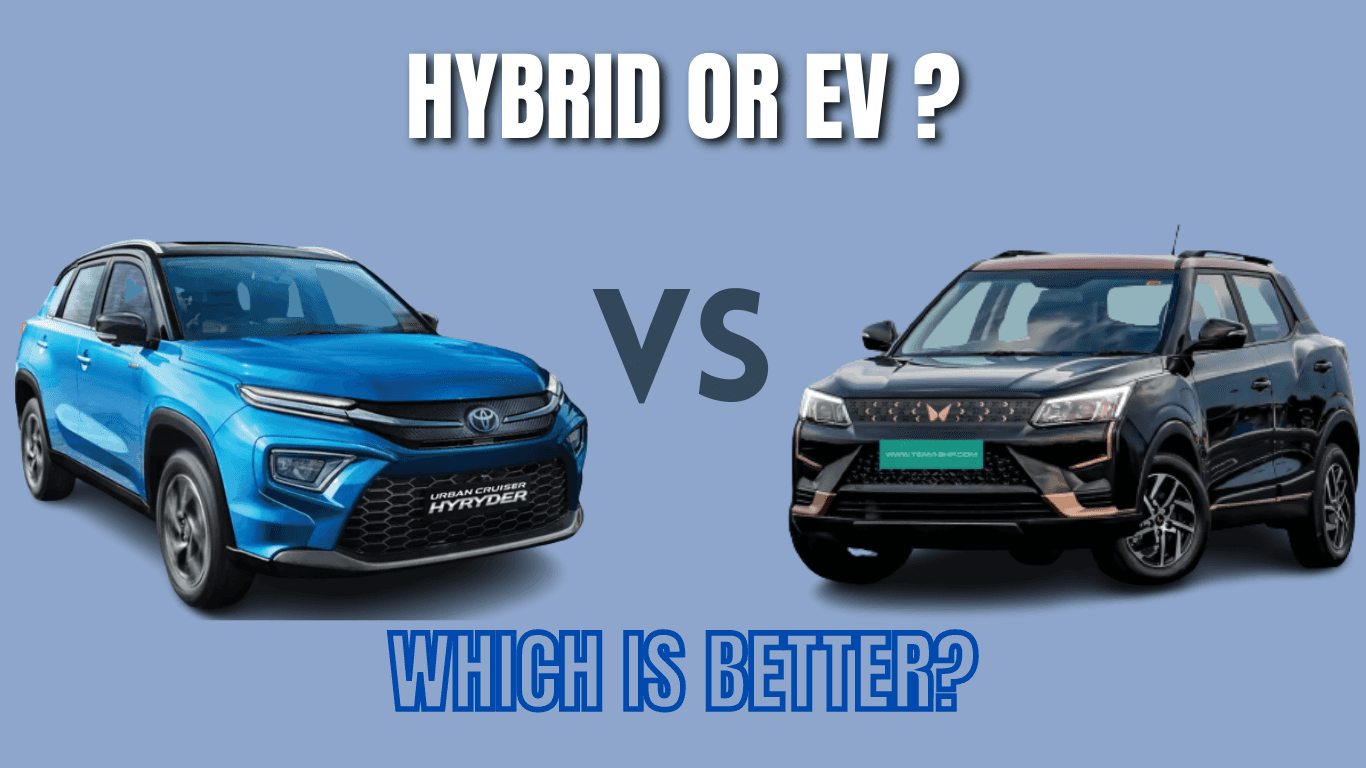
This article will help the readers compare the features and benefits of EVs and Hybrid cars and take the right decision when purchasing their next car. Some popular Hybrid cars are Toyota Urban Cruiser Hyryder, Volvo XC90, and Toyota Camry Popular EVs are Mahindra XUV400, Tata Tiago EV, and Tata Tigor EV.


You May Like


Find your perfect car

Budget

Brand

Body Type

Fuel

Mileage

More
Latest Car Videos


Talking about new Honda City and upcoming ZR-V SUV with Honda India’s Kunal Bahl!
2026 Honda City Launched in India - Better than VW Virtus, Hyundai Verna & Skoda Slavia?

Weekly Auto & EV Wrap-Up: Luxury Launches, AI Tech & Big Industry Updates!

Weekly news wrap-up - CNG sales up, Fortuner prices raised, Hyundai completes 30 years
Other Car News

Listen to Car Audios


Vihan AI - Your Car assistant
Ask me anything about cars, prices, and comparisons.