ELECTRIC
Amara Raja to invest Rs 10,000 crore in lithium cell manufacturing by 2032
 Add CarBike360 on Google
Amara Raja is set to invest Rs 10,000 crore in lithium cell manufacturing by 2032, aiming to expand India’s EV battery ecosystem and reduce import dependency.

Apr 22, 2026 03:57 am IST
Amara Raja has announced an investment of ₹10,000 crore through 2032 to expand its lithium cell and pack manufacturing in India. The company aims to start local cell production by the end of next year, according to executive director Vikram Gourineni. This move follows Ola Electric, making Amara Raja the second company to begin local cell manufacturing in the country.
Key Highlights
- Amara Raja to invest ₹10,000 crore in lithium cell manufacturing by 2032
- Local cell production to start by end of next year with bulk production in 2027
- Locally made cells will cost at least 15 percent more than imports initially
- Company splits planned 16 GWh capacity between mobility and energy storage
- Amara Raja has deployed 1 GWh of lithium storage across 50000 telecom sites
Investment and Production Timeline
Amara Raja will take a phased approach to scaling up production. Initial cell production will begin this year at a megawatt-hour scale. The company will supply commercial samples to Indian customers for qualification. Bulk production at a 2 GWh scale is planned for 2027. The company expects to serve the mobility segment primarily, but also plans to supply adjacent markets such as power tools and lawn and garden equipment to reduce demand concentration risks.
The company originally planned for a 16 GWh capacity. However, due to strong demand growth, Amara Raja sees potential to increase this number. Access to raw materials and technology remains a challenge as the company expands its operations.
Cost and Supply Chain Challenges
Vikram Gourineni stated that locally produced lithium cells will carry at least a 15 percent price premium over imports in the near term. This is because it takes time to build a comprehensive upstream ecosystem, from raw materials to components. China spent two decades developing its supply chain, and India is still in the early stages.
Gourineni explained that domestic cell makers need to reach a scale of 8-10 GWh and develop a supporting supply chain before local production becomes cost-effective for electric vehicle makers. Until then, the economics will not favor EV manufacturers in India.
Market Expansion and Operational Milestones
Amara Raja recently reached a milestone by deploying 1 GWh of lithium energy storage across 50,000 telecom sites nationwide. The company has also revised its capacity allocation. Instead of focusing mainly on mobility, Amara Raja will now split its planned 16 GWh capacity equally between mobility and energy storage solutions (ESS).
Other companies are also entering the market. Agratas, a Tata Group venture, is setting up a facility in Gujarat and is expected to start production in a similar timeframe.
Amara Raja's investments and operational milestones highlight the evolving landscape of lithium cell manufacturing in India. The company continues to address challenges related to supply chain development and raw material access as it works toward large-scale production.


You May Like





Latest Battery Videos


Other Battery News
Union Cabinet approves Semicon 2.0 With Rs 1,27,500 crore boost for India semiconductor mission
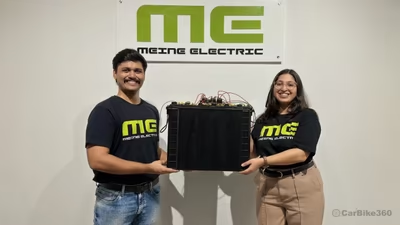
Meine Electric fast charging iron air battery passes independent validation

Amara Raja and Nuvation Energy Partner for Local Battery Management System in India
JSW Green Mobility invests in lithium urban technologies to accelerate electric fleet growth
Listen to Battery Audios