ELECTRIC
Mahindra Plans Hybrid and Range-Extender SUVs Amid Slower EV Adoption
 Add CarBike360 on Google
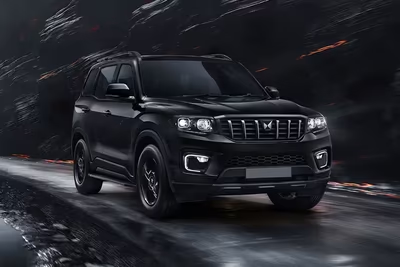
Mahindra is developing hybrid and range-extender powertrains for future SUVs, including the XEV 9e and XUV 7XO, as EV adoption remains slower than expected and hybrid demand rises in India.

May 10, 2026 05:44 am IST

Mahindra is developing hybrid and range-extender powertrains for future SUVs, responding to slower electric vehicle (EV) adoption and evolving market needs. The company is considering both range-extender EVs and strong hybrids, aiming to offer more flexible powertrain options as the automotive industry shifts towards electrification.
Key Highlights
- Mahindra developing hybrid and range-extender SUVs for future market needs
- EVs made up about 9 percent of Mahindra sales last financial year
- XEV 9e and XUV 7XO among first models to get new hybrid systems
- Adapting EV platforms for hybrids requires significant engineering changes
Mahindra’s Hybrid and EV Strategy
Mahindra previously projected EVs would make up 20-30 percent of its sales by FY2028. The company committed over USD 1 billion to its INGLO born-electric platform, which underpins models like the XEV 9e, BE 6, and XEV 9S. However, in the last financial year, EVs accounted for only about 9 percent of Mahindra's total volumes. This lower-than-expected uptake highlights the need for hybrid options as the market transitions through different electrification stages.
Internal project codes W613 and W623 are linked to Mahindra’s upcoming hybrid SUV program. The W623 project is expected to result in a coupe-styled SUV, likely arriving around 2028. Mahindra is studying range-extender technology for INGLO-based products, with the XEV 9e (codenamed W623) among the first models under evaluation.
Technical Challenges and Industry Context
A range-extender hybrid uses a petrol engine as a generator to charge the battery, rather than driving the wheels directly. This setup allows for an EV-like driving experience while addressing range limitations. Mahindra has started technical studies and testing for such systems, evaluating two engine sizes: 1.2-litre and 1.5-litre units for the INGLO platform.
Adapting a dedicated EV platform for hybrid use requires significant engineering changes. The platform must accommodate an engine, gearbox, exhaust system, and additional cooling hardware. Mahindra will need to address packaging, thermal management, and crash safety, requiring extensive research, development, and new safety validation.
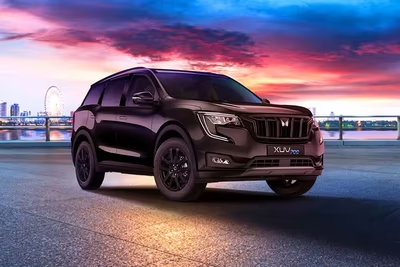
Alongside INGLO-based range-extender projects, Mahindra is considering strong hybrid technology for future SUVs based on its existing internal combustion engine (ICE) platforms. The XUV 7XO, built on the W601 monocoque platform, is expected to be among the first to receive a strong hybrid setup, with a launch anticipated around 2027. A strong hybrid system allows the SUV to run on electric power for short distances and use the combustion engine to drive the wheels when needed, similar to the Toyota Hyryder and Maruti Grand Vitara.
Market Trends and Regulatory Factors
Globally, several automakers, including Stellantis, Mercedes-Benz, Ford, and Honda, have adjusted EV investments due to slower adoption rates. Converting born-EV platforms for hybrid use remains uncommon, as these architectures were not initially designed for combustion powertrains. In India, EV penetration in the passenger vehicle market stands at about 4.25 percent, below earlier expectations. Hybrids are gaining popularity as buyers seek better fuel efficiency without relying solely on charging infrastructure.
Mahindra’s hybrid plans are also aimed at meeting future Corporate Average Fuel Efficiency (CAFE) regulations. The company continues to focus on its SUV portfolio, much of which is currently diesel-heavy, while preparing for stricter efficiency standards.


You May Like


Find your perfect car

Budget

Brand

Body Type

Fuel

Mileage

More
Latest Car Videos


Top Auto News of the Week: Tata Sierra EV, BMW X6, E85 Fuel & More - Weekly Wrap

Top Auto News of the Week | Hyundai i20 Leak, Honda ZR-V, Tata Sierra EV, Skoda EV & More!
Talking about new Honda City and upcoming ZR-V SUV with Honda India’s Kunal Bahl!
2026 Honda City Launched in India - Better than VW Virtus, Hyundai Verna & Skoda Slavia?
Other Car News
Listen to Car Audios