ELECTRIC
Hero Xoom 110 Review: Redefining Performance and Practicality in India’s Most Competitive Scooter Segment
 Add CarBike360 on Google
A detailed ride review of the Hero Xoom 110, exploring performance, comfort, mileage, features, and real-world usability in India’s highly competitive 110cc scooter segment.

Jan 29, 2026 05:54 am IST
Published On
Jan 28, 2026 01:41 pm IST
Last Updated On
Jan 29, 2026 05:54 am IST
The 110cc scooter space is considered to be the most competitive segment in the Indian two-wheeler market. This category also marks the highest-selling displacement, with an estimate of approximately 450,000 to 500,000 units of monthly sales (as per late 2024 to early 2025 data), which individually accounts for roughly 60-65% of the overall scooter dispatchment, dominating over 20-22% of total two-wheeler volumes. Two decades back, what started as a measure for budget-friendly short-distance utility transportation has now transformed into much more of a day-to-day practicality, following the change of consumership. Today, the 110cc scooter lineup is not a mere two-wheel transportation but a symbol of one’s recognition based on diverging purposes. Having said that, this sector might be led by multiple contenders. However, the performance quotient is only defined by “Hero Motocorp”, where the Xoom 110 plays a pivotal role.
The Xoom badge has existed for the last three years, starting with the 110cc displacement, now expanded to both 125 and 160cc packages. The Xoom 110 is perhaps selling in low numbers as compared to the segment leaders, such as the Honda Activa and TVS Jupiter, although after riding it for almost a week, I am convinced of its presence to narrate an underrated story of evolution, stating a blend of necessity and enthusiasm. Nevertheless, preceding the rapid growth of the budget-centric scooter division, bringing a tech-focused approach and alternate fuel options, is the Xoom 110 still relevant, or has it aged well to be an experimental phase? This ride-review experience explores on the same.
Design:

The Xoom 110 is the first sports scooter from Hero MotoCorp, portraying modern age styling cues, incorporating an apron-mounted LED headlamp surrounded by H-shaped daytime-running LEDs (DRL) mimicking the Vida V1, and a sharper hazard-functioning bulb indicator mounted on the cowl. Contrarily, only the top-end trim sports a dual cornering lights setup that utilises an accelerometer and a gyroscope paired to sensors for detecting the potholes and rough patches every time you turn your scooter, which cumulatively ensures safety all round and helps during high-speed cornering in the dark.
Additionally, the side fenders are slimmer in proportion, continuing to an aggressive H-shaped LED tail-light. Taking care of practicality, the floorboard area is large enough and is equally capable of accommodating an LPG cylinder. Besides, the under-storage compartment has a storage of 19.2 L, allowing a half-sized helmet to fit in easily alongside a large quantity of daily groceries. This compartment also lights up during the night, enhancing convenience. Barring to this, there are two cubby pockets that came quite handy to me for charging my smartphone through a power bank on the go, considering no additional charging ports were available. In addition to this, the sporty character of this entry-level scooter is accentuated by five different dual-tone exterior shades.
Technology:
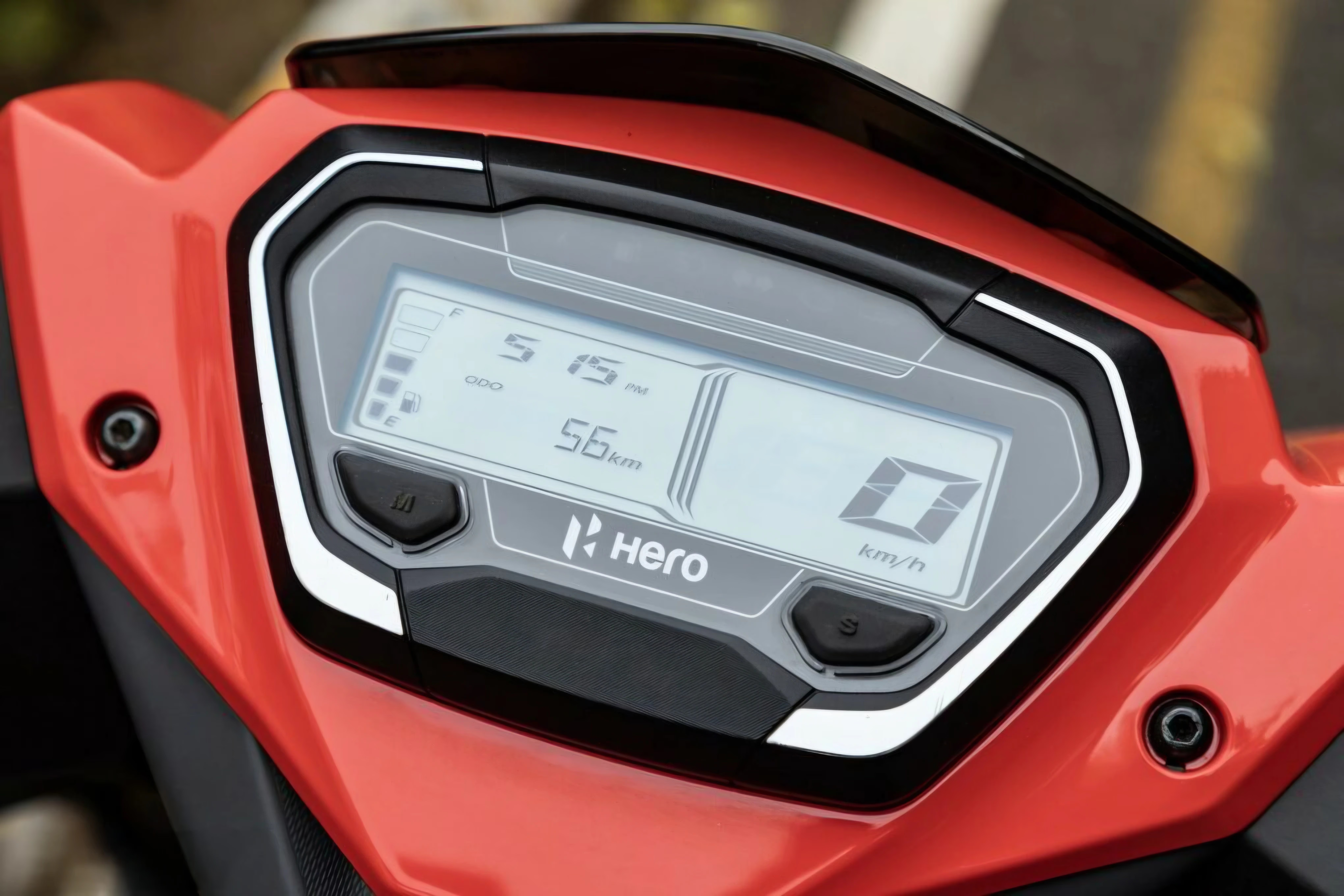
In terms of consumer tech, the instrumentation is guided by a Bluetooth-enabled negative-lit LCD display, which glows bluish and further highlights the speedometer, tachometer, and odometer. However, the connectivity is limited to message and call alerts in conjunction with the timer, although the turn-by-turn navigation and music control are lacking within. Furthermore, in order to track the vehicle’s health, this instrumentation is paired with the Hero App Connectivity, with this suite being exclusive to the top-end trim. Meanwhile, the competition receives the turn-by-turn navigation; the lack of this feature compared to the internal township and city rides feels like a major miss.
Engine & Performance:

The Xoom 110 derives power from the same mill as the Maestro, sporting a 110.09 cc air-cooled single-cylinder 4V motor. This engine generates a peak power output of 8.0 bhp at 7,250 rpm and a torque figure of up to 8.7 Nm, redlining at 5,750 rpm. To me this power source felt the peppiest in the segment, delivering the juice at the initial end, which goes linear at the mid-point and goes constant at the final end. The performance feels lively off the line, with brisk acceleration up to around 60 kmph, followed by a more relaxed and progressive build-up toward its top speed.
Given my larger build and prevailing road conditions, I managed an indicated 80 kmph. The power is sufficient considering daily riding conditions, letting the motor release seamless pull-overs even on uphill travels and rough, slanted patches. Refinement levels are commendable, with low NVH overall and only occasional, minor vibrations that do not detract from a smooth and comfortable ride. The Xoom 110 is also equipped with the i3S start-stop system, which functions effortlessly, saving fuel up to 53.4 kmpl (ARAI) and no less than 45.0 kmpl in real-world conditions.
Ride & Handling:

The Xoom 110 underpins the same chassis as the Maestro, weighing 109 kg max. It introduces several key mechanical updates that distinguish it from its predecessors. Moving away from the Maestro’s 10-inch setup, the Xoom rides on larger 12-inch wheels, featuring cast alloys, enabling cornering agility on the top variant supported by premium telescopic front forks and a rear monoshock.
Talking of comfort, the seat is well-cushioned and provides generous space for a solo rider, although the floorboard area feels somewhat restricted, as the front utility pockets encroach upon the available legroom. These upgrades translate to a ride that is stable even at highway speeds, with light steering and suspension that absorbs road imperfections with composure. While it may not possess the inherently aggressive sportiness of the TVS Ntorq 125, the Xoom feels sufficiently agile and zippy. Moreover, the experience is not without minor ergonomic and mechanical critiques. Larger riders may find the seating position slightly cramped. Furthermore, while the braking system (front disc and rear drum) provides adequate stopping power, it would benefit from a sharper initial bite. It is also worth noting that some test units produced a creaking noise under hard braking.
Also Read: Upcoming Bikes Under ₹5.00 Lakh | January-February, 2026
Verdict:

The Hero Xoom 110 was initially launched with prices starting at ₹68,599 for the LX variant, going up to ₹76,699 for the fully loaded ZX trim. Post the introduction of GST 2.0 and a streamlined lineup that phased out the LX variant while adding the Combat Edition, the entry price has been revised to ₹72,351 (ex-showroom). Despite this upward revision, the Xoom continues to be competitively priced, placing it squarely against established rivals like the Honda Activa and TVS Jupiter 110.
As a package, the Xoom 110 delivers well on the fundamentals expected from a daily-use scooter. While its sharp and sporty styling hints at aggressive performance, the riding experience is tuned more towards practicality than outright sportiness, a trade-off that aligns well with the expectations of this segment. Its segment-first cornering lights have received a mixed response. Although some may consider them more of a novelty and the light throw could be improved, their presence still adds value, especially at this price point. However, to stay competitive in an increasingly feature-driven market, an update to the overall equipment list would be timely and necessary.


You May Like


Find your perfect bike

Brand

Budget

Body Type

Fuel

Mileage

More
Other Scooter Expert Reviews
Listen to Scooter Audios