ELECTRIC
India’s EV growth: Overcoming price, infrastructure, and supply chain hurdles
 Add CarBike360 on Google
Despite surging EV sales in 2026, India grapples with high costs, sparse charging stations, and import-dependent supply chains. Discover hurdles and pathways to sustainable mobility.

Apr 21, 2026 09:10 am IST

India’s electric vehicle (EV) market is expanding rapidly, with sales rising 84 percent year-on-year in FY26 to 2.45 million units, according to the Federation of Automobile Dealers Association (FADA). Despite this growth, EVs made up only 7.6 percent of total vehicle sales in 2024, far from the government’s 30 percent target by 2030. The transition is visible, but significant challenges remain.
Key Highlights
- EV sales in India rose 84 percent in FY26 to 2.45 million units
- Electric vehicles accounted for only 7.6 percent of sales in 2024
- Average electric car price is about Rs 13 lakh, nearly triple petrol entry price
- Over 29,000 public charging stations installed but access remains uneven
- India relies on imported lithium-ion batteries for EVs
Affordability and Consumer Choices

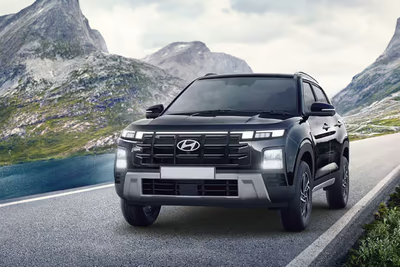
The entry price for an average electric car in India is about Rs 13 lakh, nearly three times that of a basic petrol vehicle. For example, the Hyundai Creta’s petrol version starts at around Rs 12.8 lakh, while the electric variant approaches Rs 19.5 lakh, creating a Rs 7 lakh gap. Although lower running costs can offset this difference over time, most buyers focus on the upfront price. This price barrier limits adoption, especially among middle-class households. Fleet operators and high-mileage users benefit more from EVs due to higher usage and lower running costs.
Mahindra & Mahindra reported delivering over 50,000 electric SUVs within a year, with March 2026 marking its highest monthly sales. The company highlights features like a 500 km real-world range and ultra-fast charging but acknowledges the affordability gap persists. Industry experts note that while more EV models are entering the market, faster rollout and better consumer education are needed to drive adoption.
Charging Infrastructure and Regional Disparities
India has installed over 29,000 public charging stations in five years, including more than 8,800 fast chargers. The government has liberalized the sector, allowing private investment without licensing barriers. However, charging availability remains uneven, especially outside major cities. In Karnataka, for instance, private operators have set up charging stations in only nine out of 31 districts, mainly in urban areas. This leaves much of the state underserved and highlights the urban-rural divide in EV infrastructure.
Policy Support and Supply Chain Challenges
Government policies such as FAME incentives, the Rs 10,900-crore PM E-DRIVE program, and production-linked incentives support EV adoption and manufacturing. Reduced GST and state-level incentives further encourage investment. However, frequent policy changes create uncertainty for manufacturers and suppliers. India also relies heavily on imported lithium-ion batteries and critical minerals, exposing the sector to global supply disruptions. Recent export controls by China on battery materials have underscored this vulnerability.
Adoption Patterns and Consumer Trust
Electric two-wheelers and three-wheelers have seen the fastest adoption due to cost advantages and predictable usage. Buses are also gaining ground with policy support. Passenger car adoption is slower, and electric trucks remain rare. Consumer concerns about battery life, replacement costs, and resale value persist, slowing broader acceptance.
For many buyers, the decision between petrol, diesel, and electric vehicles remains a balance of upfront cost, efficiency, and long-term savings. Continued policy support, improved infrastructure, and greater consumer awareness are needed for India to meet its EV targets.
Also Read: India Shifts EV Policy Focus from Incentives to Compliance and Structured Growth
CarBike 360 Says
India’s electric vehicle sector holds immense promise amid rising sales and policy support, yet price barriers, charging gaps, and supply chain woes demand urgent action. With targeted investments in local manufacturing, grid upgrades, and incentives, India can accelerate EV adoption, slashing emissions and fostering green mobility by 2030. The road ahead requires collaborative innovation to turn hurdles into highways of progress.


You May Like


Find your perfect car

Budget

Brand

Body Type

Fuel

Mileage

More
Latest Car Videos



Other Car News
Listen to Car Audios