ELECTRIC
The SUVs took over India’s car market as sedans struggle to stay relevant
 Add CarBike360 on Google
The Indian car market is shifting rapidly as SUVs outsell sedans and EVs gain traction. Changing consumer preferences and modern tech drive this transformation.

Mar 27, 2026 10:53 am IST

The Indian car market has seen a clear shift in buyer preference from sedans to SUVs, driven by road conditions, buyer perceptions, and evolving vehicle features. SUVs now dominate most price segments, while sedans face declining demand except in specific niches.
Key Highlights
- SUVs have overtaken sedans in most Indian market segments due to road conditions and buyer perceptions.
- The Hyundai Creta set a new standard by offering comfort, efficiency, and premium features in one package.
- Sedans like the Hyundai Verna and the Skoda Slavia still attract enthusiasts for their driving dynamics.
- Electric sedans may gain traction as EV buyers prioritize efficiency and range over ground clearance.
Changing Buyer Preferences
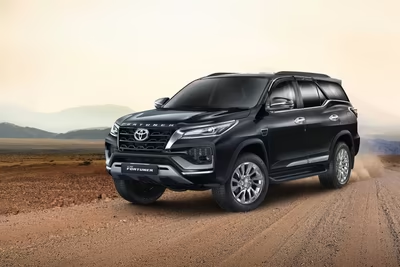
Indian buyers value vehicles that handle rough roads, offer comfort, and align with social perceptions. The Toyota Fortuner, a premium SUV priced above Rs. 50 lak, exemplifies this trend. It is seen as aspirational and durable, making it a popular choice despite its high cost.
Sedans in the Rs. 10-25 lakh segment struggle due to India's challenging road conditions. Potholes, uneven surfaces, waterlogging, and sharp speed breakers make low ground clearance a disadvantage. As a result, buyers in this segment often avoid sedans. Only sub-Rs. 10 lakh models like the Maruti Dzire and Honda Amaze have maintained strong sales.
Above Rs. 10 lakh, sedan demand drops sharply. In contrast, SUVs are perceived as offering a higher stance, more space, and greater reliability. These factors have contributed to their popularity across various price points.
Market Response and Model Evolution

The introduction of the Hyundai Creta marked a turning point. It bridged the price gap with a mix of comfort, efficiency, and premium features. The Creta offered good ride quality, high-quality interiors, an efficient diesel engine, and a comfortable second row. It also addressed issues that affected sedans, such as ground clearance and feature offerings.
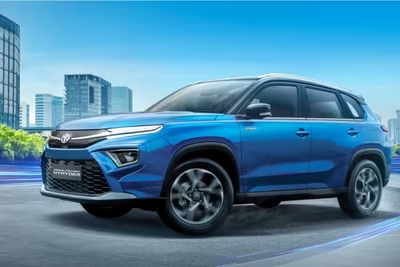
Following the Creta, models like the Maruti Brezza, Kia Seltos, and MG Hector expanded SUV options for buyers. These vehicles introduced features like sunroofs and advanced safety systems, further increasing their appeal. Wireless connectivity and multiple airbags became standard, reinforcing the premium image of SUVs.
Sedan Advantages and Future Prospects
Sedans still offer advantages in driving dynamics. Their lower center of gravity, aerodynamic design, and balanced weight distribution attract driving enthusiasts. Models like the Hyundai Verna, Skoda Slavia, and Volkswagen Virtus remain popular among this group.
Electric vehicles (EVs) may offer new opportunities for sedans. Sedans can achieve SUV-like range with smaller batteries due to better aerodynamics and lower drag coefficients. As EV adoption grows, electric sedans could appeal to buyers focused on efficiency and real-world range, potentially overcoming previous concerns about ground clearance.
Also Read: Indian government reduces special excise duty on petrol and diesel.
Conclusion
The rise of SUVs in India marks a turning point in consumer behavior and industry strategy. As sedans lose their traditional appeal, automakers are investing heavily in electrified SUVs and compact crossovers to meet changing demands. With the EV revolution accelerating, the Indian market is heading toward a future defined by innovation, efficiency, and evolving mobility choices.


You May Like


Find your perfect car

Budget

Brand

Body Type

Fuel

Mileage

More
Latest Car Videos


Top Auto News of the Week: Tata Sierra EV, BMW X6, E85 Fuel & More - Weekly Wrap

Top Auto News of the Week | Hyundai i20 Leak, Honda ZR-V, Tata Sierra EV, Skoda EV & More!
Talking about new Honda City and upcoming ZR-V SUV with Honda India’s Kunal Bahl!
2026 Honda City Launched in India - Better than VW Virtus, Hyundai Verna & Skoda Slavia?
Other Car News
Listen to Car Audios