ELECTRIC
Vienna Motor Symposium 2026: Experts stress need for diverse powertrain solutions
 Add CarBike360 on Google
Industry leaders at the Vienna Motor Symposium 2026 emphasized a balanced approach to future mobility, advocating for a mix of electric, hybrid, and internal combustion powertrains to meet global demands.

By Utsav Chaudhary
Apr 23, 2026 10:16 am IST
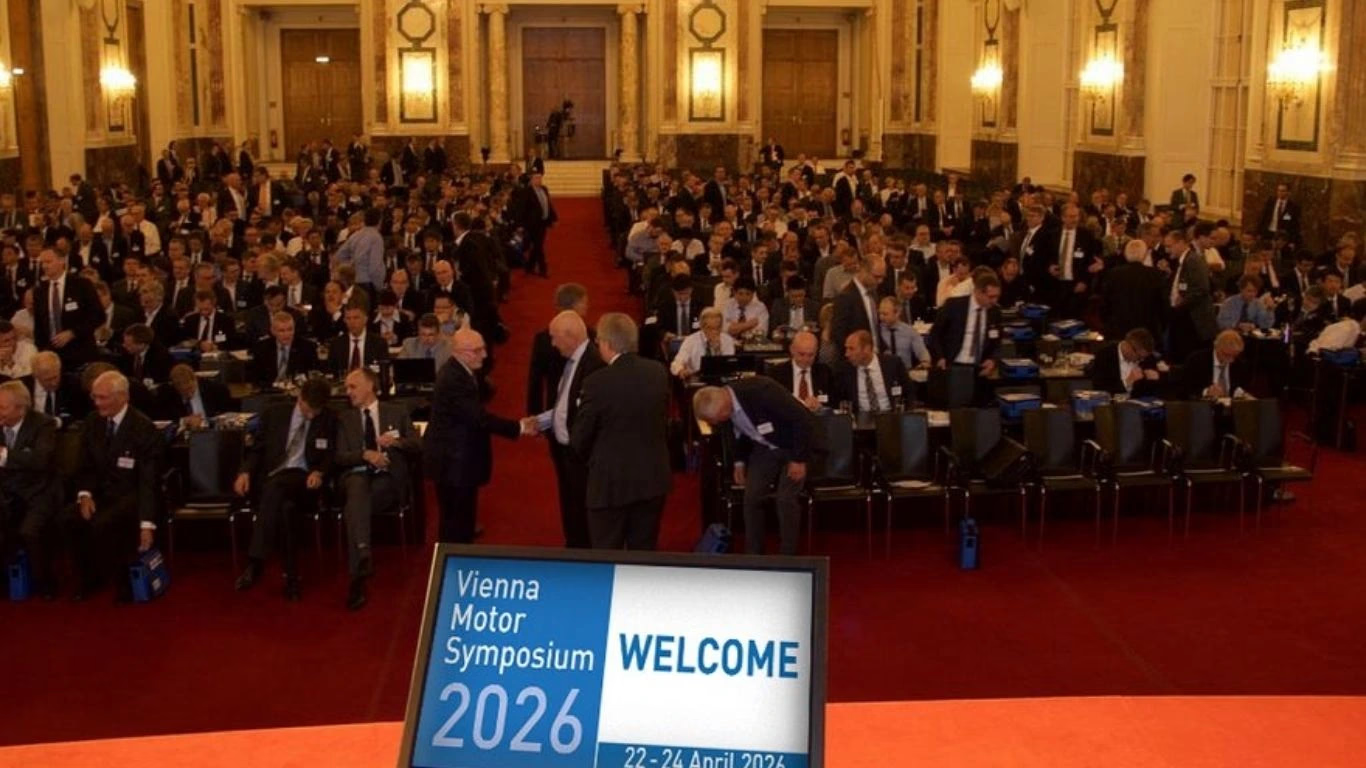
Industry leaders at the 47th International Vienna Motor Symposium stressed the need for a technology-neutral approach to mobility. The event, held on April 23, 2026, at the Vienna Hofburg, gathered about 100 speakers and 1,000 delegates from over 20 automotive nations. The agenda covered propulsion technologies for passenger cars, commercial vehicles, trains, ships, and aircraft.
Key Highlights
- Vienna Motor Symposium gathered 1,000 delegates from over 20 nations in April 2026
- Industry leaders called for a technology-neutral approach and a resilient portfolio of powertrain solutions
- China's 'Roadmap 3.0' and Hyundai's philosophy highlighted global strategies for future mobility
- TRATON Group's modular system supports multiple powertrain types for commercial vehicles
Calls for Technology Neutrality
Professor Dr. Bernhard Geringer, President of the Austrian Society of Automotive Engineers (ÖVK), opened the symposium by urging a comprehensive and neutral debate on propulsion technologies. He emphasized the importance of considering total energy availability and greenhouse gas emissions across the entire chain, not just the drive system.
Prof. Stefan Pischinger, Chair of Thermodynamics of Mobile Energy Conversion Systems at RWTH Aachen University and Supervisory Board Chair at FEV, echoed this view. He warned against framing the propulsion debate as an 'either-or' choice.
Pischinger stated that the global transformation involves regulation, market needs, technological maturity, and industrial implementation speed. He concluded that the industry should focus on building a robust, resilient technology portfolio instead of searching for a single powertrain solution.
Global Perspectives and Strategies

The day before the symposium, the ÖVK and China SAE organized a 'Forum on Powertrain for Sustainable Mobility' in Vienna. This event highlighted growing Sino-European cooperation. Ruiping Wang, Senior Vice President of Geely Auto, described China's leadership in large-scale electrification.
He noted China's shift toward AI-driven intelligence and digitalization. Wang referenced China's 'Roadmap 3.0 for Energy-Saving and New Motor Vehicle Technologies,' which outlines future pathways in efficient powertrains, batteries, electric motors, control systems, and artificial intelligence.
Donghee Han, Executive Vice President of Hyundai Motor Company, shared Hyundai's philosophy. He described a culture of humility and learning that guides Hyundai's development of next-generation electric drive and range-extender technologies. Han emphasized the company's commitment to adapting and shaping a future-proof vision for mobility.
In the commercial vehicle sector, Niklas Klingenberg of the TRATON Group presented the group's modular system strategy. TRATON, which includes Scania, MAN, Navistar, and Volkswagen Truck & Bus, employs 12,000 people in shared R&D. The TRATON Modular System supports battery-electric, conventional, and alternative powertrains within a scalable architecture. This design allows flexible adaptation to changing technological and geopolitical conditions.
Industry Embraces Pragmatic Solutions
The opening day of the Vienna Motor Symposium showed the automotive industry moving toward pragmatic, systems-level thinking. Delegates agreed that flexibility, diversity, and humility are essential for shaping the future of mobility. The focus is shifting from ideological debates over individual technologies to building resilient and adaptable solutions.
Also Read: 2026 Beijing Auto Show: Chinese carmakers push into premium segment with global ambitions
CarBike 360 Says
The Vienna Motor Symposium 2026 made one thing clear: there is no one-size-fits-all solution for the future of mobility. A diversified powertrain strategy, combining EVs, hybrids, and cleaner combustion engines, will be crucial to address regional challenges, infrastructure gaps, and sustainability goals. Collaboration and innovation across technologies will ultimately shape a more practical and inclusive automotive future.


You May Like


Find your perfect bike

Brand

Budget

Body Type

Fuel

Mileage

More
Latest Bike Videos


Other Bike News
Listen to Bike Audios