

 ELECTRIC
2023 भारतीय ऑटोमोटिव उद्योग की सबसे बड़ी झलकियां
 Add CarBike360 on Google
2023 में भारतीय ऑटोमोटिव उद्योग को आकार देने वाली महत्वपूर्ण प्रगति और हाइलाइट्स का अन्वेषण करें।

By Mohit Kumar
Jan 02, 2024 02:14 pm IST
Published On
Jan 02, 2024 01:24 pm IST
Last Updated On
Jan 02, 2024 02:14 pm IST
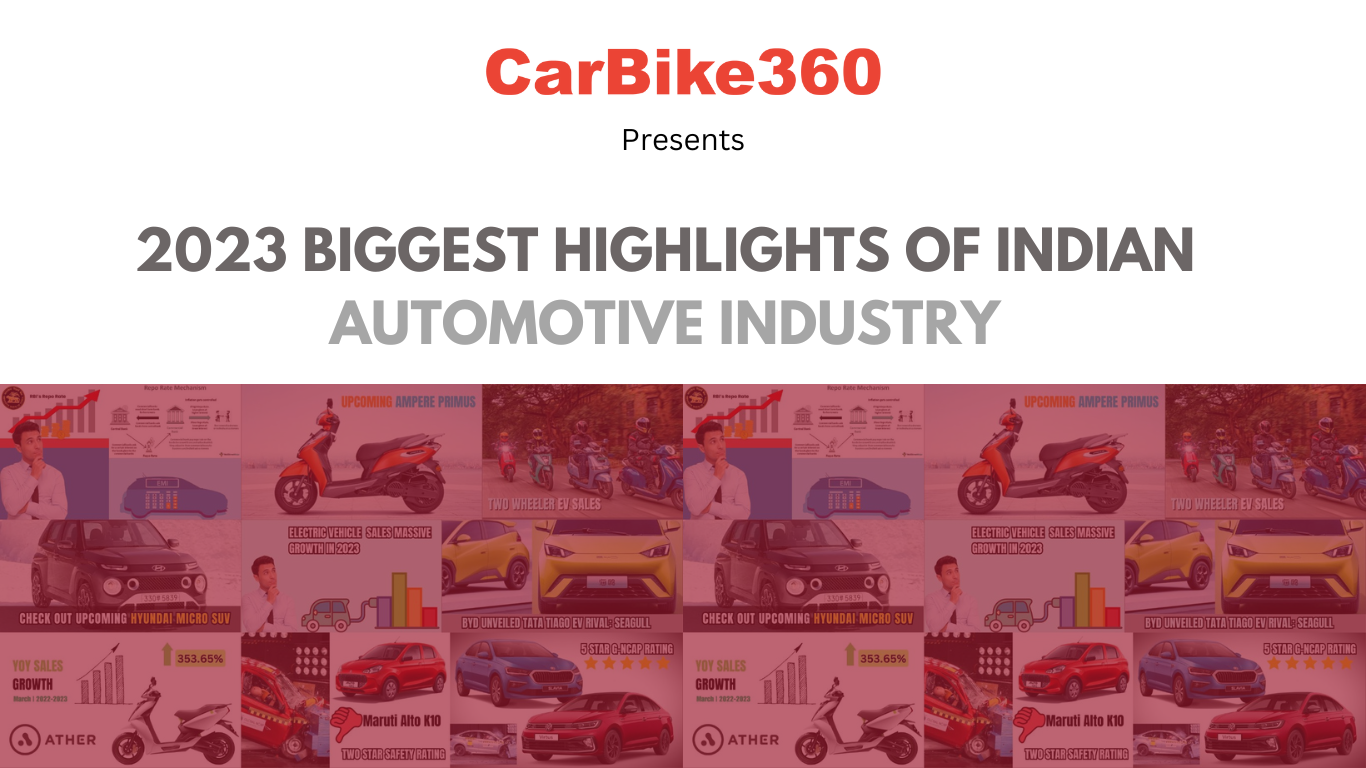
2023 A Year of Transformation for the Indian Automotive Industry
The year 2023 was a remarkable one for the Indian automotive industry, as it witnessed several events and developments that shaped its future. From setting new records to launching new products, from embracing new technologies to overcoming new challenges, the industry demonstrated its resilience and innovation in a dynamic and competitive market.
Here are some of the biggest highlights of the Indian automotive industry in 2023.
Pandemic impact on the Indian automotive industry
- A severe disruption of the supply chain, due to the global shortage of semiconductors and the rising prices of raw materials.
- A decline in consumer demand for passenger vehicles, due to the lockdowns, the reduced discretionary spending, and the increased cost of ownership.
- A loss of revenue and profitability for the manufacturers, dealers, and suppliers, due to the reduced sales volume and the increased production costs.
- A negative growth in sales of all vehicle categories in FY21, compared to the previous year.
- A shift in consumer preferences towards new segments, such as micro-SUVs, electric vehicles, and premium vehicles.
The industry also adopted various measures to mitigate the impact, such as:
- Implementing safety protocols and flexible work plans for the employees.
- Managing inventory and cash flow efficiently.
- Launching new and exciting products in the market.
- Embracing new technologies and innovations, such as electric vehicles, connected vehicles, and autonomous vehicles.
- Complying with the regulatory changes, such as the vehicle scrappage policy and the emission norms.
The industry is expected to recover gradually in the coming years, as the pandemic situation improves and the consumer sentiment revives. The industry also has the potential to grow and develop further, as it aligns itself with the global trends and the government policies.
Record-breaking performance
The Indian auto industry recorded impressive sales growth of 19% in the festive period of 2023, with vehicle sales reaching 3.793 million units. This was a significant recovery from the previous year, when the industry was hit by the COVID-19 pandemic and the subsequent lockdowns. The industry also benefited from the pent-up demand, low interest rates, and improved consumer sentiment.
The industry also achieved new milestones in terms of production and exports. India became the second largest manufacturer of two-wheelers, the sixth largest manufacturer of passenger vehicles, the seventh largest manufacturer of commercial vehicles, and the largest manufacturer of tractors in the world.
India also emerged as one of the most preferred locations in the world for manufacturing high-quality automotive components and vehicles of all kinds, attracting FDI inflow of $33.77 billion from April 2000 till September 2022.
The industry also witnessed some record-breaking feats on the track, as Porsche and Autocar India set new lap records for production cars and production EVs, respectively, at the Buddh International Circuit (BIC). The records were set in a Porsche 911 992 GT3 RS and a Taycan Turbo S driven by India’s first Formula 1 driver Narain Karthikeyan.
New product launches
The year 2023 saw the launch of several new and exciting products in the Indian automotive market, catering to the diverse and evolving needs and preferences of the customers. Some of the notable launches were
Tata Punch
The first micro-SUV from Tata Motors, the Punch, was launched in October 2023, with a starting price of Rs. 5.49 lakh. The Punch offered a spacious cabin, a peppy engine, a high ground clearance, and a host of features, making it an attractive option for urban and rural customers alike.
Mahindra XUV700
The much-awaited successor to the popular XUV500, the XUV700, was launched in August 2023, with a starting price of Rs. 11.99 lakh. The XUV700 boasted of a powerful engine, a premium interior, a panoramic sunroof, and advanced safety and connectivity features, setting a new benchmark in the mid-size SUV segment.
Maruti Suzuki Celerio
The third-generation Celerio, the best-selling hatchback from Maruti Suzuki, was launched in November 2023, with a starting price of Rs. 4.99 lakh. The new Celerio offered a fresh design, a spacious cabin, a refined engine, and a high fuel efficiency, making it a value-for-money proposition for the mass market.
Hyundai Alcazar
The first seven-seater SUV from Hyundai, the Alcazar, was launched in June 2023, with a starting price of Rs. 16.30 lakh. The Alcazar offered a luxurious and comfortable ride, a powerful engine, a feature-rich cabin, and a versatile seating configuration, making it a suitable choice for family and leisure trips.
Hero MotoCorp 450 ADV
The first adventure bike from Hero MotoCorp, the 450 ADV, was launched in September 2023, with a starting price of Rs. 2.30 lakh. The 450 ADV offered a rugged and sporty design, a capable engine, a long-travel suspension, and dual-purpose tyres, making it an ideal companion for off-road and on-road adventures.
Technology adoption and innovation
The year 2023 also saw the Indian automotive industry embracing new technologies and innovations, in line with the global trends and the government policies. Some of the key areas of focus were
Electric vehicles
The Indian EV market witnessed a significant growth in 2023, driven by the increasing awareness, affordability, and availability of EVs. The government also supported the EV adoption by extending the Faster Adoption and Manufacturing of (Hybrid &) Electric Vehicles in India (FAME-II) scheme till 2025, and announcing various incentives and subsidies for EV manufacturers and buyers.
Some of the popular EVs launched in 2023 were the Tata Tigor EV, the Mahindra eKUV100, the Hyundai Kona Electric, and the Ola S1 Air and S1 Pro electric scooters.
Connected vehicles
The Indian automotive industry also leveraged the power of connectivity and data, to offer enhanced convenience, safety, and entertainment to the customers.
Brands also collaborated with various technology partners, such as Google, Amazon, Microsoft, and Reliance Jio, to integrate various features and services, such as voice assistants, navigation, music, video, and e-commerce, into the vehicles.
Some of the examples of connected vehicles launched in 2023 were the MG Astor, the Kia Seltos Gravity, the Renault Kiger, and the Honda City Hybrid.
Autonomous vehicles
The Indian automotive industry also made some strides in the field of autonomous vehicles, as it experimented with various levels of automation and driver assistance systems, such as adaptive cruise control, lane keep assist, blind spot detection, and parking assist.
They also had to struggle in some cases, such as the lack of infrastructure, regulation, and consumer acceptance, for the deployment of fully autonomous vehicles in the country.
Some of the examples of vehicles with autonomous features launched in 2023 were the Mercedes-Benz S-Class, the Audi e-tron GT, the Volvo XC40 Recharge, and the Tesla Model 3.
Challenges and opportunities
The year 2023 was not without its share of challenges and opportunities for the Indian automotive industry, as it had to cope with various internal and external factors, such as
Supply chain disruptions
The Indian automotive industry faced severe supply chain disruptions in 2023, due to the global shortage of semiconductors, which are essential components for various electronic systems in vehicles.
They also faced the impact of the rising prices of raw materials, such as steel, aluminium, copper, and rubber, which increased the production costs and affected the profitability. The industry had to resort to various measures, such as production cuts, price hikes, inventory management, and alternative sourcing, to mitigate the supply chain issues.
Regulatory changes
The Indian automotive industry also had to comply with various regulatory changes in 2023, such as the implementation of the new vehicle scrappage policy, which aimed to phase out old and polluting vehicles and promote the sales of new and greener vehicles.
Now they will have to prepare for the upcoming emission norms, such as the Bharat Stage VI (BS-VI) for two-wheelers and the Corporate Average Fuel Efficiency (CAFE) norms for four-wheelers, which would require the adoption of more efficient and cleaner technologies.
Consumer behaviour
The Indian automotive industry also witnessed a shift in the consumer behaviour in 2023, as the customers became more aware, informed, and demanding.
The customers also preferred more personalised, customised, and digitised experiences, as they used various online platforms, such as websites, apps, social media, and e-commerce, to research, compare, and purchase vehicles.
It attracted more interest in new segments, such as micro-SUVs, electric vehicles, and premium vehicles, as they sought more value, performance, and style from their vehicles.
Which Company Sold Most car in 2023
According to the web search results, the company that sold the most cars in India in 2023 was Maruti Suzuki. It sold approximately 1.5 million cars across India, followed distantly by Hyundai and Tata. Maruti Suzuki had seven models in the list of top 10 best selling cars in FY2023, with the Wagon R being the most popular.
Auto Expo 2023
Auto Expo 2023 was India’s largest motor show, held from January 11 to 18, 2023, at the India Expo Mart in Greater Noida, Uttar Pradesh. The event showcased a variety of new models, concepts, and technologies from various car manufacturers, two-wheeler OEMs, EV makers, and commercial vehicle players. Here are some of the highlights and impacts of Auto Expo 2023 on the Indian Automotive industry:
Key Highlights from India's Automobile Industry
Unveiled the YY8, its inaugural fully electric SUV concept, signalling ambitious EV plans for both domestic and global markets. Also previewed the anticipated five-door Jimny and Baleno-based coupe SUV, slated for a 2023 launch.
The Alcazar SUV, a seven-seater variant built on the Creta platform. Additionally, it showcased the Nexo hydrogen fuel cell vehicle boasting a remarkable 609 km range on a single charge.
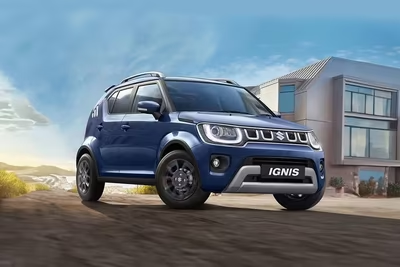
Launched the Safari SUV, a modified Harrier model with an extended wheelbase and a third row of seats. Introduced the HBX micro SUV concept set to compete with Maruti Ignis and Mahindra KUV100.
Presented the larger, more luxurious Carnival MPV and the seven-seater Sorento SUV aimed at competing with the Toyota Fortuner and Ford Endeavour. Also introduced the futuristic EV9 concept, an electric crossover with a lounge-style interior and sliding doors.
Rolled out the Astor SUV, a petrol version of the ZS EV, equipped with advanced features like a personal AI assistant, panoramic sunroof, and a 360-degree camera. Showcased the Cyberster concept, a two-seater electric sports car boasting a retro-futuristic design.
Two-Wheeler Highlights
Launched the Imperiale 530, a larger, more powerful iteration of its retro-style cruiser bike. Additionally, showcased the Leoncino 800, featuring an 800cc parallel-twin engine in a scrambler-style design.
- Ultraviolette Automotive
Unveiled the F77 electric bike, boasting a top speed of 147 kmph and a range of 150km, positioning itself as a significant player in the electric bike segment.
Displayed the T6X electric bike set for a 2023 release, offering an affordable option in the electric bike market with an expected price tag around Rs 1.25 lakh.
Auto Expo 2023 was a successful event that attracted a large number of visitors and media attention. The event showcased the latest trends and innovations in the Indian Automotive industry, such as electrification, hydrogen fuel cells, connected cars, and digital assistants.
The event also highlighted the growing competition and diversity in the Indian market, with new segments, models, and brands emerging to cater to the evolving needs and preferences of the customers. Auto Expo 2023 was a reflection of the resilience and potential of the Indian Automotive industry, which is poised to grow and thrive in the post-pandemic era.
Conclusion
The year 2023 was a year of transformation for the Indian automotive industry, as it showcased its potential and prowess in a dynamic and competitive market.
The industry also faced some challenges and opportunities, which tested its resilience and innovation. The industry also aligned itself with the global trends and the government policies, which shaped its future direction.
The industry is expected to continue its growth and development in the coming years, as it strives to meet the changing needs and expectations of the customers, and contribute to the economic and social development of the country.





अपनी परफेक्ट कार खोजें

Budget

Brand

Body Type

Fuel

Mileage

More
नवीनतम वीडियो


Top Auto News of the Week | Hyundai i20 Leak, Honda ZR-V, Tata Sierra EV, Skoda EV & More!

Talking about new Honda City and upcoming ZR-V SUV with Honda India’s Kunal Bahl!
2026 Honda City Launched in India - Better than VW Virtus, Hyundai Verna & Skoda Slavia?

Weekly Auto & EV Wrap-Up: Luxury Launches, AI Tech & Big Industry Updates!
अन्य खबर
टाटा मोटर्स ने फ्लेक्स-फ्यूल वाहन अपनाने को बढ़ावा देने के लिए जीएसटी कटौती पर किफायती इथेनॉल का समर्थन किया

ARAI और प्राज उद्योगों ने भारत में 10 महीने का आइसोबुटानॉल-डीजल सत्यापन कार्यक्रम शुरू किया

MG विंडसर कम्यूट EV टैक्सी सेगमेंट के लिए 13.49 लाख रुपये में लॉन्च किया गया

चेन्नई उपनगरीय रेलवे ईवी बैटरी स्वैपिंग स्टेशन शुरू करेगा