ELECTRIC
Tata Motors Leads Market Growth Despite September 2025 EV Sales Dip: New EV Emerging Players & Premium Brands Gain Ground
 Add CarBike360 on Google
September 2025 saw a 17.4% dip in India’s EV car sales, with Tata Motors retaining the top spot. New entrants and luxury players gained traction amid evolving market dynamics.

By Utsav Chaudhary
Oct 04, 2025 11:09 am IST
Published On
Oct 04, 2025 10:36 am IST
Last Updated On
Oct 04, 2025 11:09 am IST

The Indian 4W electric market experienced an M-o-M decline in September 2025. The sales of EVs saw a dip of 17.4% to 15,118 units for the 2025 season. Tata Motors has maintained its dominant leadership with a strong 40.5% market share, despite a 17.7% dip in sales. These reluctant figures show the market recalibration within the new emerging players in the Indian electric automotive landscape.
For the 2025 iteration, many OEMs faced a decline in EV sales in September 2025. Emerging international brands like Tesla and VinFast made notable entries, signaling intensified competition. The premium segment also saw greater activity, with luxury automakers recording steady sales, highlighting the segment’s diversity and growth potential. Let’s check out the top emerging players of electric 4W in India and how they are performing in the Indian automotive market.
OEM-wise E4W Sales Table – September 2025
The following table shows the brands with their respective sales in September 2025 and August 2025, followed by the differences in sales figures, showcasing their performances in the Indian automotive market.
S.No | Automotive Brands | September 2025 | August 2025 | Diff. | % Change | Market Share (Sep-2025) |
1 | Tata Motors | 6,126 | 7,446 | -1,320 | -17.7% | 40.5% |
2 | MG Motor | 3,865 | 5,078 | -1,213 | -23.9% | 25.6% |
3 | Mahindra & Mahindra | 3,204 | 3,699 | -495 | -13.4% | 21.2% |
4 | BYD India | 541 | 478 | 63 | 13.2% | 3.6% |
5 | Kia India | 502 | 463 | 39 | 8.4% | 3.3% |
6 | Hyundai | 345 | 618 | -273 | -44.2% | 2.3% |
7 | BMW India | 309 | 393 | -84 | -21.4% | 2% |
8 | Mercedes-Benz India | 95 | 80 | 15 | 18.8% | 0.6% |
9 | Tesla Motors | 61 | 0 | 61 | - | 0.4% |
10 | PCA Automobiles | 36 | 23 | 13 | 56.5% | 0.2% |
11 | Volvo India | 22 | 21 | 1 | 4.8% | 0.1% |
12 | VinFast Auto | 6 | 0 | 6 | - | - |
13 | Porsche AG | 5 | 6 | -1 | -16.7% | - |
14 | Rolls-Royce Motor | 1 | 0 | 1 | - | - |
15 | Audi AG | 0 | 3 | -3 | - | - |
Total | 15,118 | 18,308 | -3,190 | -17.4% | 100% |
1. Tata Motors: Market Leader
Tata Motors continues to dominate the EV car segment with 6,126 units in September 2025. This signifies the 40% market share, despite a 17.7% decline from August, driven partly by GST adjustments and tax reforms. Some models like the Tata Nexon EV and Tata Tigor EV remain popular. Tata Nexon EV evolved as the best-selling electric car across the portfolio. The brand's concerted push in tier-2 cities, price rationalizations, and expanded dealer engagements have ensured sustained consumer interest.
2. JSW MG Motor and Mahindra: Facing Pressures
For the 2025 iteration, JSW’s MG Motor has fallen sharply by 23.9% to 3,865 units but maintained a solid 25.6% share. The MG Windsor continues as a strong contender, but the brand battles intensified competition and shifting customer preferences toward newer models. MG Comet also faces dissatisfaction with poor sales performance in the Indian market.
Mahindra & Mahindra’s sales declined 13.4% to 3,204 units, holding 21.2% share amid tougher market conditions as buyers reassess choices post-GST impact. Talking about the GST 2.0 reforms, Mahindra shows a slightly upward trajectory in September 2025. But the sales were not enough when compared with the previous month. The Mahindra BE.6 is the only car that outperformed across the portfolio. However, many other models, such as XEV 9e & Mahindra BE.5, are still struggling to attract customers.
3. BYD & Kia: Rising Upward
BYD India recorded a spontaneous growth of 13.2%, increasing sales to 541 units in the Indian automotive market. The brand, which has the Atto 3 SUV, Seal Sedan, eMax 7 MPV, and BYD Sealion 7 under the portfolio, sold around 541 units total, which is more than the 478 units sold in August 2025. Kia India also posted growth with 502 units, up 8.4%, reflecting strong retail activity for models like the Kia EV6 and Carens EV in key urban markets. Kia’s EV portfolio also has the Kia EV6 and EV9, which are imported as CBUs into the Indian electric car market.
4. Hyundai Motors: Sales Stagnant
The South Korean carmaker sold around 342 electric vehicles across the nation. Despite such affirmative sales, the brand still experienced a drop of 45% M-o-M compared to 618 units in August 2025. The most sales were brought by the beloved Hyundai Creta electric. The car was released in January 2025, and since then, the monthly sales have seen a rise from 775 units in February 2025 to 905 in March 2025.
Luxury and International Brands Gain Traction

Talking about the luxury car market, the luxury passenger electric vehicles have performed far better than the cumulative sales from other markets. BMW India has emerged as the leader of the luxury EV market, selling around 307 units in September 2025.
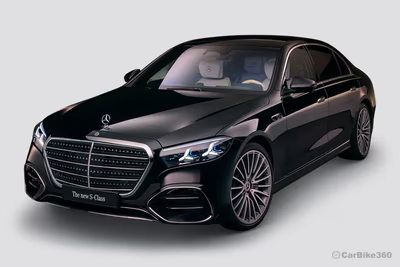
Another German giant, Mercedes-Benz, grew by 18.8% to 95 units, signaling rising demand for luxury EVs among affluent buyers.
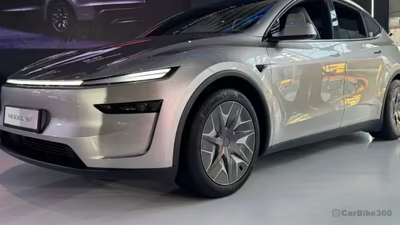
Tesla India Motors officially launched retail deliveries with 61 units sold. This milestone is significant, marking a new chapter for premium EVs in India, emphasizing performance and cutting-edge technology. Even Volvo Auto India shares a 19% dip in month-on-month sales. The brand was able to sell around 20 EVs last month. PCA Automobiles India (Peugeot Citroën) increased sales by 56.5% to 36% in the Indian automotive landscape.
New entrant VinFast Auto India logged 6 units as it is making plans to expand its business portfolio in India. With VF6 and VF7 models, blending international design with local assembly advantages. The Vietnamese brand also decided to open new dealership networks and showrooms across the nation.
Among rarer luxury names, Porsche AG Germany (5 units), Rolls-Royce Motor (1 unit), and Audi AG (no sales in September) underscore the expanding premium electric vehicle options available for Indian consumers.
Market Outlook: Improvement with Long-term Growth Promise
The Indian electric four-wheeler saw a 17.4% overall decline, which is indicative of a market pause and correction rather than a slowdown in EV adoption. The sector maintains a strong year-on-year growth trajectory of nearly 160%, fueled by expanding charging infrastructure, enhanced product offerings, and a consumer shift toward long-range, feature-rich EVs.
Conclusion
As OEMs adjust strategies to meet sophisticated consumer needs, the intensified competition from both domestic leaders and new international entrants like Tesla and VinFast will accelerate innovation and market expansion in India.


You May Like




Find your perfect car

Budget

Brand

Body Type

Fuel

Mileage

More
Latest Car Videos


Talking about new Honda City and upcoming ZR-V SUV with Honda India’s Kunal Bahl!
2026 Honda City Launched in India - Better than VW Virtus, Hyundai Verna & Skoda Slavia?

Weekly Auto & EV Wrap-Up: Luxury Launches, AI Tech & Big Industry Updates!

Weekly news wrap-up - CNG sales up, Fortuner prices raised, Hyundai completes 30 years
Other Car News
Listen to Car Audios